Code
Box Info
Platform: HackTheBox, OS: Linux (Ubuntu 20.04), Difficulty: Easy, Released: 2025-07-05, IP: 10.10.11.62 → code.htb
Attack Path
- Gunicorn app on
:5000. An online Python code editor with a keyword blacklist sandbox. - Bypass the blacklist to reach the app’s own SQLAlchemy models and dump the
userstable → MD5 hashes fordevelopmentandmartin. - Crack
martin→nafeelswordsmaster→ SSH. martinmaysudo /usr/bin/backy.sh, which archives paths from an attacker-supplied JSON. Its../sanitiser is bypassable → archive/root→ read root’s files (androot.txt/ an SSH key).
Credentials & Flags
| Where | Value |
|---|---|
development (cracked MD5) | development |
martin (cracked MD5) | nafeelswordsmaster |
user.txt | /home/martin/user.txt |
root.txt | recovered from the /root archive |
Overview
Code is, at its heart, a Python sandbox-escape box, and almost all of the interesting work happens right at the foothold. The target exposes an “online code editor” that lets you submit Python for execution, and the developers tried to make that safe the way most people instinctively do: with a blacklist of dangerous substrings like import, os, subprocess, eval, open, and __. The moment I saw that approach I had a pretty good idea where this box was going, because blacklisting substrings in a Turing-complete language is a losing game from the start. You don’t actually need to write import os when the Flask application hosting your sandbox has already done all the importing for you and left its db session object and User model class sitting in the global namespace, fully reachable from inside the “sandboxed” code. Once I confirmed that, the rest of the foothold was standard ORM abuse to pull credentials straight out of the database. Privilege escalation turned out to be a different flavor of the same underlying lesson: a sudo script that trusted a path field inside an attacker-supplied JSON file, defeated by a path-traversal sanitiser that only stripped ../ once instead of looping until the string stopped changing.
I’ve run into this “blacklist versus Turing-complete language” pattern often enough that I keep a mental catalog of related boxes. The eval/sandbox-escape family includes Headless, TwoMillion, and Athena, while the “attacker-controlled config feeding a sudo script” pattern shows up again on Bizness (through gradlew), and across the cluster of Stocker, Bagel, and Forge.
Reconnaissance
I started, as I do on every box, with a full port scan to get a baseline picture of what code.htb was exposing before I touched anything else:
Nmap scan report for code.htb (10.10.11.62)
PORT     STATE SERVICE VERSION
22/tcp   open  ssh     OpenSSH 8.2p1 Ubuntu 4ubuntu0.12
5000/tcp open  http    Gunicorn 20.0.4
|_http-title: Python Code Editor
Foothold. Sandbox escape → DB dump
Since the editor was clearly built on Flask, my working assumption was that a SQLAlchemy User model was already imported somewhere in the application and therefore reachable from the sandbox’s global scope. The runtime itself was locked down hard behind a keyword blacklist, but blacklists filter source text, not the object graph that’s already sitting in memory, so direct attribute and object access was still fair game. I tested that theory by walking the ORM directly from inside the editor:
Why the blacklist fails
The sandbox rejects any source string containing patterns like import, os, open, eval, exec, __, or subprocess, but it never touches objects that are already sitting in scope by the time my code runs. A Flask application’s module globals almost always include the app instance, the db SQLAlchemy session, and every model class it defines, and none of those names trip the filter because I’m not importing anything, I’m only referencing what’s already there. From that starting point, db.session and Model.query hand me full ORM read and write access without a single forbidden keyword ever appearing in my payload. Even against an app that doesn’t leave anything quite that convenient lying around, I can usually still walk ().__class__.__mro__[1].__subclasses__() to enumerate every loaded class until I find something like subprocess.Popen. That’s exactly why blacklisting __ is such a common instinct, and also why it’s such a commonly broken one: it catches a lot of naive exploitation attempts, but it also breaks legitimate introspection, and a determined attacker routes around it regardless. In my experience the only mitigation that actually holds up is a real, OS-level sandbox: a separate process, seccomp filtering, nsjail, or something like RestrictedPython built around an allowlist rather than a blacklist.
for i in User.query.all():
    print(i.__dict__)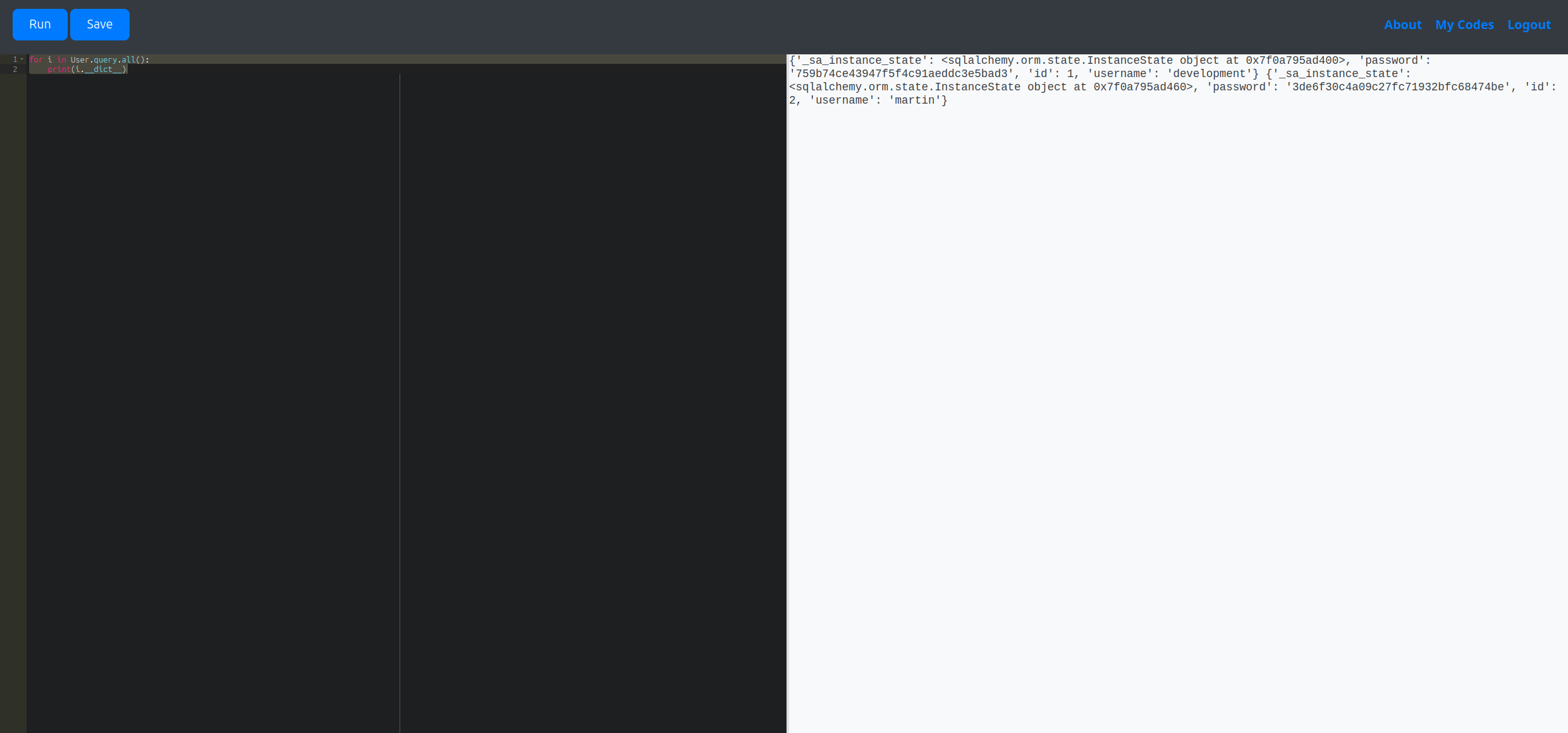
Credentials (hash:username → cracked password)
759b74ce43947f5f4c91aeddc3e5bad3 : development→development3de6f30c4a09c27fc71932bfc68474be : martin→nafeelswordsmaster
With both hashes pulled out of the users table, I threw them at hashcat against rockyou.txt rather than trying to guess anything manually, and martin’s hash cracked almost immediately:
hashcat -m 0 hashes.txt /usr/share/wordlists/rockyou.txt
ssh martin@code.htb          # nafeelswordsmaster
Privilege Escalation. sudo backy.sh path traversal
martin@code:~$ sudo -l
User martin may run the following commands on code:
    (ALL : ALL) NOPASSWD: /usr/bin/backy.sh
With a shell as martin, checking sudo -l was the obvious next move, and it paid off immediately: martin could run /usr/bin/backy.sh as root with no password. Digging into what that script actually does, I found it wraps /usr/bin/backy, a small backup utility that reads a JSON task file describing which directories to archive and then shells out to tar on martin’s behalf.
The traversal bypass
Reading through backy, I found it restricts directories_to_archive to paths starting with /home/ or /var/, then makes exactly one non-recursive pass to strip the literal substring ../ out of whatever path I give it. That single pass is the entire flaw, and it’s a satisfying one to spot: if I double up the dots into ....//, stripping the first ../ the sanitiser finds out of the middle of that string still leaves ../ behind. Stack two of those groups in front of root/ and the one-shot strip collapses /var/....//....//root/ down to /var/../../root/, which resolves straight past /var and lands in /root the moment tar actually walks it, well after the sanitiser already finished its job. The leading /var/ is all it takes to satisfy the whitelist check before any of that collapsing happens, so the crafted path sails through untouched.
{
  "destination": "/home/martin/backups/",
  "multiprocessing": true,
  "verbose_log": false,
  "directories_to_archive": [
    "/var/....//....//root/"
  ],
  "exclude": [".*"]
}
sudo /usr/bin/backy.sh task.json
# then extract the resulting archive from /home/martin/backups/
tar xf /home/martin/backups/code_home_martin_*.tar.bz2
cat root/root.txt # and root/.ssh/id_rsa -> ssh root@code.htbLoot
| Flag | Location |
|---|---|
user.txt | /home/martin/user.txt |
root.txt | /root/root.txt (via the archive) |
Lessons & Takeaways
- Blacklists aren’t sandboxes. If you must run untrusted code, isolate it at the OS level (
nsjail, gVisor, a throwaway container). Never with string filters. - Don’t leave live ORM handles in module globals of a service that evals user input.
- Unsalted MD5 for password storage is indefensible; use
argon2/bcrypt. - Path sanitisers must loop until stable and canonicalise with
realpath()before the prefix check, not after a singlestr.replace. - Scope
sudoscripts and validate their entire input, not just a prefix.
Related Writeups
- Python / eval sandbox escape: Headless, TwoMillion, Athena
- Attacker-controlled config →
sudoscript: Bizness, Stocker, Bagel - Dump an app’s own user table → crack: Cat, MonitorsTwo, Nocturnal
sudomisconfig privesc: Forge, Headless, Lookup
References
- Escaping Python sandboxes https://hacktricks.boitatech.com.br/misc/basic-python/bypass-python-sandboxes
- RestrictedPython https://github.com/zopefoundation/RestrictedPython
- nsjail https://github.com/google/nsjail
- The
backy.shpath-traversal privesc was cross-referenced against public writeups for this box.